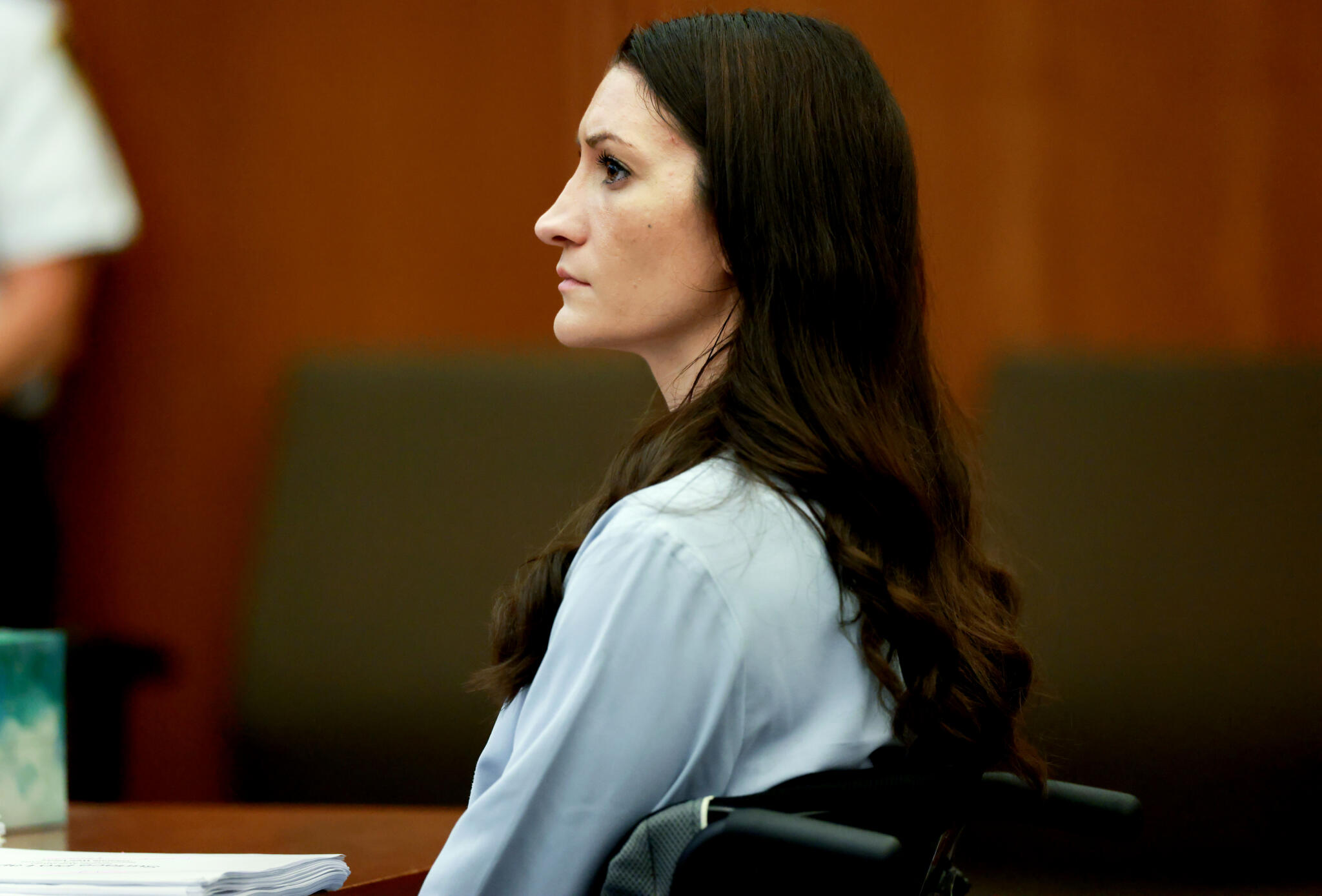
Postpartum mental health is at the center of Lindsay Clancy’s triple-murder trial, now unfolding before a jury in a Massachusetts courtroom.
Clancy’s attorneys, who have admitted that she killed her three children before attempting to die by suicide, are mounting a defense that hinges on the often misdiagnosed condition known as postpartum psychosis.
Medical experts and women who’ve experienced the disorder say the trial shows the need for more research and education about this little-discussed but severe psychological illness.
‘In a deluded reality’
Meghan Cliffel described how her life completely changed after an episode of postpartum psychosis.
“It’s wild how quickly it happened, and also how, in my case, how logically I was acting, but in a deluded reality,” Cliffel said.
Cliffel was riding the subway home from her job in New York City in December, 2015, when her thoughts started to unravel, she said. She believed people were watching and following her. She thought other passengers on the train were part of a group trying to harm her and her daughters, who were 2 years old and 8 months old at the time.
“My brain is essentially taking all of these little details and knitting them together into this new alternate sense of terrifying truth wherein the entire city is out to get me and my girls,” Cliffel recalled.
Her mind took an even darker turn when she got home. Cliffel said she thought the refrigerator was spewing poisonous gas, and people on television were threatening her. She didn’t divulge her thoughts to her husband because she wasn’t sure whether he was in on the plot.
“My brain is essentially taking all of these little details and knitting them together into this new alternate sense of terrifying truth wherein the entire city is out to get me and my girls.”
Meghan Cliffel
At one point, she described feeling overcome by paranoia and believing that if she made it to the roof of her apartment building and proved she was willing to jump, she would be safe.
“My husband’s got our two baby girls in our bedroom, and I punch him in the face trying to get to them,” Cliffel said.
Then, she ran to the door of their apartment building and told him, “I just need to go to the roof.”
Her husband called 9-1-1.
Police officers arrived and handcuffed Cliffel inside the couple’s Lower East Side home. The children were watching Elmo in the bedroom, she said. The officers took Cliffel to a psychiatric ward.
During her 12-day hospitalization, a psychiatrist convinced her to take medications to treat mania and psychosis, helping her, as she described it, “reattach to reality.” But the ordeal was frightening and bewildering for Cliffel, who still didn’t know what had caused her behavior.
“My breast milk is, like, leaking through this blue jumpsuit, and I am feeling like a shameful mess that is unfit to mother,” Cliffel said. “And I don’t know if I’ll be of any worth again, to be honest.”
Hospital staff said she might have bipolar disorder and recommended more psychiatric care once she was discharged. Two months later, Cliffel finally got a diagnosis: postpartum psychosis.
“That moment of somebody naming it was so helpful to me,” she said.
With help from the mood stabilizer lithium, Cliffel got better. Studies suggest the drug, combined with other medications, eases symptoms for 98% of patients. Electroconvulsive therapy also has been shown to help.
Medical experts say postpartum psychosis is temporary and treatable, but patients often have difficulty finding appropriate care.
A ‘massively missed’ disorder
Dr. Susan Hatters Friedman, a reproductive and forensic psychiatrist at Case Western Reserve University, said one major obstacle is that postpartum psychosis is not listed as a distinct diagnosis in the Diagnostic and Statistical Manual of Mental Disorders, or DSM, the main handbook used to identify mental health conditions.
“This is the scariest mental illness that I know of,” Hatters Friedman said. “You have these symptoms happening rapidly, you may or may not have any mental health history or any mental health literacy, and you’ve got this dependent little person with you — and it’s not listed in the DSM. So doctors might not recognize what’s going on.”
Postpartum psychosis occurs in an estimated one to two out of every 1,000 births — higher than the rate of sudden infant death syndrome in the U.S. Yet most parents and doctors know little about the risk of psychosis.
Mental health professionals say research on the disorder is scant, and not all doctors are trained to recognize its myriad symptoms, or help patients who may be confused by what’s happening to them and fearful of admitting to thoughts that could jeopardize custody of their children.
“We know that we don’t train our doctors in it, that it’s massively missed,” said Dr. Veerle Bergink, a psychiatrist and director of the Women’s Mental Health Center at Icahn School of Medicine at Mount Sinai.
“This is the scariest mental illness that I know of. You have these symptoms happening rapidly, you may or may not have any mental health history … and you’ve got this dependent little person with you.”
Dr. Susan Hatters Friedman
In the case of Clancy, the Massachusetts mom, prosecutors argue that she deliberately planned to kill her kids — it wasn’t sudden psychosis, as the defense claims.
There’s plenty of evidence that Clancy sought help in the months leading up to the killings, including meeting with psychiatrists, attending an outpatient hospital program and being admitted to McLean Hospital for five days for inpatient psychiatric care.
Several healthcare providers who treated Clancy have already testified during the trial. Some have said Clancy admitted to having suicidal thoughts but did not divulge a specific plan to carry it out. Clancy was prescribed several psychiatric medications, including benzodiazepines, Trazodone, Zoloft, Valium, Seroquel and Remeron.
One provider testified that she suggested to Clancy that she might have a mood disorder, or “underlying bipolar disorder,” but did not appear to have postpartum psychosis.
To Bergink, who has treated hundreds of women with postpartum psychosis but was not involved in Clancy’s care or her trial, Clancy’s symptoms echo a familiar pattern.
“She was manic after delivery and it was not treated, and medication made it worse,” Bergink said. “For me, it’s a very classical, typical story of a woman with postpartum psychosis not being diagnosed, not being treated.”
Bergink and Hatters Friedman said high-profile trials like Clancy’s may increase awareness about postpartum mental health, but change can be slow. Hatters Friedman pointed to the 2002 trial of Andrea Yates, a Texas mother charged with killing her five children. Yates was eventually found not guilty by reason of insanity and remains committed to a state mental health facility.
Hatters Friedman was in psychiatric training at the time of that trial and said she began pushing for more research into postpartum psychosis. More than two decades later, she said, there is still a lack of clarity about this condition.
“I do think there has been some more community knowledge since then, but not as much as we need, for sure,” Hatters Friedman said.
Cliffel, who is now a mental health advocate, said the unrelenting national attention on the Clancy trial — the proceedings have been livestreamed and are a hot topic on social media — has been difficult for people with postpartum psychosis. She said many wonder why others only seem concerned about the condition in the wake an unspeakable tragedy.
“You care about this now when it’s the center of this dramatic and tragic trial, but you don’t care about this enough,” she said, because real concern would be “creating a system of care that is not just centered around the baby, but is actually centered around the family’s wellbeing.”
Four years after Cliffel’s ordeal with postpartum psychosis, she had a third child — with therapy, psychiatric care and medication she took for a year after birth. Her children are now 13, 11 and 6 years old.
Resources: You can reach the National Suicide Prevention Lifeline at 988 and the Samaritans Statewide Hotline (call or text) at 1-877-870-HOPE (4673). Call2Talk can be accessed by calling Massachusetts 211 or 508-532-2255 (or text c2t to 741741). The National Maternal Mental Health Hotline can be reached at 1-833-TLC-MAMA.