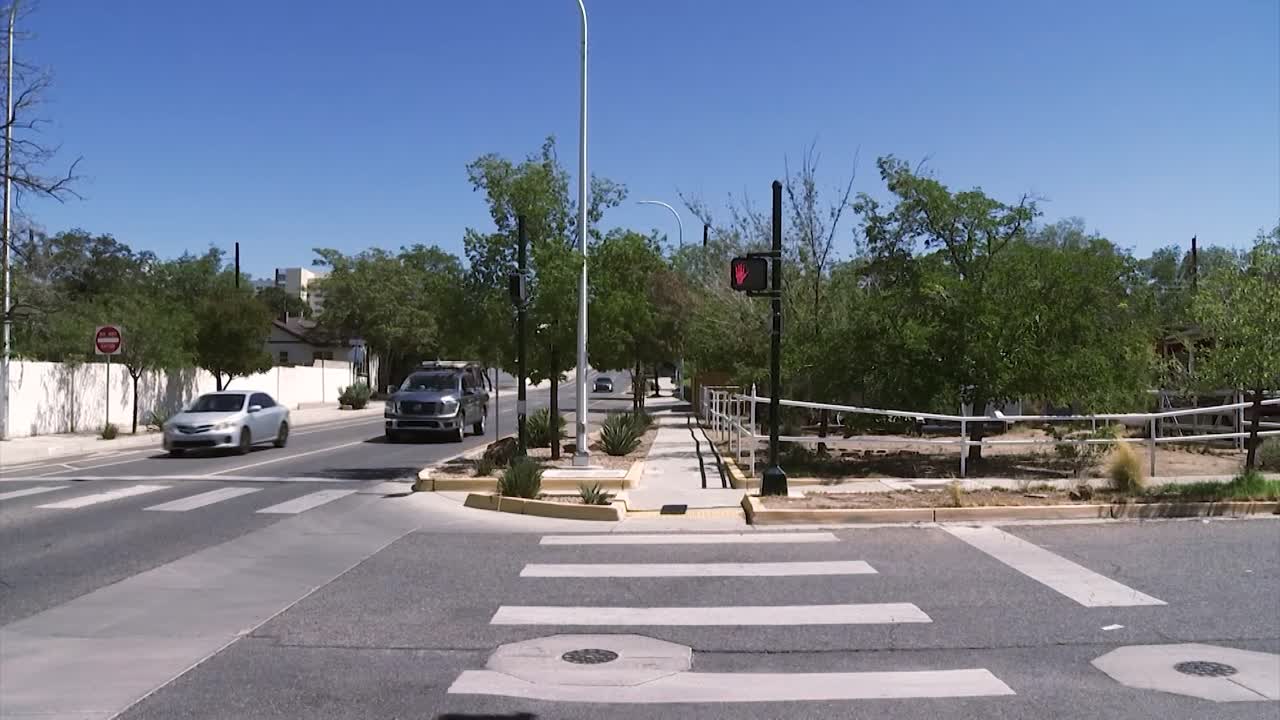
ALBUQUERQUE, N.M. – Albuquerque says six rest-in-red traffic lights on Lead and Coal have cut crashes and injury crashes by up to 70%.
The city installed the $50,000 signals in 2022 to slow drivers on Lead and Coal. The lights stay green for drivers at or below the speed limit and turn red for speeders.
Myra Sanchez lives near Lead and Coal and said crashes used to be common there.
“We would see or hear accidents all the time, all the time,” said Myra Sanchez. “I’ve seen some horrific accidents, especially right here going down lead. I’ve seen people die. I’ve seen people get their knees ripped off through motorcycle accidents. That tree right there, that’s kind of halfway. A car landed there one time. It flew across.”
Sanchez said the lights changed what she hears in the neighborhood and how safe the area feels.
“These lights, they’re amazing. I personally get frustrated if I’m going a little fast and I have to stop right now. But, you know, at the end of the day, I think they they did something great on those lights. It it was a long time coming,” said Sanchez.
“You don’t hear the screeching, the screeching of the cars. You don’t hear the big bangs, or wondering, oh my goodness, is it somebody I know? You know, is it one of our loved ones coming or going? So it’s it’s actually great. We don’t hear it anymore, not as much at least,” said Sanchez.
Jennifer Turner, director of municipal development for the City of Albuquerque, said the city has six traffic lights in full operation.
“The intersections where we’ve implemented the technology, we’ve seen up to 70% drops in both crashes and also crashes with injuries. And so we’re trying really hard to make our streets safer for everyone,” said Turner.
Turner said the lights also cut the number of drivers going more than 10 miles over the speed limit in a 30 mph zone. Sanchez said she has seen drivers go 40 and 50 there.
The city plans to add 12 more traffic lights by the end of the year. The city said it chooses roads through the High Fatal and Injury Network, which identifies roads and intersections with serious and deadly crashes above the regional average.
“The data has shown us huge, huge reductions in that dangerous driver behavior,” said Turner.
Turner said other states, including Texas, Arizona and Oregon, have contacted Albuquerque to ask how the traffic lights work.
- For Related Stories: Alika Medina