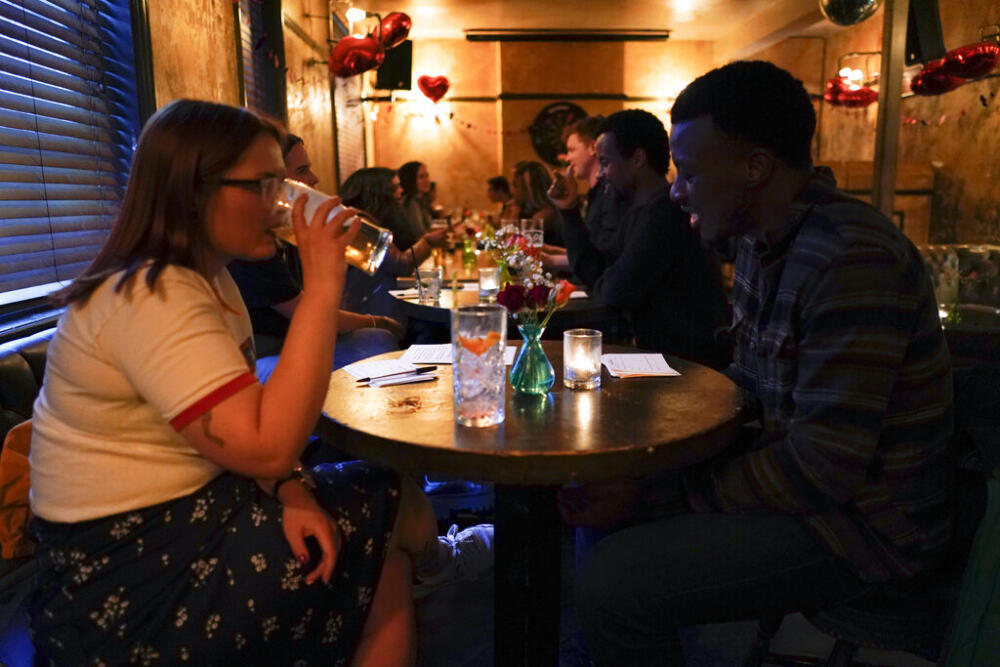
In his new book, “Walking Red Flag: Dating Advice from Your Favorite Guy Friend,” comedian Jared Freid offers tips, tricks and real talk on modern dating.
Guest
Jared Freid, a stand-up comedian and the author of the new book, “Walking Red Flag: Dating Advice from Your Favorite Guy Friend.” He’s also the host of two podcasts: “The JTrain Podcast” and “U-Up?”
Book Excerpt
Excerpted from WALKING RED FLAG. Copyright © 2026, Jared Freid. Reproduced by permission of Simon Element, an imprint of Simon & Schuster. All rights reserved.
The version of our broadcast available at the top of this page and via podcast apps is a condensed version of the full show. You can listen to the full, unedited broadcast here:
Part I
AMORY SIVERTSON: Most things you read online about dating these days tend to be negative. Heck, most things you hear firsthand about dating are negative. People are fed up with the apps. They’re having trouble meeting people in real life. Some have even declared they are giving up on dating entirely.
And yet so many people out there still want to find their person and start building a routine, a family, a life together. But how? That is the question. And comedian and podcaster Jared Freid wants to help. He has a new book called Walking Red Flag: Dating Advice From Your Favorite Guy Friend. Jared offers tips, tricks, and maybe most importantly, he offers real talk on dating from the perspective of a, quote, “everyday bro.”
He joins us now from New York City with some of that real talk. Jared Freid, welcome to On Point.
JARED FREID: Thank you so much for having me. It’s a pleasure to be here.
SIVERTSON: So I’d love to start by having you read the dedication for this book, because I feel like that says a lot. Will you do that for us?
FREID: (LAUGHS) Okay, let me pull it out. I had it with me. Basically, it was really a shout-out to all the people who really give all this advice all the time. So here it is: “For the girl who told her friends literally everything in this book like 200 times, but they only listened when I said it, I’m sorry. You did good. Rest now.”
SIVERTSON: Yeah. You say, “Sorry it took a guy with old fried rice lodged in his couch cushions to get them to listen.”
FREID: That’s right. That’s who they took it from. And yeah, because dating advice is really like diet and exercise. It’s not that interesting. It’s really pretty simple and it’s been made more complicated just because — and the reason that I talk about dating so much, it’s interesting to me. Especially in 2026, the intersection of new technology with kind of this old school, you know, just like you just talked about. Everyone still wants connection. Everyone still wants to find someone.
Dating advice is really like diet and exercise. It’s not that interesting. It’s really pretty simple.
People want to meet the right person for them. Dating is like you’re trying to find great, your life is pretty good. And you have this belief and this hope that it could be a great life.
SIVERTSON: Yeah. You’re trying to level up. So explain the approach here, because this is a book primarily for straight women coming from a straight man.
So what are you hoping to offer here?
FREID: Reasonability. I think if you’re over, I’ve done dating podcasts for over a decade, so I’ve heard from lots of straight women, because that’s who’s interesting in the dating discussion. Men don’t think they have a dating problem.
Generally. So and I know that’s funny, because they do. But they don’t, it’s not a priority for them. That’s not socially, and these are, like, a lot of this is societal stuff that I can’t conquer. I’m just kind of living, it’s raining out and I’m here to give you an umbrella, and tell you kind of how to deal with someone like me.
And here’s the reality is that if you’re single and trying to figure it out, you’re probably online a lot. You’re probably on social media a lot. And that’s not a great place to go to for dating perspective. You’re only going to find angry men and woo woo women. And both are just not true.
SIVERTSON: And you said something there about dating being this thing that you want to conquer, and I think that really speaks to why we actually wanted to take it on this show, which is a more cerebral show, and yet finding love feels like for some people it’s this goal in life.
And unlike other goals in life where there is a roadmap, there is a prescribed way that you might get there, dating doesn’t feel that way. It can feel like this crapshoot where no matter what you do, you cannot follow a certain number of steps perfectly and end up with the result that you’re hoping for.
FREID: I totally agree. That’s the thing about the people that I’ve come in contact with who enjoy the podcast, the You Up? podcast, and have enjoyed the book. They’re super successful women. They’ve crushed it in everything else. Just like you said, this thing called dating, it’s driving them a little crazy. Because they’re like, I’m doing great everywhere.
Look at the numbers, look at the page, I have the resume is here. And this thing called dating is driving me up a wall. And I know it in my own life, I am 41, never married, no kids. Why would anyone come to me for dating advice?
I know. As my mom says every day. But … the person you’re dealing with, and I think in my own life I’ve had the issue of dating has to be like a milkshake that is a mix of both cynicism and romanticism. And that is a really tough milkshake to get right.
And I know it from myself. As I got older and I was single, I became more cynical. When I was younger, I’d be more romantic and I’d make more mistakes, and then you get protective as you get older, and I think a lot of people deal with that. And especially as you get older, because I was 40 and single, and now I’m in a relationship and I’m very happy.
But it took a lot for me to kind of get over the hump of practicality. My life, a lot of people who are single, their life is really good. They got their bills taken care of, they have good friends, they have a great living space, and the only thing that could ruin their life is a relationship.
And that’s a really practical way to look at it, and it’s not really what’s going to get you in the relationship that you’re looking for.
SIVERTSON: So for people out there who maybe have your mom’s point of view, of why is this person giving me dating advice. Or for people out there who are maybe not familiar with your podcast, familiar with your comedy, and might be thinking, “Is a guy about to mansplain dating to me?” What is your response to that? What makes you the right person to offer advice?
FREID: First of all, yes, I’m going to. No I’m joking, but I think the rhetoric, especially on the internet, is just false.
When it comes to dating, it’s like women having fun and then angry men in the comments that are like school shooter types, and that’s just not the men that I come across. That’s not how I am. And I used to always say on the podcast, I’d be like, “I’m a single guy. I don’t even know where I am. Where are the single men?” I would be like, “I don’t even know where I hang out.”
SIVERTSON: That’s step one.
FREID: And I do agree this is a problem. I do agree with the women who are upset with men. I just think my job is to be vulnerable and to give another side of the equation that isn’t hateful, that is hopeful, looking for, and I was honestly looking for a relationship. I did believe that, and I can give answers to anything that’s going on. And again these conversations with dating can get into pretty horrible areas that, you know, that I’m not really, that I have to acknowledge.
And I think getting you inside the mind of the man that you are maybe looking to date, because I’m a lot like the men that … I’m pretty normal. I’m pretty average. And so I think if you’re looking to hear from the other side, which I understand can feel icky and you don’t want to hear it, but there is something going on inside the guy’s head that isn’t, “I’m just looking for a hotter chick.”
And I think men get painted in dating as either master manipulators or completely barren of any emotional intelligence, and both can’t be true. And I’m here to say that we are more emotionally intelligent than you let us be or you assume us to be, and we aren’t that smart to lead you along and trick you.
SIVERTSON: Yeah. You write, “Try to think of me as an enemy spy who turned on his own people.” … Let’s turn on your own people. Can you let us into the mind of what you would say are, like, most guys these days? What are most guys, or the pretty average straight guy, thinking about dating?
What do they want when they’re out there in the dating pool?
FREID: It’s weirdly romantic. Someone could say, not believe me, but I would say what men believe of themselves is different than how they act. So I think a lot of men believe like in the coming-of-age movie from the ’80s and ’90s, that the woman of their dreams is going to knock them upside the head and make them forget everything else and commit and be ready to go.
I do believe that. So a lot of men have the general default setting of, “I’m here to have fun until I’m whisked away and swept off my feet, and I have to have that girl.” And that’s why it’s enraging to a lot of women who are practical about this because men are just looking to have fun. Who cares?
We’re figuring this out. Of course I’m looking for a relationship. They’ll write on dating apps that they’re open to casual but looking for serious because they really do believe that. That’s how men date. They’re looking to have fun, and then have so much fun that they don’t want to be with anyone else in the world.
[Men are] looking to have fun, and then have so much fun that they don’t want to be with anyone else in the world.
And I’m giving that a very romantic side, but I’m just saying that’s what they believe. Okay. And I do believe that kind of turns into, that can get men in trouble. Again, that’s back to what I was saying before where I was romantic when I was younger, because I’m like, “I’m just having fun.”
And then you hurt someone’s feelings and you go, “Oh, okay, I can’t … maybe I shouldn’t have introduced someone I wasn’t positive about to my parents.”
SIVERTSON: Yeah. Jared, we have to take a break here in just a second. But I do wanna point out, you’re pretty adamant in the book that you are not a dating expert. Can you very briefly explain what you mean by that?
FREID: I’m just, I’m giving you my opinion on my life, and it’s just going to probably be close to, I’m 10% away from every guy, is what I’m saying.
Part II
SIVERTSON: Jared, we were talking before the break about how you say you are 10% away from most guys. And the perspective of this book is you are the guy that someone has dated, the guy that someone has broken up with, the guy that has broken up with you.
And so as someone who has gone on a lot of dates and been on the dating apps and heard a lot of dating anecdotes from fans of your work, would you say that dating today is broken, as a lot of the sort of cultural think pieces would lead us to believe?
FREID: Those are the ones that get clicks, so no, I don’t think it’s broken.
I just think it’s more. If you’re single, it can just feel like a lot. I think you’re getting more, more all the time, and that means more heartbreak. It’s like a genie’s wish gone bad. I’d like to meet, I’d like to have an app that can find me the nearest single person, you know, from where I’m sitting, and now you’re gonna get 20 of those people, and they’re all gonna be messaging you at once, and they’re not all people you wanna talk to.
It’s like, you go to a bar, and you talk to one person that could’ve, your expectation of that one person wasn’t really that much, and on a dating app, because you’re under the, you’re on the quote, dating app, you’re expecting things to happen. Your expectations aren’t met.
You have this imagined idea of this romantic idea of what you want, and it’s just you’re dealing with just a lot of people looking for a lot of different things. So I just think it’s a lot of, and plus that adds in your family trying to set you up or your friends who are asking about your single life.
It’s just more. And I think that’s what feels bad.
SIVERTSON: Oh, yeah. We’re going to get to some of those setups. And actually, on that point, I will confess, I met my husband in college. So this was before most people had a smartphone. It’s before dating apps were really a thing. And it also means, according to you, that I’m a bad person to be giving dating advice to my single friends.
You compare people like me —
FREID: I don’t think you’re a bad … I’m sorry to interrupt. I don’t think you’re a bad person for dating advice. I do believe that married people generally talk about their own story and don’t really think and kind of tell you, and don’t believe that single issues are issues at all.
I think married people, because when you get married, getting in a relationship is an act of confidence. I think there’s no more confident thing in the world than saying, “Okay, I’m signing up for this person because I believe we can be great together.”
And then the real-life problems start to you. So I think when you hear about single people and their problems, you’re like, yeah, it’s like hearing about someone’s dream. It’s yeah, then you woke up. And then it didn’t happen. And I think with single people, it’s tough for us to confide in our married friends ’cause they’re looking at you, yeah, and you don’t have to live with that person.
SIVERTSON: Yeah. You describe people like me as Amish people trying to explain why the Wi-Fi isn’t working. Like we don’t know what we don’t know, and that makes sense, and I get that, and that is very much heard, but speaking to this point of single people. It’s not just that simple because you devote the first chapter of your book to the different kinds of single people and why it’s important to know what kind of single person you are.
Why is that?
FREID: You gotta look in the mirror. I think this is a problem that I had, that I have. A lot of us have. I just remember, and I tell the story in the book about asking a woman if she was in a relationship, and she said that she was very single. And I was like, “What does that mean to you?”
And she started saying, “I can’t really … I haven’t been on a date. I can’t really think of anyone I would go on a date with. I’m just very single.” And I thought that was so interesting. Because I actually started writing out the versions of single that I’ve been. And very single or single and ready to date or single and just looking to hook up or single and still thinking about someone else.
And there’s a lot of blame in dating, but if you don’t really understand who you are and what you’re looking for, how can you ask that of someone else? And I do, I have a friend who I gave the book to early on. She’s successful woman living in Toronto, and out there and dating, and she was like, I gave her the book and a month later she’s, I’m dating someone, and it’s because of your book.
And I’m like, “Come on.” Whoa. “That’s crazy.” I didn’t write this book to actually work. Like I was like, because I really —
SIVERTSON: Unintended consequences.
FREID: Totally. I wrote this book to make people feel seen and laugh at dating. And, again, it’s your advice from your favorite guy friend.
I think a lot of women had guy friends in high school, and then the guy friends get married and you don’t really deal with a lot of men that are just having fun with you without the, are they trying to date me, trying to hook up with me type of thing. I think as you get older, you lose those childhood guy friends.
And that’s what this book serves as. So she goes, “I read the, what type of single part are you, and I’m very single. And then I went on a few dates with a guy and he was really cool, and we were having a good time, and then we talked about your book.” And I was like I asked him what type of single is he, and he went through and read all the singles.
And I think … and he was like, “I’m very single.” And she was like, “It was a great way to know where he stood.” And I was like, that’s a fun thing where a lot of this book is putting words to feelings.
SIVERTSON: Yeah, and I think communication is an underlying theme of the book, too. And finding different ways to communicate about whether it’s just who you are or what you want, it does feel crucial. Oh, yeah, go ahead.
FREID: I’m sorry to interrupt, but that’s kind of what I said in the beginning of dating advice is not that interesting. It’s diet and exercise.
How many times has anyone said communication?
SIVERTSON: And we all need to be told to do that.
FREID: I know. It’s like and it’s how do you make a date? That’s why you find a lot of grifters in the dating world. And because they’re going to say mean things that are going to rage bait-y things, and this book, I’m a comedian first.
I’m a storyteller first. This book is meant to make you feel how I feel or make you feel seen or to tell you stories that the advice in them, of course, communication, talk to someone, say your feelings, speak in I terms, these are all things I came to learn from mistakes I’ve made and the feelings I felt, and that’s the real, that’s the thing about the book that I’m proud of, is I don’t do comedy to make people feel bad.
I don’t do a dating book to make someone not want to date. I do a dating book because I want people to get a little more excited, find a new way to think, see a new perspective, and also understand the guy they’re seeing is kind of going through the same stuff as them.
SIVERTSON: Yeah. And sometimes that just means saying the thing out loud, and you do that with not just the different types of single, but different types of being alone types of being afraid and naming fears that we need to get over versus ones that we just need to live with, versus ones that we might need to finesse a little bit.
And so that brings me to one of our listeners, because we asked our listeners for their dating questions. So On Point listener Helen of Portland, Oregon. She’s 26 years old. She says she wants to meet people in real life, but her biggest challenge is this.
HELEN: It seems that, at least in public, people are very shy.
It seems like the culture is I’m in my group and you’re over there in your group and never the twain shall meet. So the advice that I would be seeking is how do we re- encourage people from my generation to start being spontaneous and confident again in talking with strangers? It feels like I walk down the street, and if I pass another 26-year-old, they are going to look at their shoes and pretend I’m not there.
SIVERTSON: So Jared, this feels like it falls under what you call afraid to approach, which is one of the fears that you say we all need to get over. So what are your thoughts on Helen’s dilemma?
FREID: First of all, Helen’s right. Sometimes people just wanna hear they’re right.
SIVERTSON: Helen, you’re right.
FREID: Helen, you’re right. I just want her to know she’s right. I think a lot of the problem now is you can kind of get down the rabbit hole of, doing your own think piece on the fly. No one talks to each other these days. Okay, you’re right. Now what? And I would say to Helen there’s a couple things.
One, she mentioned looking down at your shoes. I think that’s the best opening line you could ever have with someone. “Hey, I love your shoes.”
SIVERTSON: (LAUGHS)
FREID: I think “Hey, I love your shoes.”
SIVERTSON: Clearly you do too because you can’t take your eyes off of them.
FREID: Those shoes you’re looking at, they’re pretty cool. I agree with you.
Because I think shoes are not sexual. Shoes are someone’s own art project. Someone thought about the shoes they would wear. And it’s a compliment. Why not? “Hey, I love your shoes.” And I think a lot of us right these days, especially considering the pandemic and losing a little bit of social ability because we’re just out of practice with social media, I think we just need a good opener, and I think that’s a great opener.
I could go up to anyone and say, “I love your shoes.” Whether I was into them or not, it’s just a nice comment. If they’re looking for a line, I just gave you one. Here’s an arrow for your quiver. My other piece of advice is what they described, what Helen described, she starts to get into being romantic and being what’s it called?
Off the cuff. She’s started talking about this romantic idea of “I want something to happen.” I would say to her, Let’s be a little bit … that can happen, but let’s also get some reps with the people that are closest to us. I think everyone who wants to meet someone in real life and have something spontaneous happen, that was the word I was looking for, go on a walk with your friend and their spouse.
I think we once on the podcast, I can’t remember her name, but we had this great psychologist or doctor, and she was talking about loose connections. You’re probably going to meet someone who knows someone. So I think I do believe in loose connections.
You’re not going to date someone’s close friend, but maybe a friend of a friend. So you gotta kinda start walking that road, and the best way to start that road is go out with your friend, go for a walk with your friend and their spouse. Everyone says their friend is married. They immediately say to you, “All my friends are married,” and they don’t know anybody.
You’ve never really hung out with their husband. I can promise you that. You’ve probably hung out with their husband in a loud space where your friend sat between you two. I think your friends’ husbands are the key to this whole thing, because your friend’s husband isn’t thinking of you. They are not thinking of relationships.
Again, relationships are not a priority to men, and they’re not thinking of all their single friends that they can fix you up with. Your friend is. So go on a walk with your friend and their husband, and tell them about your life. Have fun with them. Be cool. Because the best thing you’re going to get out of your friend’s husband or friend’s spouse is, “Yeah, she’s cool,” or, “Eh, not that great. Kind of a pain.”
So I think if you’re looking for in real life connection, that’s a really good. And then also, I’m not saying go on a walk to ask to be fixed up. Go on a walk to have fun with your friend and their husband. You’ll get closer to them.
SIVERTSON: Okay, it’s a good tip.
Friends’ husbands. Jared, this wouldn’t be a show about dating in the 2020s if we didn’t spend some time talking about the apps. So I want to hear from another On Point listener here. This is Laurie Smith from Santa Cruz, California. She’s single, she’s in her late 50s, and to meet people, she mostly uses the dating apps.
LAURIE SMITH: Which are an absolute hellscape, as I think almost anyone who uses them would tell you. The algorithms, the things that I hate in other people on those apps are things that I’ve done before, getting addicted to the dopamine and half picking things up and forgetting about people. One has to be really intentional to make sure you don’t fall into that swiping addiction game.
And I’ve gone through various stages over time of hopefulness to bitterness, to becoming the problem, to recognizing I’m the problem, to being annoyed at others for being the problem, to having grace for them. And that can all cycle in even one day’s time.
SIVERTSON: An absolute hellscape, Laurie says about the apps.
FREID: (LAUGHS)
SIVERTSON: Which is a very common sentiment, but I know that you take issue with people who lead with this perspective, at least who lead with this perspective maybe in conversation on the apps themselves. Can you say more about that?
FREID: Yeah, she’s doomed. She’s already —
SIVERTSON: Oh, no.
FREID: I’m sorry, she needs to take a break.
She’s doomed. She already is doing, there’s this version of people that go on dating apps, and they just go right into their dating blog, and that’s what she’s kind of doing. And I knew she’s doomed because she used the word algorithm. If you’re talking about the algorithm on a dating app, it’s time to delete the dating app. Because she’s not saying this, but what she’s saying is I’m not getting shown the good people.
When you’re talking about the algorithm, it’s this idea, and I hear this a lot, where it’s like, I’m not getting the people that are really out there. Now you’re in conspiracy land. You’re not even, because the whole idea of the dating app is you have to believe in it. You have to sit there and go, “Okay, these are the people and this is who I can meet.”
But she’s actually thinking that there’s other people being hidden from her. And I think when you go on a dating app with this perspective and you start talking about how bad the dating apps are, and you talk about the algorithm you’re being actually rude to the people who are talking to you.
And you’re basically saying that you’re better than the app that you’re on. And she has a lot of awareness. I liked her as a caller. So I don’t want to sound like I’m being negative about her as a person, because I do believe she’s seeing all this. But I think there’s a bit of a, you gotta take a break.
SIVERTSON: Yeah. Speaking of taking a break, we have to take another one in a second here. And I do want to talk more specifically about tips that you have in the app. But something else that Laurie’s call makes me think of, and we were talking about this a minute earlier, not knowing Laurie’s situation.
She’s in her, she says she’s in her 50s. I don’t know if she’s looking for a first love, second, third, fourth, whatever. But something that I’ve wondered about speaking to the fears, is this a fear that some people have of kind of mucking up their life as it is? And I know as someone with single friends that you do worry that maybe people are more set in their ways the longer they’ve been single, less willing to compromise.
Do you have any specific advice for those folks who want to see their friends happy or want to be happy, but might not be willing to shake things up too much?
FREID: I was that friend. I’m that, I don’t wanna change my life. I’m not willing to compromise. I wanna order all the appetizers I like.
I think the best advice is to not, I don’t think you, I think you gotta tell them when they’re being miserable, when they sound miserable. You gotta tell them what they sound and not just tell them how right they are, okay. Don’t, “Oh, you’ll find someone,” is not a fun thing to hear.
It’s, “Hey, you sound miserable. I wouldn’t wanna hang out with you, and I’m your friend.”
Part III
SIVERTSON: Jared, you have done something on the tour for this book called Dating Profile Makeovers, where you critique an audience member’s profile in real time, and I have permission from a friend to share her dating app bio.
I have it in front of me here.
FREID: Okay. I’m excited.
SIVERTSON: So I’m wondering if we can do a real-time critique.
I can’t wait. But also, Amory, thank you so much for having me. It’s so cool to be on NPR. I’m from Needham. Oh. So it’s cool to hear, like, all the, 617 numbers and BU and all that stuff.
My parents both went to BU for a year.
SIVERTSON: Incredible. Yeah. It’s great to have you, and and I’m excited to hear what you think of this bio. You ready for it?
FREID: Yeah.
SIVERTSON: All right. She says, “Looking for a partner,” in parentheses, “firm anti-crime stance.” I’m guessing that has to do with partner in crime.
“Looking for a partner, firm anti-crime stance. Very capable and happy in my life, but if you’ve ever had a kidney stone, you’ll know how valuable it is to have someone hold your hand in sickness and in health. Extrovert intrigued by quietly funny introverts.”
FREID: I like it. I think it’s a little dark.
To bring up sickness and health and holding your hand as you pass away is a little bit early for me.
SIVERTSON: Just pass a kidney stone.
FREID: Yep, a kidney stone. … When I hear sickness and health and holding your hand I go straight to a dead grandma, like looking up at you going, “I always loved you.” I actually like it because it’s so her. I actually feel like I know her a little bit. And then she sounds like she’s smart. And that only, even for me, I’m not, I went to a state school, so I’m a little dumb. But I could tell that she’s a reader. There were, like, only a certain type of guy. She’s gonna get a specific guy who’s going to be able to take that baton and run with it. Because my advice to anyone on a dating app is to be so severely you that it turns people off.
And I think what that bio to me, generally I like a one-sentence, happy-go-lucky bio, but it’s gotta be personal. If it’s not personal, then you’re doing yourself no favors. Your profile has to be equally attractive as it is unattractive. And because again, you’re not looking for, the problem people have on dating apps is they’re looking for matches when you should be looking for a good match. And that’s the problem when someone’s like, “Oh, these dating apps are just tech companies trying to make money.” And they want to keep you on it as long as possible.
I don’t know about that. I think that’s a little high horsey to me. I think the dating apps are built like slot machines, as has been said before. That’s not an original take. And your human nature is like, “Oh, I wanna win the app. I wanna get a lot of matches because I want all the choices in the world.”
I like a one-sentence, happy-go-lucky bio, but it’s gotta be personal. If it’s not personal, then you’re doing yourself no favors.
That bio to me susses out a lot for her. And also the way people look at their dating app and how they get their matches, they’re looking at every match being the same. I don’t believe that to be true. Her match that responds to her bio specifically is a better match than anyone else she matches with that doesn’t respond to her bio.
SIVERTSON: Okay. So for people who are maybe not quite there yet in how they craft their own bio, do you have any advice in terms of, like, how can people work smarter, not harder in the apps? Or not more lazily in the apps if they’re just swiping mindlessly?
FREID: I think smarter not harder is answering. I think Hinge is a good app because there’s more to write. I think the more to write, because men if you’re a straight woman, this is like men are going, I’m telling you I swipe very quickly. Women would be very surprised to watch how quickly men swipe. And a lot of men are swiping right on everyone and seeing what comes back.
Because you have to remember, men are not afraid of getting murdered. And again, that’s too very, I know it sounds funny, and I’m not trying to make light of a bad thing. But I’m trying to be shocking because you have to remember that while you swipe. You are not swiping the same way as them.
SIVERTSON: Dating can actually be dangerous.
FREID: For women. And no man thinks of danger when they date. So men are not checking off any other box than, am I attracted? Men don’t go on dates with people they’re not attracted to. That conversation gets bogged down by who’s attractive, who’s not attractive.
I’m not saying that. Everyone’s attractive to someone. Everyone has a type. So I don’t want to get bogged down by, because again, when I talk about dating and you’re like, when people ask why, what do you know? I’m trying to make an icky side of the conversation more palatable.
And I, again, it’s raining out, I’m giving you an umbrella. So when I’m on a dating app, if I were a woman, I would judge men very heavily by how they react to my profile. If they’re just liking a picture, that is not the same as responding to something I wrote that was specifically about me, where they came back with something specifically about themselves.
SIVERTSON: So that’s a good tip there, respond to something in their bio that is specific, as opposed to just doing like a specific, or like a general pickup line.
FREID: And be more aware of who, of how people respond to your profile. So on Hinge, you can answer prompts. If I was to answer prompts, I would be personal, specific, and fun.
On Hinge, you can answer prompts. If I was to answer prompts, I would be personal, specific, and fun.
Those are the three rules: personal, specific, and fun. I go out to dinner, I like going out to dinner, is not the same as I love Legal Seafood Test Kitchen because they have new stuff every Tuesday. I go with my girlfriends on the weekends. Do you understand?
SIVERTSON: I do. I do.
FREID: You know what I’m saying? And then the guy who writes back, “I love Legal Seafood Test Kitchen” is someone reading your profile and slowing down a bit.
That’s different than the guy who likes your picture and checks a lot of boxes for you.
SIVERTSON: And you’re gonna weed out the person who doesn’t like Legal Seafood Test Kitchen, ’cause forget that guy.
FREID: So I just think our perspective is flawed when we look at matches. If you think of like the dopamine hit is from the match generally.
It’s not from, “Hey, I actually would love to hold your hand in sickness and health. I just had…” Like that woman’s bio, your friend’s bio, if someone wrote to it, “I just had a kidney stone, it was the worst day of my life.” They’re already being vulnerable. They’re already connecting. That is a really good match.
SIVERTSON: That’s a great point. So you’re hitting on something that I want to turn to another On Point listener for this idea of attraction in the app. So On Point listener Steve lives in Highland, Utah. He says he’s middle-aged. He’s recently divorced, so he’s reentering the dating scene.
He’s joined the apps, but he says he has a problem with them.
STEVE: In a world where dating apps are focused on quick glances of physical attraction, I worry that too many people are missing the profiles of people with whom they would have the kind of deeper connection that they claim to seek. Clearly, attraction’s important, but visual attraction as opposed to an attraction to personality has different importance.
SIVERTSON: Jared, your thoughts on that?
FREID: My thoughts are that, Steve is his name, correct?
SIVERTSON: Yep.
FREID: Steve is doing what I’m talking about that a lot of women do too, is thinking that women are swiping the same way he’s swiping. And I think Steve who’s worried about attraction, he might not be getting a lot of matches and going the women aren’t thinking I’m hot.
And I would argue that I don’t think a lot of women are swiping that way. I think he’s thinking of things through a male gaze and a male view, and I think he might have a profile that he thinks is better than it is. Men make profiles to rush a fraternity, and women make profiles where they hide in their own profiles.
So his profile might be him hunting and fishing and a camera angle. He’s recently divorced, so I’m assuming every picture comes from below his chin. I don’t, recently, I’m just saying, I’m a detective a lot of times, and just hearing Steve, I think this is a guy who has not asked one woman to help him take a picture.
His profile might come off bad lighting and looks like someone who’s maybe dangerous, and he’s not giving a lot.
SIVERTSON: Steve, I’m just gonna say, you might have to send in your profile.
FREID: I would love to see it.
SIVERTSON: And prove Jared right or wrong here. Justice for Steve.
FREID: But he’s so caught up on attraction, but that’s not, again when I talk about men not thinking of being murdered, he’s that perspective. I think there’s a lot of boxes that a lot of women want to check for safety on a man’s profile that maybe Steve’s not thinking about, if he’s thinking about attraction.
SIVERTSON: I hear Steve when he says that there’s a deeper connection that might just be missed if we are encouraged to look at looks first. And I relate to that in the sense that all of my relationships followed the sort of friends to more than friends trajectory, and that is not how the dating apps work.
You have to really be able to see yourself with that person immediately.
FREID: Totally.
SIVERTSON: And I wonder is that actually more efficient, or are these apps and other technological tools depriving us of the slower burn that allows some couples to build a deeper connection that don’t start as a physical connection, as Steve says?
FREID: The dating apps, I think the dating apps are distracting us from doing the other parts of the pie that we should be doing. If the dating apps are your whole dating pie, then you’re gonna feel that way. You’re gonna go, but that’s, we went from a world with no dating apps to a world with dating apps.
So there’s other ways to date, and I agree with you that the way you kinda match on a dating app is not allowing for a slow burn, but I would say that there’s other ways to date that do. There’s other ways to meet people that do. I think you’re asking for McDonald’s to be the Cheesecake Factory, and I just don’t think that’s what it is.
SIVERTSON: Okay, I wanna hear from one more listener here, Jared. This is Kyle, who lives in Helena, Montana. He says it’s a wonderful place to live, but given how rural the state is, it’s a hard place to date.
KYLE: And you might just have to be willing to go the distance, which is to say drive one, two hours one way for a date or to work on building a relationship, which is more difficult because distance relationships are much harder to maintain in the beginning.
And also, they also knock out a lot of the spontaneity and just ease that can be had when you meet someone and are dating someone more locally. So that is a problem here comparable to big cities. If you do find someone who meets a lot of your criteria or some of your criteria, you might just be inclined to settle because your odds of finding someone are low.
SIVERTSON: So Jared, I’ve heard people say dating in a rural area is hard. I’ve heard people say that dating in a big city like New York is hard. Where do you land on this?
FREID: There’s no dating Garden of Eden. If there was, I just, I’m smiling and laughing as I hear him because listen, we did U-Up? live in 19 different cities in the country.
We hear from the whole world on dating. I’ve heard everywhere, everyone thinks their town is the worst for dating. Everyone thinks that. There was a saying … that we heard a lot in San Francisco in the tech area of the country, and the women would say, “The odds are good, but the goods are odd.”
And I thought that was so funny. So the women were saying, “There’s a lot of men here, but they’re a little bit weird, and they’re kinda like engineering types.” Now I hear what this guy’s saying, and I agree that’s a problem, and then you move to a big city, and you feel like you’re replaceable.
You feel like you’re not, like everyone in New York says that everyone’s disposable. And then you go to a rural area, there’s not a lot of people to choose from. And I don’t really know what to say to someone other than, “That sucks.” Because if I was in his position, you have to, there’s a little bit of pain tolerance here.
Is he happier in the place he is while being alone and still dating there and trying, or is it time to move? And then it’s are you moving for, to find a relationship because that’s a better place that fits your personality? There’s someone that heard that thing about tech area, and they’re, like, looking for an oddball, and then maybe they’re living in New York, and they’re like, “Maybe I should be in Silicon Valley, because I’ll find my oddball there.”
I don’t know. Yeah. I just think you’re never gonna find everything and there’s no place that is where men are committing to long-term relationships and women are hooking up on the first date. There’s no Eden.
SIVERTSON: Yeah. Jared, we are so quickly running out of time here, but I do just wanna ask, the hope with this book was that it would help people.
But I know you wrote it, you were single when you wrote it. You’re in a relationship now. So I wonder, did writing the book help you in any way in your own sort of search or figuring out what love would look like for you?
FREID: Absolutely. Absolutely. I wrote the book while I was dating someone and I ended that relationship, and then we got back together after the book was written.
And a lot, there’s a lot of stories in here about things that I had to review and look over and reassess, and I do think if anyone’s looking to get back with their ex, just have them write a book first. And recount all their stories. And I’m very happy and it is, to me, it’s a beautiful story.
The first draft of this transcript was created by Descript, an AI transcription tool. An On Point producer then thoroughly reviewed, corrected, and reformatted the transcript before publication. The use of this AI tool creates the capacity to provide these transcripts.