“A Place for the Birds: The Legacy of Creamer’s Field Migratory Waterfowl Refuge”
By Jessica A. Shepherd, Illustrations by Mark D. Ross; Fathom Publishing, 2025; 142 pages; $20.
Just north of Fairbanks, not far beyond the city limits, nearly 3,000 acres of tranquil land lies untouched by the nearby subdivisions. Creamer’s Field Migratory Waterfowl Refuge, managed by the Alaska Department of Fish and Game and tended to by a virtual army of volunteers, provides a large open space of fields and woods where residents and visitors alike can take a respite from the small city and enjoy a slice of nature that immediately abuts one of the town’s busiest roads.
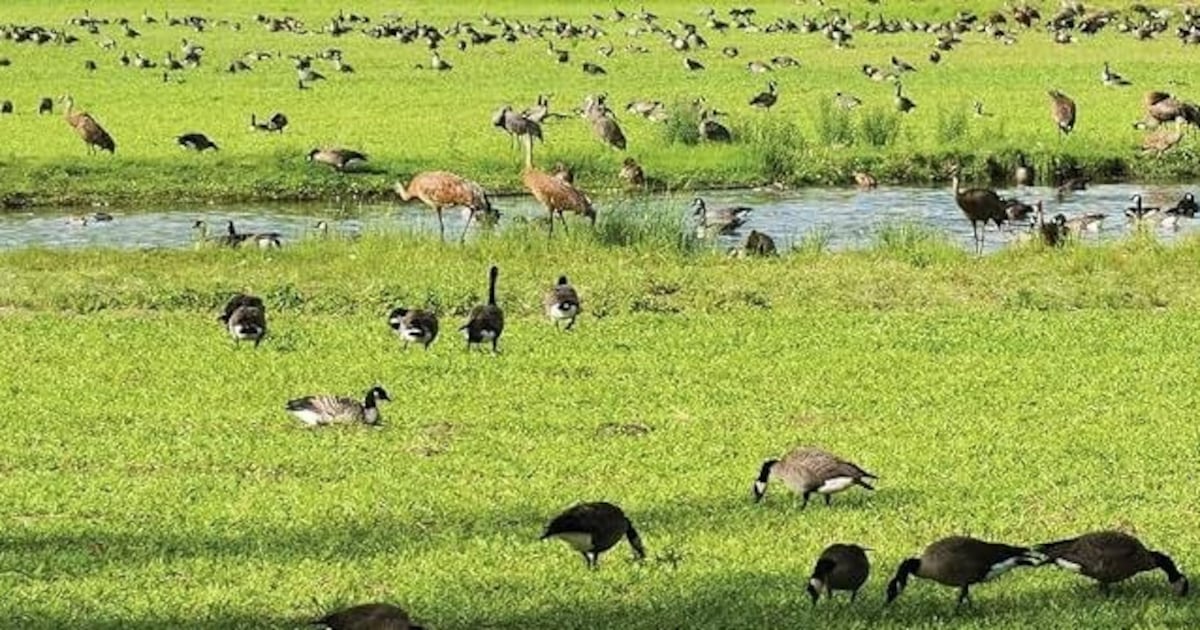
More importantly, the refuge has been consciously cultivated as a stopping point for lesser sandhill cranes, Canada geese, trumpeter swans and other birds that pass through the Fairbanks region during their annual migrations heading north in the summer and south come fall. People line the fences to see and photograph the avian gatherings. But it’s not just for charity or human enjoyment that seed is spread on Creamer’s Field to attract the birds. It also diverts them from flying close to the local airports.
Most Fairbanks residents who have spent any time at the field know it originated as a dairy and farm. The two large barns located not far from the road make this obvious even to passersby.
How this beloved location came into being is the subject of Homer author Jessica Shepherd’s book “A Place for the Birds.” It’s a history not just of the field and dairy itself, but also, through the story of both, a history of Fairbanks as well.
The tale of what for decades would be known as Creamer’s Dairy begins with the arrival in Fairbanks of two families, both of them in 1904.
One of those families was, of course, the Creamers. CN Creamer had by then been repeatedly coming to Alaska in pursuit of gold. When better prospects arose in the Interior than elsewhere, he and his wife Minnie relocated there that year with their children, including their son Charlie.
Meanwhile Charles Hinkley and his wife Anniebelle, who had operated a dairy in Portland, saw an opportunity to run a similar operation in Gold Rush Alaska. After first trying in Nome, where their efforts came to naught, they too headed for Fairbanks in 1904 with their daughter Anna. There they began slowly and successfully building their dairy and supplying residents with fresh milk. Initially they worked out of a small location near downtown, but in 1910 they bought land along what is now College Road, and began expanding their business.
An image of geese from “A Place for the Birds: The Legacy of Creamer’s Field Migratory Waterfowl Refuge.” The book was written by Jessica A. Shepherd with illustrations by Mark D. Ross.
Eventually Anna and Charlie would marry, but first they needed to reach adulthood while a bit of Fairbanks history unfolded.
Shepherd guides readers through the early days of the city, offering a brief but lively detailing of Fairbanks as it boomed during the Gold Rush, busted following the first big strikes, then slowly regained its footing as hard rock mining created a solid economic basis.
During these years Charlie and Anna were themselves in and out of Alaska, and after Anna’s brief first marriage ended in divorce, the two were wed. Meanwhile Anna’s parents were still hard at work, filling the vital need for locally produced milk.
By the late 1920s, the Hinkleys were ready to retire, and in 1928, Charlie and Anna began the process of purchasing the farm from them. Five years later they assumed full ownership, and a local institution was born.
Shepherd follows the Creamers and their dairy through the winding decades that followed. The farm slowly but steadily expanded, barns were raised, the herd grew, and soon they were engaged in agriculture as well, growing oats and peas for the cows, and barley and later potatoes as well.
By the late ’30s, the business was thriving and the Creamers were providing residents and restaurants with daily milk deliveries. Later they’d obtain contracts with the military bases as well.
In addition to farming operations, the large barn that the Creamers had built became a de facto community center, with dances, children’s entertainment, movies and other events taking place there. A frozen pond attracted ice skaters in winter.
Things went into decline in the 1950s when food began coming into Fairbanks on airplanes and up the Alcan Highway. Dairies in the Lower 48 were able to ship milk in at prices the Creamers couldn’t compete with. Meanwhile, increasing sanitation regulations created insurmountable costs.
Slowly the farm went under and Charlie Creamer put it up for sale. For several years it looked like the enormous open space would be subdivided and gobbled up with housing and other development.
A few determined residents belonging to the Alaska Conservation Society didn’t want to see this and began a long process of bringing together resources to turn the farm into a preserve for wildlife and birds. The Department of Fish and Game also took interest, as did then-Gov. Wally Hickel.
An image titled “Cow over the Moon” from “A Place for the Birds: The Legacy of Creamer’s Field Migratory Waterfowl Refuge.” The book was written by Jessica A. Shepherd with illustrations by Mark D. Ross.
In 1970, the land transfer went through just ahead of the onset of the pipeline era, when the sudden influx of workers needing housing likely would have put too much pressure on Fairbanks for the preserve to have been created.
ACS member Celia Hunter said “We got that area at probably the last moment that it was possible to get a large chunk of land as a green belt along College Road.”
Shepherd devotes much of the remainder of the book to the 1990s, when Creamer’s Field developed into the attraction it is today.
Initially set aside as a migratory bird refuge, it soon became a popular recreation spot for wildlife viewing and the year-round use of trails. Programs of all manner sprung up, including summer day camps for children, bird festivals, guided walks, and much more.
The book is illustrated with numerous historic photographs, as well as the meticulously accurate wildlife drawings of artist Mark Ross, long known for his decades of commitment to educating people about the refuge.
“A Place for the Birds” is the gentle story of how Creamer’s Field has been a community treasure in all of its variations. Now get out there and go for a walk.
• • •
“A Place for the Birds” can be purchased online from Friends of Creamer’s Field or on Amazon. Proceeds help fund the organization’s programs.
This year’s Tanana Valley Sandhill Crane Festival takes place from Aug. 16 to 23. Author Jessica Shepherd will be on hand for some events.