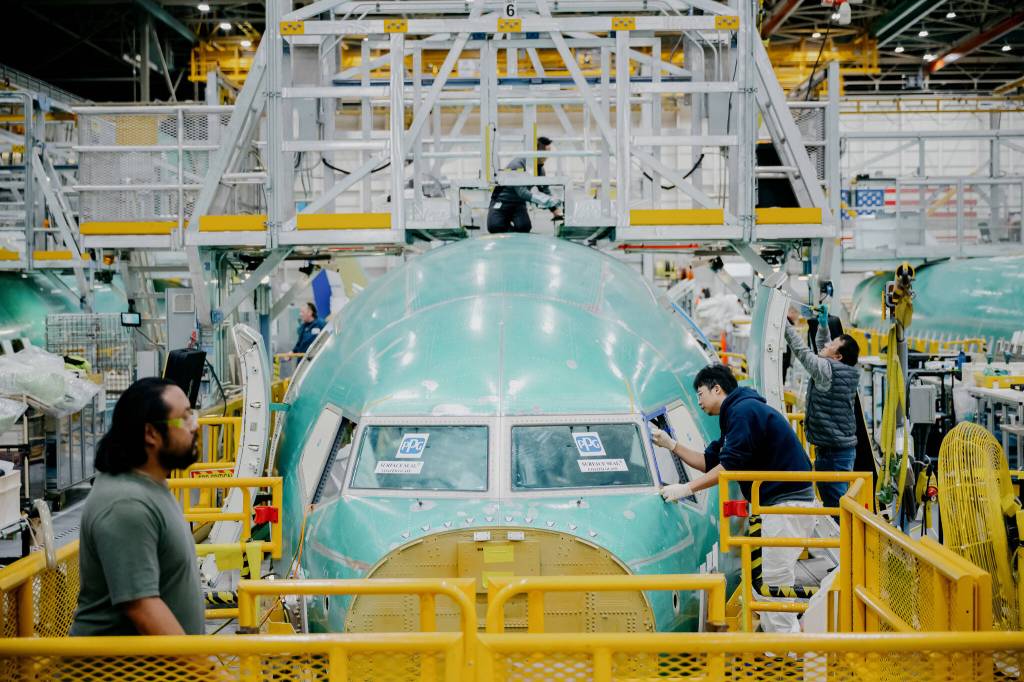
Boeing said on Monday that it planned to cut about 5% of the employees who designed and built its commercial airplanes because the company was unable to increase production as quickly as it had expected. That comes out to about 2,500 workers.
Over the past two years, Boeing increased the rate at which it builds the 737 Max, its most popular commercial plane. But the company has said in recent months that it is taking longer than planned to consistently produce 47 of those airplanes every month. Among other things, the company has struggled to produce wings quickly enough for the 737.
As a result, Boeing needs to give its factories and suppliers more time to get up to speed, Stephanie Pope, the CEO of the company’s commercial airplanes unit, said in a note to employees Monday.
“Adjusting our production schedules and reducing aircraft output puts us in an overstaffed position,” she said in the note. “Unfortunately, that means we need to align our staffing levels to our revised business plan, resulting in a reduction of approximately 5%.”
Pope said that the company would achieve that goal through layoffs and by not filling open positions. Affected employees will be notified starting next month. Boeing’s commercial airplanes group employs more than 50,000 people.
In recent years, Boeing has fallen behind Airbus, its main competitor, in delivering commercial planes and this latest setback will mean it will remain far behind the European aerospace giant.
That said, Boeing has made notable progress since its last crisis in early 2024, when a poorly installed panel blew off a 737 Max jet during a flight. That incident resurfaced concerns about quality and safety. Since then, Boeing has overhauled its practices under oversight from the Federal Aviation Administration.
The company had long been criticized for prioritizing production speed over quality. Kelly Ortberg, who became the company’s CEO in the summer of 2024, has said that the company will resist that pressure.
“We’re not yet to where I can say we’re stably producing wings to support the 47 a month rate,” Ortberg said on a call last month to discuss Boeing’s quarterly financial statement with investor analysts. “So we’re going to want to dwell on that for a little while to make sure we’re stable and don’t end up in an unstable situation with production.”
This article originally appeared in The New York Times.