One day in the early 1970s, Betty Farnsworth was at home in West Lebanon when her daughter ran inside from the yard.
“I came in and said Mom, there is a parrot out in the tree,” recalled Lori Wakeman, who believes she was 8 or 9 years old at the time. Farnsworth assumed her daughter was mistaken, but she insisted. “I said, ‘No, it’s a parrot.’ It was big, you know those blue macaws?”
She showed Farnsworth, who was stunned. As it turned out, the bird had escaped from a house in Vermont. “And it just flew to my mom’s house,” Wakeman said.
Throughout her life, animals were drawn to Farnsworth, just as she had a fondness for them — a mutual love that eventually contributed to establishment of the Upper Valley Humane Society.
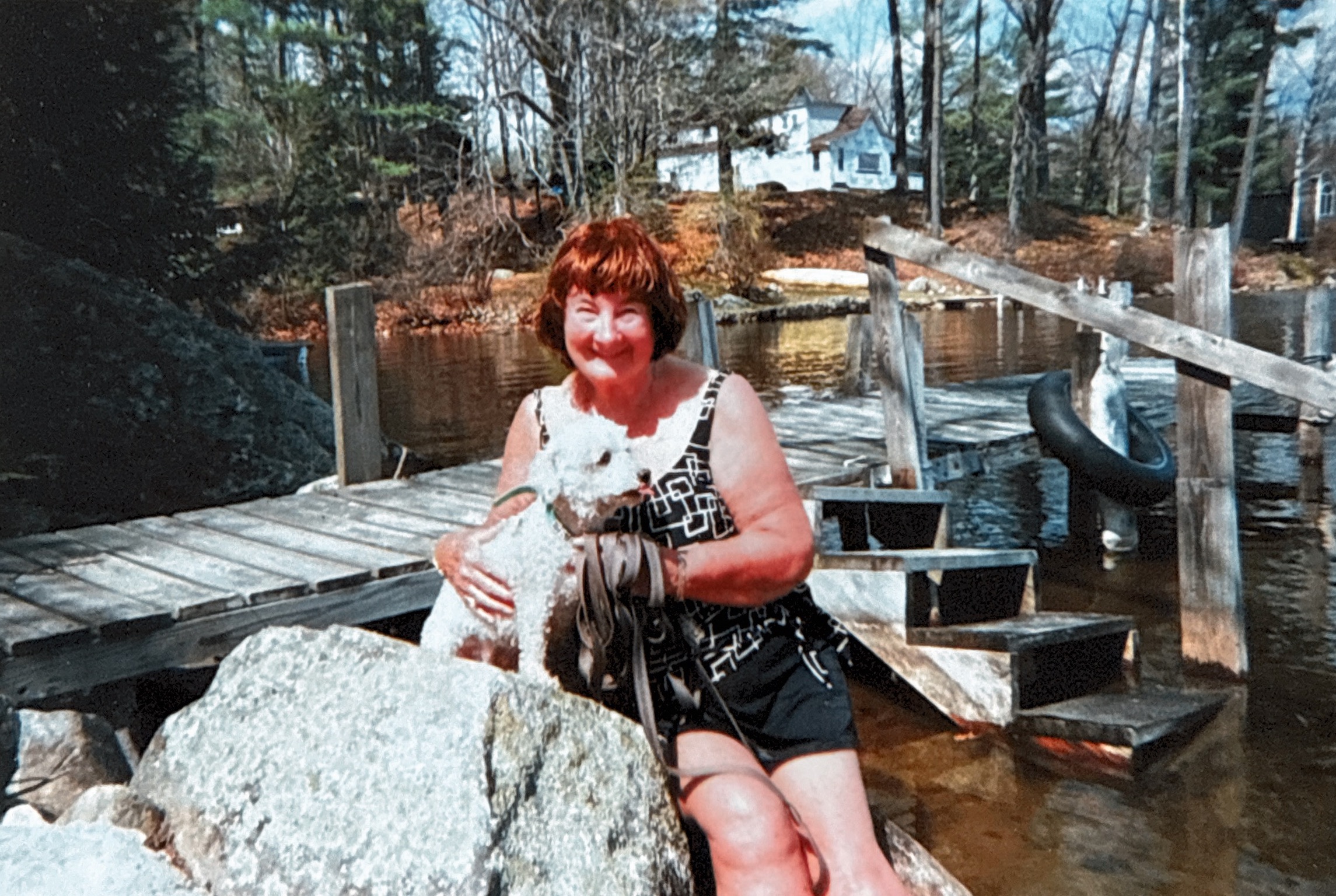
Farnsworth was born Betty White in Dorchester, Mass., on Feb. 7, 1931. When she was still young, she moved with her mom to Hanover. She didn’t have any siblings. So, growing up, her best friends were the family pets: a cat named Happy, and Chummy, a dog. Wakeman believes her mom’s love of animals really developed in those early days with Happy and Chummy.
White graduated from high school in Hanover in 1948, then headed south to Massachusetts where she attended Becker Junior College. It wasn’t long before she returned to New Hampshire, and got a job at the insurance company A.B. Gile.
One day, White rode her bicycle from Hanover to Trues Brook in West Lebanon to go for a swim. She was pedaling home when a man pulled his truck over and asked if she wanted a ride. One thing led to another, and she soon found herself in love with the driver, Everett Farnsworth.
At 4 p.m. on June 27, 1954, wearing a dress of white nylon lace and satin and carrying a bouquet of carnations and baby’s breath, 23-year-old Betty entered the Church of Christ at Dartmouth College. Waiting for her was Everett; he became her husband that day, and he held the role for 71 years.
Together the Farnsworths started a home in West Lebanon. They raised three children: Steven, Jeffrey and Lori. As she grew her family, Farnsworth also dedicated much of her time to rescuing animals.
“I knew she was different than other moms,” said Wakeman, recalling an idyllic childhood surrounded by animals that her mom was determined to help. There were dogs, cats, horses—even the occasional raccoon.
“I guess I didn’t know when I was really little that everybody didn’t take in animals,” Wakeman said.
At one point, her mom took in a dog with a broken leg. As its medical expenses added up, the family nicknamed him the “million dollar dog.” But that didn’t matter to Farnsworth. If an animal was in need, she found a way to help — and there were a lot of creatures in need.
Farnsworth developed a two-notebook system. One contained a running list of animals looking for a home. In the other, she wrote the names of people who wanted pets.
“And you knew that if you were looking for something, you called her … and people who couldn’t hold on to their animals brought them to my house,” Wakeman said.
Farnsworth’s kindness extended beyond animals. The family house was always open to people in need, too, even if it was just for a meal. She taught her kids that the most important thing in life is to be kind.
“She was always happy and positive and delightful to be around,” Wakeman said. “And I think just everybody gravitated to that and loved her for that.”
Occasionally, Farnsworth would take time away from her animals for other activities. She taught skiing to kids at Whaleback Mountain in Enfield and volunteered with the women’s fellowship at her church. She also had a motorcycle license and rode a Honda 125 that she eventually passed down to her daughter.
As the years went on, it became clear in the rescue community that a more comprehensive solution was needed for housing animals in the Upper Valley. Things started to come together in the late 1950s, when the Grafton County Humane Society began to organize.
At that point, then-president Frank Sanborn had set up a temporary shelter at his home. Others, like the Farnsworths, sheltered animals at their houses, too.
In March 1970, the organization met in Lebanon to discuss plans for something more permanent. “The society will erect and maintain a well-run shelter for animals,” publicity chairman Jean G. Wood said in a Valley News article published March 30 of that year. “The cooperation of all city and town governments will be of vital importance in this civic venture.”
They had a plan, but they needed a location, and they needed money. Farnsworth went all-in on the effort. She and other volunteers hosted bake sales, rummage sales, auctions and pet shows.
Wakeman thinks her mom’s personality played into her knack for fundraising. “My mother had an ability — she was such a lovely, genuine person — to charm people. People loved her. And she spoke from her heart, she made things happen.”
By 1973, the humane society thought it had found a location for the shelter in Hanover, but zoning issues and noise concerns took the property off the table. Farnsworth expressed her disappointment in a letter to the editor published in the Valley News on June 20, 1973. “It’s a disgrace there hasn’t been a shelter all these years and these poor helpless creatures are dropped off everywhere and left to starve, suffer and freeze to death,” she wrote. “Something must be done to alleviate the abuse and suffering around us before another winter is upon us. We would appreciate any help from anyone.”
In fact, they did find a solution by winter, when a property known as the “Doggy Motel” went up for sale in Plainfield. At that point, the society had raised well over $10,000, but it needed significantly more money to make the purchase. They turned to the Hanover Board of Selectmen for help, looking for “a loan, not a gift,” as Farnsworth clarified at a meeting, reported on by the Valley News on Sept. 18, 1973. The selectmen weren’t sure they could allocate town money to buy a property that wasn’t in Hanover, so they delayed a decision.
With winter looming and concerns that someone else might buy the property, humane society members knew they needed to pivot. They decided to take out a $25,000 mortgage to make the purchase possible. Farnsworth pledged to start fundraising immediately to get the loan paid off.
“We also hope to contract with various towns including Hanover for the pickup and care of loose dogs,” she said in a Sept. 25, 1973 Valley News article. “We’ve never had to borrow this kind of money and we’re more than a little scared.”
But if anyone was capable of facing that fear and fundraising, it was Farnsworth. “Betty had endless energy. … She had great confidence,” said her son-in-law, Kit Wakeman. “She was very engaging, like all good qualities for sitting down with someone and saying ‘let’s do this, we’re going to do this.’”
Even with a financial plan, the humane society continued to face skepticism from the community, as neighbors worried about whether the shelter would bring increased noise, smells, and even disease. Farnsworth did her best to reassure them. “We want to do this right; we want to do this humanely,” she told the Valley News in October 1973.
The sale went through in November, and the Grafton County Humane Society soon became the Upper Valley Humane Society.
Fundraising continued, as did Farnsworth’s outreach efforts. For nearly two decades, she wrote a regular column in the Valley News for the humane society. In it, she offered tips for animal safety, and reminders about rabies clinics, leash laws, and the importance of spaying and neutering animals. The column also featured photos of animals that needed homes, like a pointy-eared dog named Freedom who appeared in the paper on July 20, 1981. “I’m a 7-month-old spayed female brought in from Unity,” Farnsworth wrote, giving a voice to Freedom. “Won’t you please come down to the shelter & meet me and all my friends …”
Farnsworth continued to work with the humane society for much of her life, holding each of the positions on the organization’s board at different times. In 2005, the society recognized her many years of work by establishing the Betty Farnsworth Tranquility Garden at its current location in Enfield.
RayLynn Bradigan now is executive director of the Upper Valley Humane Society, which now offers direct help for over 600 animals a year. The organization also hosts low-cost wellness and surgical clinics and provides supplies to the Upper Valley through its pet food pantry.
Bradigan never met Farnsworth, but says she left a lasting legacy of focusing on community and building relationships in order to connect with those in need.
“We owe a huge debt of gratitude to her for all she’s done,” Bradigan said. “Countless animals have been helped because of the efforts she made. I hope that she’d be proud of what we’re doing.”
In her later years, Farnsworth thrived in her role as a grandmother and great-grandmother. She always had a camera handy to document her family, and her charming and bright personality continued to influence those around her.
“She was giddy, giddy about everything,” said Kit Wakeman. “It’s great to be around somebody like that.”
Farnsworth spent her life trusting, adventurous, and unafraid. She fed stray cats on vacation (even if it meant she’d need a rabies shot upon returning home), made friends everywhere she went, and was in her 70s when she called her daughter to tell her she was going paragliding while on a trip to Florida.
Farnsworth was 94 years old when she died on Aug. 13, 2025. Her beloved husband, Everett, died at 96 on June 5, 2026. If she were still here today, Farnsworth would likely remind you to treat all humans and animals with respect, to be kind and not fearful — and to spay and neuter your pets.