These days cellphones are basically extensions of our bodies, so it might be hard to imagine life without them. But the world’s first telephone call — or, more specifically, the first time a discernible human voice traveled over wire from one person to another — occurred on March 10, 1876.
MIT Museum curator Florencia Pierri holds a vintage booklet which tells the history of the invention of the telephone published by Bell Telephone. (Jesse Costa/WBUR)
The exact Boston address where Alexander Graham Bell made that historic transmission doesn’t exist anymore. Nor does his former attic lab near City Hall. But two plaques designate spots downtown where Bell toiled to develop his device. On a recent afternoon pedestrians — clutching their cellphones — strolled past the marker near City Hall, largely unaware of Bell’s Boston legacy.
“I don’t know a lot about Alexander Graham Bell,” Tori Gralla admitted after stopping. “My guess is that he invented something? Wait, was it a telephone?” After learning it originated in Boston, Gralla replied, “Wow, I never would’ve known that. That’s so cool.”
Gregory Gurenich, another passerby, learned about Bell’s invention when he a kid but was also surprised by the telephone’s local connections. “I didn’t know it was all in Boston,” he said with a laugh. “I mean, I use his technology every day.”
A young woman looks at her smart phone as she walks past the plaque on Avenue de Lafayette marking the place where, Alexander Graham Bell transmitted to Thomas Watson, the first complete and intelligible sentence by telephone. (Jesse Costa/WBUR)
Mythic invention stories can often seem like they took place in some amorphous time and space, according to Florencia Pierri, associate curator of science and technology at the MIT Museum in Cambridge.
Alexander Graham Bell, circa 1909. (Courtesy MIT Museum)
“People just take the telephone for granted,” she said. “You just sometimes forget that these people in the past, they were real people who did work in real places.”
Bell was born in Scotland. His mother was hearing impaired, and his father taught elocution. Bell carried on his dad’s vocation after moving to Boston in the 1870s. He taught deaf students and became a speech professor at Boston University.
“In his spare time, he was also an inventor,” Pierri said. “And he started to tinker with things and they all have to do with speech and sound.” Late 19th century Boston bustled with innovation, like a Victorian-era Silicon Valley. Other inventors here and abroad were experimenting with acoustics and telegraphy, which is the transmission of signals over electric wires. At the time Western Union had a monopoly on the telegraph, but sending a telegram was slow and expensive.
“Bell didn’t set out to create a telephone, he set out to create a better telegraph,” Pierri explained.
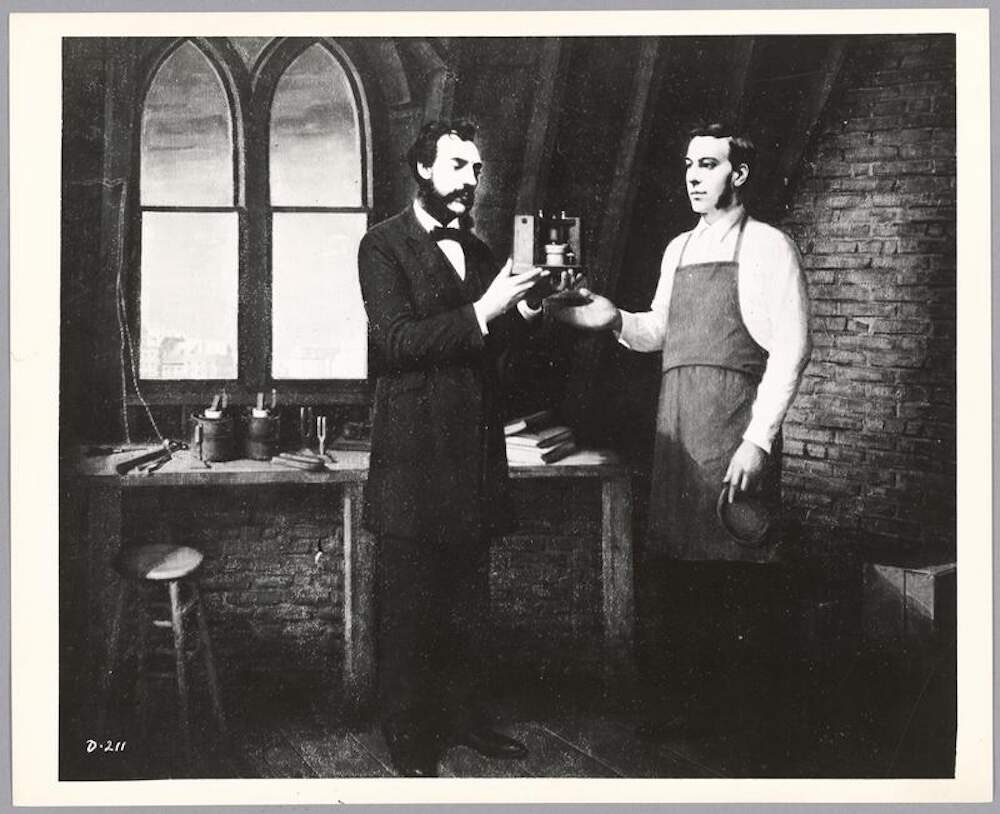
Alexander Graham Bell’s restored Boston workshop, photographed in 1959. (Courtesy MIT Museum)
Bell and his partner Thomas A. Watson labored to create something of a speaking telegraph. They found initial success sending sound via induction with a gallows transmitter, but Pierri said they eventually designed a liquid transmitter.
At the museum’s off-site collections center the curator walked past rows of gray, 10-foot-tall storage shelves to pull out an historical replica from the museum’s robust telephone collection and snapped on a pair of stretchy gloves.
The MIT Museum’s permanent collection facility with rolling archive shelves. (Jesse Costa/WBUR)
“It’s an object that, at first glance, you would not peg as a telephone,” she said as she gently lifted the piece. A black, metal cone that’s open on one end is mounted on top a brass ring connected to a wooden base.
Pierri said this type of instrument revolutionized communication 150 years ago. “We have sketches in Bell’s notebook, and from those sketches it actually does not look like this thing. The bowl for the acidified water is much bigger, and the mouth piece is different.”
An exact replica of Alexander Graham Bell’s first successfully working telephone, a liquid transmitter from the permanent collection at the MIT Museum. (Jesse Costa/WBUR)
The addition of acid was key. As the story goes, Watson and Bell were in two different rooms when Bell blurted into the transmitter, “Watson, come here. I want to see you.” Then his partner heard those now famous words through their receiver. Pierri said that moment marks “the first intelligible speech transmitted from one place to the other.”
Bell continued working on the liquid transmitter, but ultimately returned to his induction model. “And it’s on the basis of this transmitter and receiver that Bell and Watson would form the Bell Telephone Company,” Pierri explained. “And even afterwards, Bell’s transmitter didn’t work very well. The company actually used a patent by Thomas Edison of a carbon transmitter that worked much better than anything that Bell made.”
Some drama swirled around Bell’s creation, including a litigious patent dispute with another inventor named Elisha Gray. But in the end Bell and Watson ended up making history — and a whole lot of money — while forever changing the way we communicate.
MIT Museum curator Florencia Pierri lifts from the shelf an exact replica of Alexander Graham Bell’s first successfully working telephone, a liquid transmitter. (Jesse Costa/WBUR)
Pierri emphasized the fact that Bell wasn’t a lone genius working in a vacuum. His accomplishment was built on the work of other inventors, and others would build on Bell’s.
From a cone shaped device to the rotary dial, the MIT Museum’s trove traces how telephones evolved over the decades. “They become smaller, more unobtrusive,” Pierri said, “and they really start to become part of daily life.”
She suspects Bell would be proud and befuddled by today’s ubiquitous, multi-tasking cellphone. Even after explaining that we do indeed talk into them, Pierri thinks he’d ask, “But where are the wires? How does it work? What is this screen? And why is your telephone also a camera?”
He might also be tickled to see AT&T — which started as a subsidiary of his Bell Telephone Company in 1877 — is still around.