In the pages of history, they were a team that changed the world.
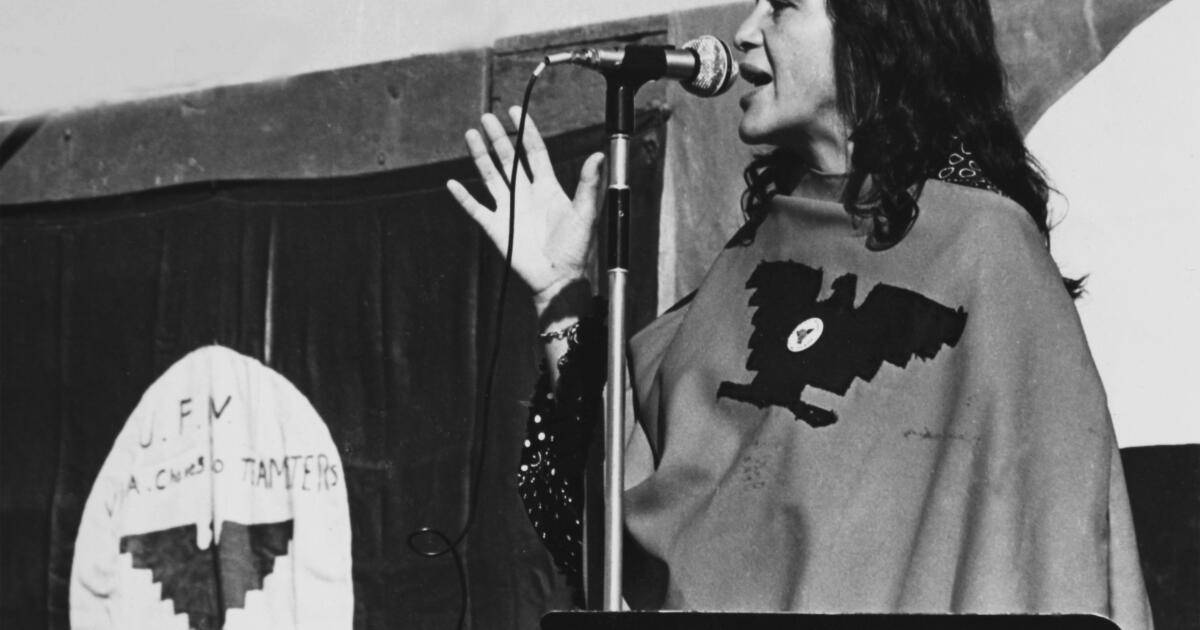
Cesar Chavez and Dolores Huerta founded the United Farm Workers and brought new life to the American labor movement, drawing national attention to the brutal working conditions and unlivable wages that agricultural workers experienced.
Chavez was the iconic leader. But Huerta was also a legend, a fiercely independent mother who had a passion for addressing the social issues of the time — women’s rights, poverty and racism. When Chavez died in 1993, she took on the mantle that, at age 95, she still wears.
But for six decades, Huerta said on Wednesday, she was keeping a secret.
In a statement, Huerta said that Chavez had raped her in the 1960s, something she had kept under wraps until allegations surfaced in the New York Times that the labor leader had sexually abused two underage girls in the 1970s.
In a emotional statement, Huerta said she felt “manipulated and pressured” to have sex with Chavez the first time. The second time, he forced her to have sex against her will “in an environment where I felt trapped,” she said. Both encounters led to pregnancies, which she hid at the time. She arranged for the children to be raised by other families “that could give them stable lives.”
Huerta addressed her long silence on the matter, suggesting she tried to put the movement and those who could benefit from it first.
“I carried this secret for as long as I did because building the movement and securing farmworker rights was my life’s work,” she said. “The formation of a union was the only vehicle to accomplish and secure those rights and I wasn’t going to let Cesar or anyone else get in the way.”
The New York Times quoted two women who said Chavez sexually assaulted them as girls in the 1970s and that some of his behavior had been whispered about within the UFW.
“The knowledge that he hurt young girls sickens me. My heart aches for everyone who suffered alone and in silence for years. There are no words strong enough to condemn those deplorable actions that he did. Cesar’s actions do not reflect the values of our community and our movement,” she wrote.
Huerta’s upbringing in California’s Central Valley greatly influenced the kind labor advocate she would become.
After her parents divorce, Huerta’s grandfather helped raise her and her two brothers while her mother, Alicia Fernandez, waitressed during the day and pulled nighttime shifts at a cannery. Eventually, Fernandez purchased a small hotel and restaurant and frequently gave free lodging to migrant farmers and their families, according to a feature on Huerta in the American Postal Work Magazine.
Huerta earned a teaching degree from Delta Community College and taught English in the Central Valley. But she was frustrated by the poverty she saw in her classroom and vowed to help in some way.
In 1955, she helped found the Stockton chapter of the Community Service Organization, which aimed to empower Latino communities by registering them to vote, organizing citizenship classes and lobbying for equal rights and improvements in Latino neighborhoods.
She met Chavez in the late 1950s and by the early 60s they co-founded a union called the National Farmworkers Assn. Huerta recounted Chavez coming to her home in East Los Angeles in 1961 and telling her “we have got to start the union. If we don’t do it, nobody else will.”
Chavez became president and Huerta vice president of the organization, which eventually transformed into the United Farm Workers.
While Chavez received more public attention in the era for his work, Huerta was a tireless advocate and a unique voice for women in the agricultural industry at a time when their needs were ignored by male leadership.
A consumer boycott of grapes under Huerta’s leadership led to the California Agricultural Labor Relations Act of 1975, which paved the way for farm workers to form unions and push for better working conditions and pay.
The New York Historical, a museum in Manhattan, described her in a biography as “soft spoken and calm” but that “behind her quiet demeanor was a powerful negotiator.”
In 1988, the then 58-year-old Huerta was hospitalized with a ruptured spleen and fractured ribs after she was beaten by police during a demonstration in San Francisco.
The incident and others prompted Chavez to say of Huerta: “Totally fearless, both mentally and physically.”
She was open that she and Chavez sometimes clashed while leading the UFW.
“Oh, we had differences. They were mostly about tactics. They were never personal. Cesar respected me; I respected him. During his first fast, I told Cesar, ‘I feel so bad because I argue with you,’ and he said: ‘Don’t ever stop. You’re the only one in the organization who really makes me stop and think,’” she told The Times in a 2012 interview.
“We were always together in terms of what we wanted to do,” she added.
In an interview with the Smithsonian oral history project, she talked about the challenge of being a woman in a union dominated by Chavez and other men. She said when the union started, Chavez asked to be the main spokesperson and she agreed.
“I think having been socialized like so many other women, that we’re supposed to support men, I said: “Oh, it’s okay Cesar,” she told the interviewer. But over time, she said she fought to bring more women into leadership and clamp down on sexism.
She served on the U.S. Commission on Agricultural Workers from 1988 to 1993 and 10 years later founded the Dolores Huerta Foundation, a nonprofit aimed to advance civic engagement, education equity and health and safety for marginalized communities.
The nonprofit issued a statement on Wednesday applauding Huerta’s decision to share her story.
“While we acknowledge the weight of this moment, we remain focused, determined and inspired to serve our community with the same relentless determination she has modeled for us,” the statement reads. “Her courage today doesn’t change our path; it clarifies it.”
Over the years, Huerta said she’s developed a “deep relationship” with the children Chavez fathered and they are close to their siblings. Still, she said, no one knew the whole story of how they were conceived until a few weeks ago.
Huerta also has two daughters from her first marriage to Ralph Head, five children from her second marriage to Ventura Huerta and four children with her late partner, Richard Chavez. Richard Chavez is the younger brother of Cesar Chavez.
Huerta said she’d experienced abuse and sexual violence before her interactions with Cesar Chavez and at the time she had convinced herself they were incidents she “had to endure alone and in secret.”
She has never thought of herself as a victim.
“I now understand that I am a survivor—of violence, of sexual abuse, of domineering men who saw me, and other women, as property, or things to control,” she said.
“I have kept this secret long enough. My silence ends here.”