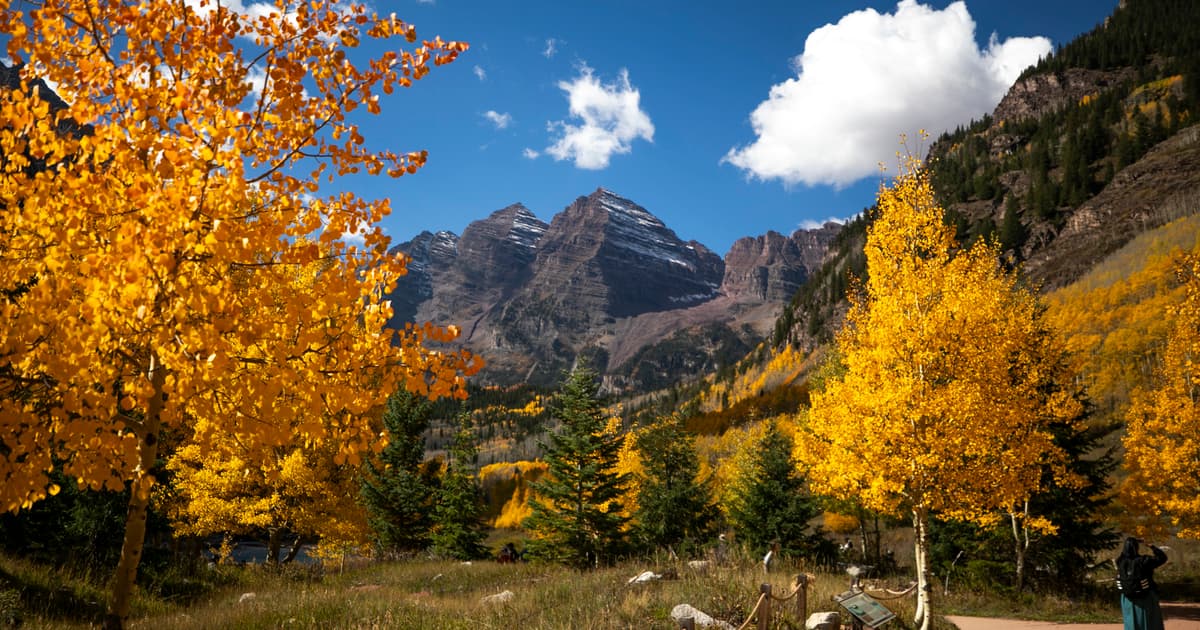
On a recent cold, fall afternoon, clouds slung so low that the tops of the iconic Maroon Bells peaks weren’t visible. But throngs of visitors still looked up, hoping to glimpse the bell-shaped peaks looming over a famously clear lake.
The Maroon Bells Scenic Area, which is run by the U.S. Forest Service, draws about 200,000 visitors a year. But despite those big crowds, the federal government says it doesn’t have the money to manage the iconic scenic area. Instead, it’s planning to transfer daily operations to Pitkin County.
Minnesotan Victor Valinskas, who hiked for days in the wilderness there, said he’s worried the move could lead to the site eventually being privatized.
“What’s it going to be? ‘The Maroon Bells brought to you by Budweiser?’” Valinskas wondered.
Pitkin County officials said that concern is justified.
“They were going to privatize the management of the Bells if we didn’t step up and do it,” explained Gary Tennenbaum, director of Pitkin County Open Space and Trails. “This was a way to keep public lands in public management.”
Stina Sieg/CPR NewsVictor Valinskas rests on a bench at the Maroon Bells Scenic Area on Sept. 28, 2026, after hiking through the surrounding wilderness. He said having more local control over this beloved piece of public land could benefit it, but he also has concerns about possible privatization in the future.
County commissioners recently voted unanimously to pursue a special-use permit to operate the Bells. The Forest Service has to formally approve the permit and has included a public comment period until Oct. 9 at the insistence of environmental groups.
Kevin J. Beaty/DenveriteThe mighty Maroon Bells. Oct. 4, 2026.Kevin J. Beaty/DenveriteA sign at the Maroon Bells Scenic Area points visitors to buses that will take them back to Aspen. Oct. 4, 2026.
Managing this beloved area has long been a group effort.
Pitkin County has worked with various partners for nearly 50 years to manage the shuttle to the Bells, and the county owns and upkeeps Maroon Creek Road, which leads to the scenic area.
Under the new arrangement, it would also be responsible for all the day-use areas, campgrounds, trails and other infrastructure in the scenic area for five years, with an option to extend for another five years. It would only be for the scenic area, and would not impact the larger Maroon Bells-Snowmass Wilderness area, where the peaks actually sit.
Tennenbaum believes Pitkin County can do things the federal government can’t, like maintain the bathrooms, which he said haven’t had soap for a while now. “We need these things. Right now, the Forest Service doesn’t have the budget to do it,” he said.
The Forest Service has faced both budget cuts and staff cuts, which have made managing the site more difficult.
“We’ve been operating in about a $380,000 deficit annually, and we don’t have enough funding … to really operate the site in the way that it should be at this point,” said Aspen-Sopris District Ranger Jennifer Schuller of the agency’s funding for the Maroon Bells Scenic Area.
Kevin J. Beaty/DenveriteLaurel Catto, a volunteer with the Forest Conservancy, helps visitors navigate the Maroon Bells Scenic Area in Pitkin County on Oct. 4, 2026. Neither the federal nor local government could handle all these visitors without some help, she said.Kevin J. Beaty/DenveriteA bus, operated by Pitkin County, drives through Aspen towards the Maroon Bells Scenic Area. Oct. 4, 2026.Kevin J. Beaty/DenveriteAutumn colors explode over the Maroon Bells Scenic Area in Pitkin County. Oct. 4, 2026.
Pitkin is a wealthy county, famous for its skiing and ultra-rich residents. Even though it’s small, home to less than 20,000 people, it has more flexibility than the Forest Service to repair and maintain the Maroon Bells.
The county will increase some of its entrance fees to cover dearly needed projects. While the cost of the shuttle into the scenic area will remain the same, the county will increase the fee to drive a car into the scenic area from $10 to $30.
It’s estimated that the Bells need $5-7 million of work, according to the county.
Tennenbaum knows that running the Bells will be a huge lift, but said, “we have to do it because it’s one of the most prized possessions in the country, but it’s also a prized possession of the local community here.”
Concerns about domino effect for other public lands
While many local residents CPR spoke with didn’t question Pitkin County’s desire to help, some experts worry about the precedent this move sets.
“This is a slippery slope,” said Mark Squillace, professor of Natural Resources Law at the University of Colorado Law School. He also worked as an assistant solicitor general for the Interior Department during the Clinton administration. “If you let the Forest Service turn over responsibility to Pitkin County, who’s next and how far does this go? And does the Forest Service ever get back the responsibility to manage these areas?”
The government is using a process called categorial exclusion to speed up the process. It means no environmental assessment or environmental impact statement is needed. And groups had to push for the Forest Service to include a public-comment period.
Pitkin County has more money than most counties in the state, but what happens in other areas of the country? Squillance worries the toothpaste won’t go back in the tube.
Ultimately he fears that lack of funds or staff “is going to be the excuse that’s used for basically turning over management of lots of other areas to private or public agencies.”
Others worry it’s a back door to disposing of public lands.
“I think that there’s growing concern as we look across our public lands from one coast to the other, that there’s these other tools that are taking a piecemeal approach to the selloff agenda,” said Hayden Wyatt, an attorney with the Center for Biological Diversity, which focuses on protecting public lands and has sued the administration over several environmental and public lands issues.
He pointed to a land transfer proposal outside of Yosemite and a land exchange at Cumberland Island National Seashore, in Georgia, for luxury housing as some other examples.
It was one of the reasons Will Roush, executive director of the Wilderness Workshop in Carbondale, pushed hard for a public comment period.
“We just really wanted to hold the agencies accountable,” he said. “Especially given that, I think, we are operating in a political environment where there are people in the administration who have explicitly said that they want to start privatizing public lands,” he said, adding that his organization supports Pitkin taking over the Bells.
Scott Fitzwilliams is a former forest supervisor of the White River National Forest, which manages Maroon Bells — for now. He said county governments and nonprofits that step up and help with the management of forests are “life-savers.” But he’s disappointed that it’s come to this point.
“The fact that one of the most iconic places in the national forest system, the most photographed place in Colorado, and the federal government doesn’t have enough money to manage it properly and has to go to a local government entity for help,” he said. “That’s a sad state of affairs.”
More importantly, transferring daily management to the county doesn’t get to the root of the problem — that federal land management agencies are underfunded and understaffed.
“You need a base level of funding and staffing to keep all the wheels turning on the bus. And it’s been a gradual depletion. And since the second Trump administration, it’s been a radical and extensive depletion of boots on the ground,” he explained.
Sen. Michael Bennet said he’ll continue pushing the U.S. Forest Service to have the necessary support. He’s the ranking member of the Senate Agriculture subcommittee that oversees the Forest Service.
“The Forest Service should have the resources it needs to care for Colorado’s most iconic places, and I’ll continue pushing for a fully funded and staffed agency,” Bennet said in a statement.
The future of the Bells
Tennenbaum pushed back on all the concerns, saying the county would happily relinquish control back to the federal government, before adding, “I mean, in five years we’ll see where we’re at. If the federal government comes in and says, ‘Hey, we got it,’ OK, possession use permit over.”
As for the concerns over precedent, Tennenbaum said management is already shifting at many well-known spots, like Hanging Lake and Pikes Peak, along with many lesser-known spots.
At Pikes Peak, which is a national forest, Colorado Springs manages the Pikes Peak highway and concessions, while the Forest Service manages the forest and trails. And this spring, the Forest Service sought submissions from parties interested in operating and maintaining visitor services and facilities at Hanging Lake, after Glenwood Springs was interested in returning management to the Forest Service.
Kevin J. Beaty/DenveriteAutumn colors fill the windows of a bus, newly operated by Pitkin County, as it carries tourists to Maroon Bells from Aspen Highlands. to Oct. 4, 2026.
Back at Maroon Bells Scenic Area, Liza Walshe, from Colorado Springs, walked down the path to the lake as a cold wind rustled the golden leaves still clinging to the aspen trees.
“It’s beautiful,” she said, tears welling in her eyes. She doesn’t want to imagine, “the loss of this, or the loss of any of it.”
She said she doesn’t want the day to come when public lands are sold off or made so expensive that average people can’t visit.
Pitkin County officials said they’re trying to protect the Bells by stepping up to manage them.
One of their first improvements? Soap in the bathrooms.
Ishan Thakore contributed reporting.