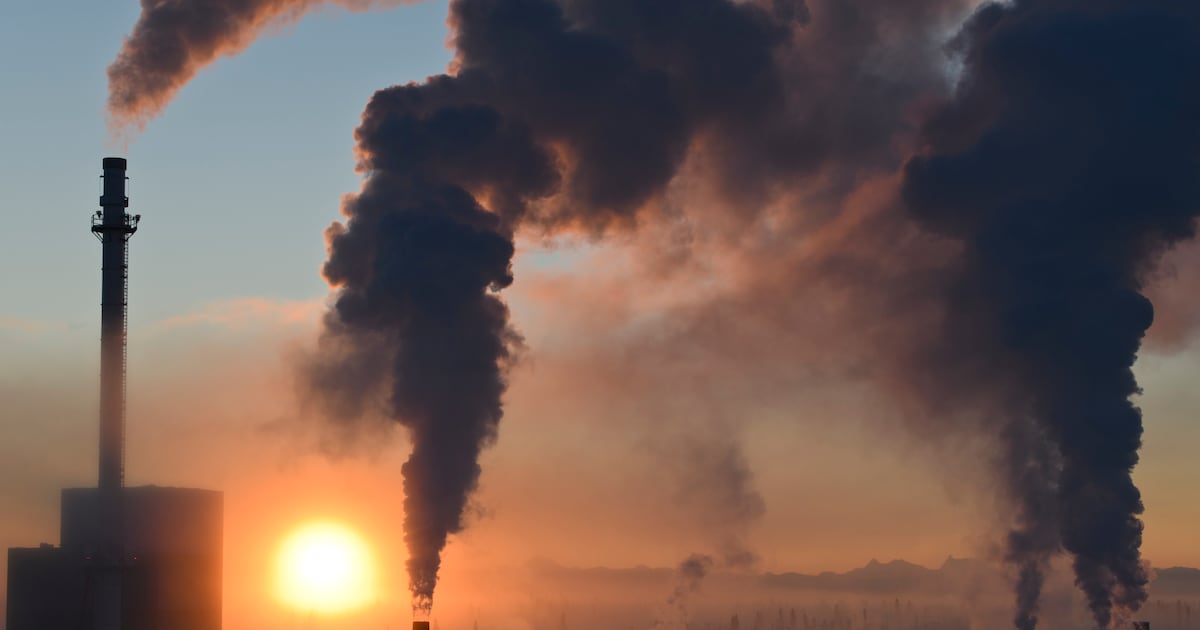
Plumes rise into minus 40 degree air from UAF’s Ben Atkinson Building, which houses the university’s heating and power plant on January 9, 2020. (Marc Lester / ADN)
Electricity prices in Fairbanks are about to soar, the result of a cold winter and the local power company’s increased reliance on diesel fuel amid the war with Iran and a shortage of natural gas from Cook Inlet.
The average power bill for residents in the city will rise close to 25%, or about $46, according to a notice to ratepayers Wednesday from Travis Million, chief executive of Golden Valley Electric Association. The projected increase on Golden Valley power bills starts June 1 and runs through Aug. 31.
If diesel prices fall next quarter, that will push down future bills.
“We now have updated data, and I want to be candid: this is an extraordinarily large increase — perhaps the most significant increase our cooperative has ever faced,” he said in the notice.
Diesel fuel costs have more than doubled, to about $5.10 a gallon, from costs anticipated earlier in the year, he said.
“The primary reason for this increase is the staggering rise in liquid fuel prices following the outbreak of the war in Iran and the resulting impacts on global oil markets,” Million said.
President Donald Trump’s war against Iran, launched in February, led to choked oil shipments in the Strait of Hormuz, causing prices for diesel fuel, gas at the pump and liquefied natural gas or LNG to surge.
Fairbanks is Alaska’s second-largest city, and home to about 40,000 Golden Valley Electric members.
The increase is based on a quarterly adjustment to the “Fuel & Purchased Power charge” on bills, the notice said. That charge covers the utility’s cost to generate and purchase power, and is passed through to customers.
Million said in an interview Thursday that the contributing factor to today’s problem stems from the shortage of natural gas from Cook Inlet near Anchorage in Southcentral Alaska.
The shortfall has forced Anchorage utilities to look at soon importing liquefied natural gas, or LNG, a potentially costly option, and increased the urgency of discussions around the proposed Alaska LNG megaproject that would tap gas from Alaska’s northernmost oil fields.
Eight years ago, Golden Valley relied on more economical Cook Inlet natural gas to provide 30% of the power for ratepayers.
That steadily dwindled, to 8% in 2024. Last year, Cook Inlet gas accounted for less than 1% of the utility’s power.
That has forced the utility to increase its reliance on diesel fuel, including during extreme cold this winter when it used diesel to “run what would normally be backup standby generation as primary generation,” he said.
“For Golden Valley, natural gas energy out of the Cook Inlet has always been an economic option for us,” he said. “It has been very beneficial for our memberships for decades.”
In the notice, Million highlighted short-term factors that contributed to the increased diesel fuel use this winter.
“Several lower-cost generation units were temporarily offline for required annual maintenance,” he said. “This work unfortunately cannot be deferred and is intentionally performed outside of winter months to minimize risk and avoid taking units offline during the coldest months of the year. ”
“Independent power producers from which GVEA purchases power also experienced unplanned outages or reduced output during this period,” he said. “Additionally, March was one of the coldest in Fairbanks’ history, and Golden Valley saw the highest electricity demand for the month of April that we’ve ever seen.”
Million said in the notice that he wanted to clearly state the reasons for the increase.
“I know so many households and businesses are already under significant financial strain after such a harsh winter, and I fully appreciate the fear and frustration that an increase of this magnitude creates,” he said. “While I understand very clearly that knowing the reasons behind an increase of this amount does nothing to lessen its impact on your budgets, I also believe members deserve direct and transparent communication about the realities affecting our system, even when the news is difficult.”
The fuel charge will fall in the next quarter, if the price of fuel falls, contributing to lower power bills, he said in the interview. Summer temperatures will provide relief as well.
“If everything else remains constant, and the price of diesel drops again next quarter, we should see a decrease in this rate,” he said.
But the situation underscores the need for a solution to the state’s shortage of natural gas production, he said in the interview.
“It does highlight the urgency for Golden Valley’s ratepayers, in particular, that something needs to happen sooner rather than later,” he said. “If we’re continuously relying on diesel fuel, we’re really at the whim of what the market’s going to do. As we saw here, just in a 30-day period of time, the price (of diesel fuel) more than doubled, and that is a direct impact rate to our members.”
The Golden Valley board of directors this week also took a step to support a project that could help stabilize future costs at Golden Valley.
Million has been approved to move forward on efforts that could lead to a power purchase agreement contract with Ameresco Delta Wind, a 36-megawatt wind farm proposed for construction in the region.