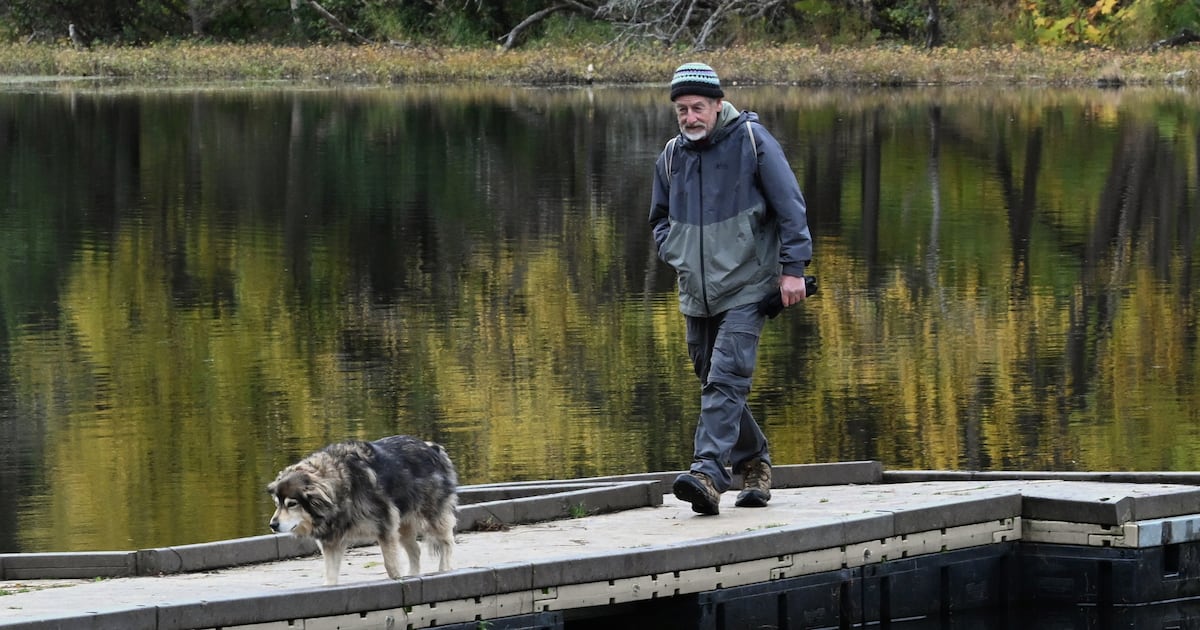
Birch leaves reflect on Little Campbell Lake as Bill Sherwonit and 12-year-old Denali walk on the dock during the fall equinox on Sept. 22, 2024. (Bill Roth / ADN archive)
This is part of Alaska Authors, an occasional series about authors and other literary figures with ties to the 49th state.
For more than 40 years, Bill Sherwonit has been a familiar voice on Alaska’s literary landscape, first through sports and outdoors writing at the Anchorage Times, then as the author or editor of over 15 books, and most recently for his columns found in this paper and the Alaska Beacon.
“I feel one of the things I can give back is to write either in praise of certain things or in defense of certain things,” Sherwonit said recently, reflecting on his lengthy career. “I’m not expressing opinions simply to express opinions,” he added. “I’m doing it on behalf of the larger world that we inhabit.”
Sherwonit didn’t set out to be a writer. He was well into his 20s before he even considered it, he said. Citing the words of author Joseph Campbell’s famous advice to follow one’s bliss, he explained that it all happened of its own accord: “It’s almost like you get on a path that was meant for you.”
That path began in Trumbull, Connecticut, a small town near Bridgeport. The child of deeply religious parents, he spent his early days exploring the nearby woods and developing his lifelong love for sports. Describing himself as a shy child, he said “wild nature became a refuge.”
After high school, Sherwonit attended Vermont’s Bates College, where he majored in geology. There, exposed to new ideas, he began questioning and eventually abandoning the faith he was raised in. He jokes that his parents’ “biggest mistake was letting me go to a liberal arts school.”
He didn’t abandon the underlying moral principles of Christianity, however, but instead developed a more broadly encompassing viewpoint. Describing himself as a “pantheistic pagan,” he said, ”I think I have a strong spiritual center.” This perspective, he added, has led him to “believe that all life has value.”
After graduating, Sherwonit entered the graduate program at University of Arizona, where he earned an M.S. While there, some friends recruited him into spending the summer of 1974 working for a mineral exploration company in the Brooks Range.
“Geology brought me to Alaska,” he said. “So geology will always have a special place in my heart.”
Alaska writer Bill Sherwonit pictured in the mid-1970s. (Photo provided by Bill Sherwonit)
Sherwonit fell in love with the mountainous Arctic landscape, and soon his allegiance shifted toward keeping it the way it is rather than developing it for profit. It was in the Ambler River Valley, while searching for signs of minerals, that he had his epiphany.
“I began to think about this,” he recalled. “If I actually had found the motherlode, this beautiful valley could be destroyed.”
Despite his deep attachment to Alaska, Sherwonit, by then a budding photographer, moved to Los Angeles in 1976, where he took photojournalism and news writing courses at Pierce College. This led to stint with the Simi Valley Enterprise as a sportswriter, and consequently he never completed the college program.
In 1982 he applied for a sportswriter opening at the Anchorage Times and was hired. Two years later he became the outdoors writer where, working for the unrelentingly pro-development newspaper, he began advocating on behalf of preservation.
“There were times where I took positions diametrically opposed to the Anchorage Times,” he recalled. “I got in trouble for some of the pieces that I wrote because this is where my green ethic began to really grow and blossom.”
Sherwonit later learned that more than once the paper’s owners and management wanted to take him off the outdoors beat. However, he said, editor J.R. Baldwin always stood up for him: “He became a champion of my work.”
In 1991 he published his first book, “To the Top of Denali,” which chronicled both famous and lesser-known expeditions on North America’s highest peak. It proved wildly popular and remains his bestselling title. It was quickly followed by “Iditarod: The Great Race to Nome,” a collaboration with photographer Jeff Schultz.
In 1992, the long newspaper war with the Anchorage Daily News culminated with the collapse of the Times, and Sherwonit was out of a job.
“Two thoughts went through my head,” he said of that morning when he learned of the newspaper’s demise. “One, I’m staying in Alaska, and the other is, I’m gonna continue to be a writer.”
Since then, he said, “I’ve eked out a living as a freelancer. My perspective has always been the pay ain’t great, but the fringe benefits are fantastic.”
Writer Bill Sherwonit and his dog Denali, pictured in Chugach State Park in 2024. (Photo provided by Bill Sherwonit)
In 1996 Sherwonit began producing a flurry of books, starting with “Alaska’s Accessible Wilderness: A Traveler’s Guide to AK State Parks.” He edited 2000’s “Denali: A Literary Anthology.” In 2008 he published the essay collection “Living with Wilderness: An Alaskan Odyssey.” In 2011 came “Chugach State Park: Alaska’s Backyard Wilderness,” another collaborative effort, this time with photographer Carl Battreall. Others emerged in this period as well.
Perhaps his most deeply personal book was 2009’s “Changing Paths: Travels and Meditations in Alaska’s Arctic Wilderness,” where he explored his childhood and tells of his brief young adult career when he “fell out of love with geology and fell more in love with the wilderness.”
Sherwonit’s most recent book, “Animal Stories: Encounters with Alaska’s Wildlife, was published in 2014. Since then his attention has turned toward writing columns and essays, often drawn from the voluminous journals he keeps of his daily life and wildland journeys.
“What I found with both writing and photography is that they help to imprint experiences in my mind or in my being,” he said of the records he has kept for decades. “I go back and read some of these journals and it just puts me back into the experience.”
For several years he wrote the column City Wilds for the Anchorage Press, where he explored the various natural places found both within and beyond the city, especially Chugach State Park, which he said he has an “intimate relationship” with. He feels the park is sorely under-financed. “You have this world-class park adjoining Anchorage, and it’s so neglected by state government,” he said.
He’s also vocally opposed the proposed Seward Highway expansion south of Anchorage, disputing claims that it will improve safety. He feels that the nearby Turnagain Arm Trail, which he describes as “my favorite woodland trail,” will be “greatly compromised and diminished by this project.”
This summer Sherwonit wrote about his recent solo stay in the Brooks Range, where he camped in one place and did day hikes instead of backpacking. At age 76, he said, “I don’t know how much longer I can do these remote trips up in the Arctic.”
He still spends considerable time in Chugach State Park, however, a 10-minute drive from the home he shares with his partner, Jan. There he continues looking for new details about the natural world that has never lost its hold on him. “The more you pay attention to something, the more amazing critters are. Or landscapes. Or even plants.”
This fascination extends even to the insect Alaskans most love to hate. “Mosquitoes, like all of us, are just doing their best to survive,” he said.
Looking back on 40 years of writing, Sherwonit repeatedly expressed gratitude for the life he has been able to live, saying that he has spent it “doing what I love to do in a place I love.”
[Book review: New work details the fading promise of a peaceful Arctic and how it affects the region’s future]
[A literary lectern for the North Pacific Rim, Cirque is a unique and essential publishing platform]
[Book review: This ‘catalog’ asks Alaskans to think deeply about our history]