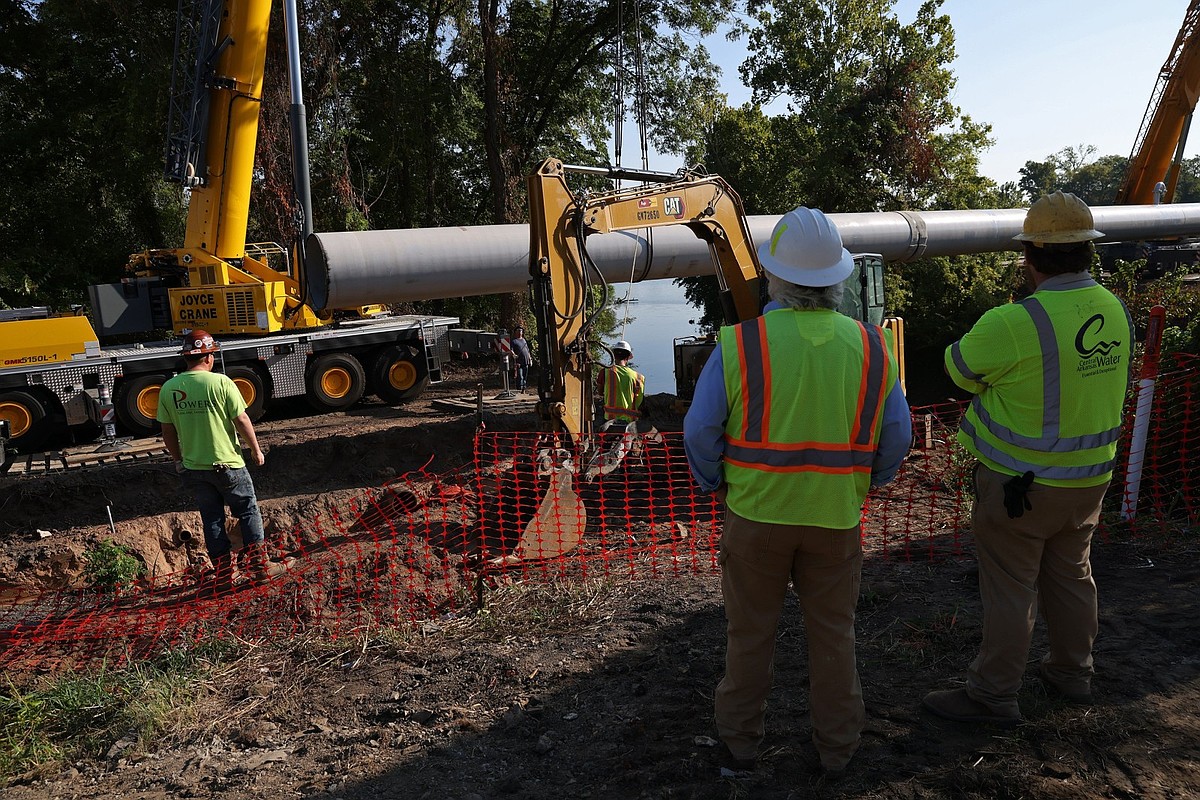
A fledgling committee is advocating for a ballot measure to authorize the Arkansas Natural Resource Commission to issue up to $500 million in state general obligation bonds for water, water disposal and pollution reduction.
Supporters of the ballot measure have described it as a means for the state to obtain funding that would allow the commission to continue to give low-interest loans to Arkansas communities.
The ballot measure is Issue 4 on the Nov. 3 general election ballot.
With three months to go before voters decide the fate of the ballot measure, the issue hasn’t generated much public attention thus far.
Senate President Pro Tempore Bart Hester, R-Cave Springs, said “there will be some work put into outreach on the supporting side when we get closer to November.”
The ballot committee promoting voter approval of Issue 4 is The Committee For Water Infrastructure Now (WIN) For Arkansas, which includes the Arkansas Rural Water Association.
During the 2025 regular session, the Arkansas Legislature approved Hester’s bill to clear the way for voters to consider whether to authorize the Arkansas Natural Resources Commission to issue up to $500 million in state general obligation bonds for water, waste disposal and pollution abatement facilities.
Under Issue 4, no more than $150 million of the state general obligation bonds shall be issued to finance irrigation projects. The total amount of bonds to be issued during a two-year period shall not exceed $60 million under the ballot measure.
Hester said Tuesday that voters should approve Issue 4 because the entire state has water infrastructure concerns.
“Whether that is new growth needs or aging and broken water line infrastructure, it’s a statewide concern,” he said. “The continuation of these water bonds is a bipartisan issue that I believe all of us can get behind.”
But Libertarian gubernatorial candidate Colt Shelby of Cecil said Tuesday that he is against Issue 4.
“Because our counties are already struggling to pay their bills, how will we be able to pay that back plus interest?”
Shelby said he would prefer that the state “turn back dollars out of the surplus to go straight to the counties to start the necessary infrastructure repairs.”
During the 2025 regular session, the Senate voted 24-3 to approve Senate Bill 421 by Hester before the House voted 86-3 to send it to Republican Gov. Sarah Huckabee Sanders, who signed the bill into law as Act 578.
Sanders spokesman Sam Dubke said Tuesday that Sanders “has directed nearly $2.8 billion to water projects in all 75 counties” and is leading a comprehensive review and update to the state Water Plan because she thinks the key to Arkansas’ future success and growth is smart investments in water and wastewater infrastructure.
In addition, the governor “signed Act 578 last year to expand that effort even further and deliver $500 million in water system overhauls to the communities that need it most,” Dubke said.
State Sen. Fred Love of Little Rock, who is the Democratic gubernatorial candidate, voted present on SB421. He could not be reached for comment by telephone Tuesday or Wednesday.
SIMILAR BOND MEASURES
Chris Harris, who is the Arkansas Rural Water Association’s executive director and treasurer for the Committee For Water Infrastructure Now For Arkansas, said Arkansas voters approved similar ballot measures in 1982, 1988, 1998 and 2008. That came after the Legislature referred the ballot measures to voters during regular sessions in in 1981, 1987, 1997 and 2007, respectively.
In 1982, voters approved a ballot measure authorizing the state to issue up to $100 million in state general obligation bonds for water-related projects. In 1988, voters approved a ballot measure authorizing up to $250 million. In both 1998 and 2008, voters approved separate ballot measures authorizing up to $300 million.
“Based on available records from 1997 and 2007, which provided $600 million in general obligation bond authority, approximately $461 million has been approved for grants and loans,” said Ayden Duncan, a spokeswoman for the state Department of Agriculture.
“Current outstanding loans are approximately $229.8 million. Arkansas has not had to write off any of the loans. A total of $630,000 of the $600 million in general bond obligation authority from 1997 to 2007 is behind on payments,” Duncan said.
Harris said passage of this ballot measure will ensure low-interest loans for water and wastewater utilities, and if Issue 4 fails the state would have a diminished capacity to provide low interest loans.
The state also wouldn’t have as much money to match federal funds, if the proposed ballot measure failed, he said.
If Issue 4 fails, Duncan said that the direct loss in funding to the state would be the full value of the $500 million from general obligation bond authority, or approximately $30 million per year for nearly 17 years.
“The General Obligation Bond Program is one of four state water funding mechanisms the Department (of Agriculture) administers,” she said.
Arkansas’ existing bond authority will be exhausted in the summer of 2027, so this measure is a renewal of an established program — not the creation of a new one — according to Duncan.
A portion of that authority would be used to leverage federal funding mechanisms with a value of approximately $444.8 million through 2030, she said.
“Without it, the state would have to meet those match requirements from its remaining funding sources, which means less money available for the purposes those sources currently serve,” Duncan said.
She said current estimates put Arkansas’ water infrastructure needs at $20.1 billion across the next 20 years, and the state Department of Agriculture currently uses four state funding mechanisms and five federal funding mechanisms to try to meet a portion of these needs.
BALLOT COMMITTEE
Besides the Arkansas Rural Water Association and Harris, the Committee For Water Infrastructure Now For Arkansas ballot committee’s members also include the association’s general counsel John Charles Edwards, who is director of Helena-West Helena Phillips County Port Authority, according to the committee’s filing with the Arkansas Ethics Commission.
The committee reported raising $38,500 and spending $38,010 through the end of June, leaving a balance of $490 on June 30.
The committee reported receiving contributions of $6,000 from the Nature Conservancy; $5,500 from the Arkansas Rural Water Association; and $5,000 apiece from the Arkansas Game and Fish Foundation, Arkansas Municipal League, Northwest Arkansas Council, the Arkansas Farm Bureau Foundation and Friday Eldridge & Clark LLP.
In addition, the committee reported receiving contributions of $1,000 apiece from the Arkansas Rice PAC and Grand Prairie Farmers.
The Committee for Water Infrastructure Now For Arkansas reported that the $38,010 it spent went to political consulting firm Gilmore, Davis Barker Group for polling on June 25 and 26.
Harris said the committee wants to inform the public about “how important (Issue 4) is to the state,” but added “we are not trying to raise massive amounts of money to do that.”
He said he has not received “a good number” for the committee’s fundraising goal yet.
OTHER BALLOT MEASURES
During the 2025 regular session, the Legislature also referred three proposed constitutional amendments to voters in the Nov. 3 general election.
These proposed constitutional amendments include:
• Issue 1, which is aimed at barring non-citizens from voting in state and local elections in Arkansas. State Rep. David Ray, R-Maumelle, proposed the measure.
• Issue 2, which is meant to specify that citizens of the state have the right to keep and bear arms for certain purposes. State Sen. John Payton, R-Wilburn, proposed the measure.
• Issue 3, which would give the Legislature the authority to provide for the establishment of economic development districts, which may issue bonds for financing projects within the economic development district. State Sen. Jonathan Dismang, R-Searcy, proposed the measure.
Michael R. Wickline
mwickline@adgnewsroom.com
Mike Wickline covers state politics, and he has covered the state Legislature for the Arkansas Democrat-Gazette since November 2000. He previously spent several years covering the Idaho Legislature for the Lewiston Morning Tribune.