Let us read it for you. Listen now.
Your browser does not support the audio element.
FAYETTEVILLE — We cannot know at this stage whether the Ryan Silverfield regime at Arkansas can produce great success, moderate success or even any success.
But we do know it will be very difficult, bordering on impossible, to reverse the ever-lengthening trend of this proud program if the Razorbacks cannot find a unity of purpose and a belief in their brotherhood.
The time for instilling those beliefs doesn’t start in spring drills or summer training camp.
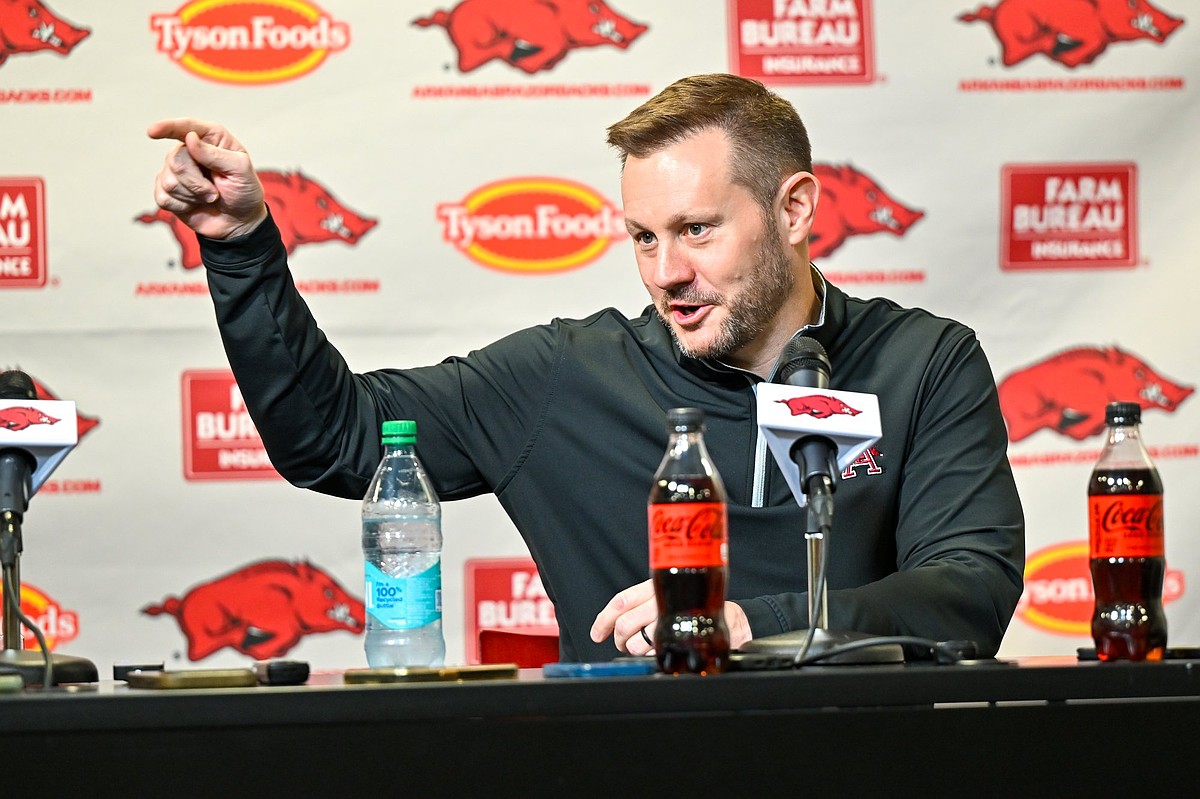
It is already happening in full force, Silverfield said during a Tuesday press conference.
Coaches and strength staffs have more availability than ever during this stage of the NCAA’s football calendar, and winter conditioning is Point A for the team-building exercises.
Silverfield said a winter workout regimen that stresses competition and cross-roster bonding has begun for the Razorbacks. He started a similar campaign at Memphis a couple of years ago as a way to assimilate large groups of newcomers in the transfer portal era.
MORE FROM WHOLEHOGSPORTS | Ryan Silverfield, Tim Cramsey talk ‘wide open’ Arkansas football quarterback battle
This one he named “War on the Hill,” and it consists of six teams, led by captains, who chose their teams in a snake-draft style. Different assistant coaches have been assigned to each of the teams. Special teams coordinator Chad Lunsford said he’s been given the title of “commissioner,” and he served as emcee for the draft proceedings.
Meanwhile, offensive coordinator Tim Cramsey and defensive coordinator Ron Roberts are free to “scout” the proceedings and check out the athletic and leadership characteristics of their charges.
A system is in place where the teams earn points through conditioning drills and other means, but they can also lose them by being late to a study hall or class or by simply parking in the wrong place.
Accountability and brotherhood are the aims.
The rosters mix players from every position group on offense, defense and special teams.
“So now, all of the sudden, you’ve created this camaraderie. The freshman defensive back now is hanging out with the senior offensive lineman that’s from Little Rock,” Silverfield said. “They’re spending all this time together and, ‘Hey, make sure you’re going to class.’ ‘Hey, let’s go do this community service.’ ‘Hey, let’s go have lunch together.’ Now you’re building that bond, because we have so many new faces. You’ve got coaches learning each other, and oh, by the way, they’re working their tails off for the betterment of our program.”
Cramsey pointed out, “It’s not offense versus defense. It’s guys coming together.
“One thing that’s going to guarantee losses, guarantee failures, is lack of camaraderie on the team and a team that is split. And that’s what this does: It brings guys together. It allows guys who normally don’t work together to work together. It allows the locker room to get to know each other and allows the coaches to get to know other players.”
Roberts described it this way.
“He’s really got it set up for us to be able to evaluate players, watch them, see how they respond to adversity, see how they push themselves. And also to be able to see the movement skills and things and try to get a better evaluation of the players.”
Lunsford said this type of exercise is much needed in modern college football.
“We’re able to put position coaches as leaders and captains on the team as well,” he said. “You may have an offensive line coach that’s with a corner, and that ability to build those relationships, I think that’s invaluable because of this day and age in college football where your team’s totally different.
“It could be totally different from year to year. The ability to connect sooner rather than later, obviously, helps you be a better football team. So, I’ve been really excited about what we’ve been doing with this team competition stuff. You obviously can work on the skill sets and the athletic ability and see all that type of stuff, but I think it’s that connection piece that’s really been good for us.”
The team names are Rack City, Hog Team 6, Hog Warriors, Watch Greatness, Work Til We Die and the Silverbacks.
The first pick of the draft, by Rack City, was former Memphis standout running back Sutton Smith.
“They said, ‘Well, he’s going to know these drills, right?’ He’s got to understand that’s what the accountability piece looks like, and all that stuff,” Silverfield said.
The morning workouts, dubbed “Tour of Duty,” began on Feb. 3, and the Arkansas football social media accounts have posted many of their exploits thus far.
Junior receiver CJ Brown from Bentonville described the drills in one post.
“War on the Hill, the offseason competitive battle that establishes our standard,” Brown said. “Within that is ‘Tour of Duty.’ Early morning competitions that all boils down to who wants it more, who’s willing to fight, who’s got what it takes.”
Silverfield said the competition will continue throughout the spring.
The Razorbacks won’t be winning any games over the next three months to start erasing the pain of a 2-10 season, but they will be laying the groundwork for getting their slumbering program off the deck.