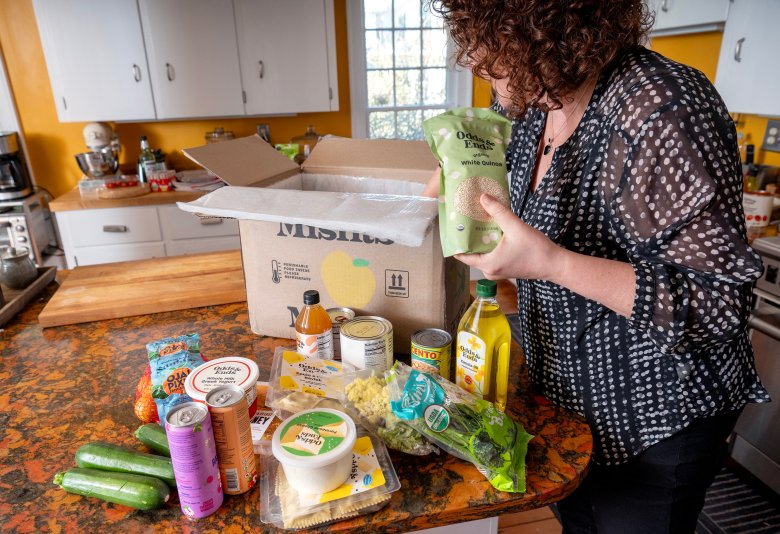
Columnist Christine Burns Rudalevige unpacks the groceries she ordered through Misfits Market, an online grocery subscription service that sells food rescued from the waste stream at a discount. (Daryn Slover/Staff Photographer)
During a recent inventory of the apps on my phone, I realized I had more than a dozen icons expressly designed to help me find food faster, more efficiently and cheaper. Do they? I wondered. Also, are they really anything new?
While my food shopping may be largely driven by my phone today, a little research made it clear that technology-forward schemes playing into the desires of food shoppers to get a good deal are nothing new: It started with the paper coupon.
HISTORY LESSON
Asa Chandler, an early employee of the Coca-Cola Company, created the first such coupon nearly 125 years ago, according to the Encyclopedia of Food Issues. At the time, 5-cent glasses of what we now call Coke sold at a rate of nine per day at a drug store soda fountain in Atlanta. In 1887, Chandler placed paper tickets for a free glass in magazines, instructed sales representatives to hand them out and mailed them directly to the homes of potential customers. By 1915, according to the company’s website, 8.5 million coupons had been redeemed, effectively seeding the market for generations of soda drinkers across the United States.
The coupon market grew during the Great Depression out of economic necessity. In the 1940s, chain supermarkets used coupons as a way to entice customers away from neighborhood butchers, bakeries and corner stores. Paper coupons hit their peak in 1992, according to a report by the grocery store consultancy CresLane, when the number redeemed totaled 7.9 billion.
As a marketing tool, coupons incentivize consumers to buy something they didn’t know they wanted and likely don’t really need. It’s a strategy that behavioral scientists have long documented as an effective marketing tool. More recently, neuroscientists are studying the physiological reactions that the thrill of a good deal elicits. Several studies published in the last five years show that scoring a deal increases oxytocin (the “feel-good hormone”) while reducing ACTH (the stress hormone).
Supermarket loyalty programs, which also tap into consumers’ good feelings about buying groceries, gained popularity in tandem with coupons. Through the S&H Green Stamps program that ran for almost 100 years, from the 1890s through the late 1980s, shoppers learned to frequent grocery stores offering the most stamps per dollar spent. Consumers would stick the stamps into booklets and exchange filled booklets for houseware items in the Green Stamp catalog. My grandmother scored my first cookbook — a 1980 edition of The Good Housekeeping Illustrated Cookbook. It still holds a prominent spot on my shelf.
In the 1990s, loyalty programs leapt into the computer age with bar-coded cards that allowed shoppers to trade their data about product preferences for a few bucks off at the register. In the early 2000s, grocery marketeers handed out streamlined cards that slipped onto key rings for customers to conveniently have at the ready. Now here we are in 2026 with grocery-store specific loyalty apps on our phones that feed AI-driven algorithms that serve up personalized coupons, all meant to allow us to buy more food at a better price.
APPS WITH A SIDE OF SOCIAL MISSION
Which brings me back to the grocery shopping apps on my phone. I had several from my local grocery stores, a few more food delivery apps that I use in a pinch, and others that offer discounted food with a social mission like reducing food waste, supporting regenerative meat production or sourcing organic products. These apps have earned their place on my phone because I’ve used them long enough to understand their glitches, offer me savings on products I routinely purchase and let me schedule grocery pickup services that save me hours otherwise spent in the stores.
For the apps that offer discounted food with the side of social mission, though, I’ve had to develop a system to determine whether I’m actually using the app to get a good deal on something I want — or if the app is driving me to buy things I don’t need. Turns out that process boils down to the same three-pronged rationale my parents used 50 years ago when they pored over the grocery store circulars in the Sunday paper and when the only phone in the house was the one on the wall in the kitchen.
Their (and my) first criteria: Would I normally buy these products?
If the answer is “No,” then even if I am tempted to download the app because I saw an enticing offer in my social media feed, I remind myself that deleting it is also quick and painless. If the answer is “Yes,” it becomes a cost comparison exercise on the front end coupled with a quality assessment exercise once the food arrives in my kitchen.
Groceries from Misfits Market, an online grocery subscription service that sells food rescued from the waste stream at a discount. (Daryn Slover/Staff Photographer)
Purchase this image
For example, I regularly use Misfits Market, a Philadelphia-based subscription grocery delivery service. Begun in 2018, the company offered organic produce that did not meet the size or aesthetic standards of grocery stores. At the time, such produce was routinely thrown out. The company has since developed a line of Odds and Ends value-added products made from imperfect or surplus crops — think cheesy popcorn (my favorite), fresh cacio e pepe ravioli (my husband’s favorite), canned whole tomatoes and concentrated paste and breads made from barley used in beer making.
My last Misfits Market delivery of 17 items cost me $72, plus $12 in packing and shipping fees, for a total of $84. I added up similar items using my Hannaford app, which totaled $105. So the Misfits Market app on this order saved me about $20.
The second criteria to help determine whether app-based grocery services are worth the money is to understand their sunken costs. There are membership fees for subscription-based grocery programs like Misfits Market and Thrive Market, another app-based grocery service I use because it offers generic organic grocery and household products for as much as 50 percent less than a grocery store’s own brand. Thrive Market’s $59 membership fee is offset, the company says, by welcome gifts. I got jars of almond butter, ghee and the company’s cookbook of quick recipes for healthy living.
While you can buy from Misfits Market without paying the $70 annual fee, membership cuts delivery fees by 30 percent, triggers deeper discounts on many products and accrues points that you can cash in for products in subsequent orders. Since I get two deliveries a month, and my average savings over local grocery store prices is $20, my true savings on this service kicks in after three deliveries.
The downside to these subscription-based apps is that shoppers must stay on top of the process. Both services let you set the frequency of your deliveries, but if you fail to go into the app within the prescribed shopping days to update your cart, they both send you exactly what you asked for in your last box — whether you want those items or not.
Chopping the dates and pistachios for a savory yogurt dish that uses yogurt and quinoa from Misfits Market. (Daryn Slover/Staff Photographer)
Purchase this image
WORTH THE EFFORT?
Assessing the time and effort spent getting these cheaper foods into your hot little hands via shopping apps is another consideration. While the Misfits Market and Thrive Market apps will take you time on the front end to select the groceries, the goods are ultimately delivered to your door.
Other food-centered apps, however, like Too Good To Go, which connect consumers with restaurants, bakeries and grocers looking to part with unsold food at the end of each day, require consumers to pick up their purchases themselves. In this instance, app users buy a “surprise bag” for between $5 to $10, roughly a third of what the contents would normally cost. They are required to pick up the bags within a designated window of time.
Too Good To Go has offered this service in Europe since 2015 and in the U.S. since 2020 and claims to have saved over 100 million meals from being thrown out. Thirty-five million meals were rescued in the U.S., which in food waste measurements terms translates to a reduction of 92.5 million kg of CO2 emissions, the equivalent to driving about 300 million miles in an average North American vehicle.
According to press relations manager Molly Sposato, the company, a certified B corporation, has over 17 million registered users in the United States, with 25,000 active partner locations across the country. That reflects a recent massive expansion through partnerships with national chains like Whole Foods Market and Circle K.
In Maine, app users can buy bags every day from dozens of Circle K locations across the state and at Whole Foods. More sporadically, they can try to snag bags from Cheese Louis, Coffee Me Up, and LB. Kitchen in Portland; and several independently owned bakeries, including The Blue in Kennebunk, Borealis in Wells and Waldoboro, Big Sky Bread in Portland, and Porteur Breads in Brunswick.
Seeded rye bread from Porteur Breads in Brunswick that columnist Christine Burns Rudalevige picked up at a deep discount using the Too Good To Go App. (Daryn Slover/Staff Photographer)
Purchase this image
I’ve used the app to buy bags at Whole Foods, LB. Kitchen and Porteur Breads. I’ve never been disappointed by the contents. That said, the process of scoring a bag from the limited supply on any given day is stressful. If I didn’t immediately react to the app’s notification that bags were available, I’d miss my chance. Even a five-minute delay meant the bags were sold out.
When I embarked on this bargain-hunting adventure, responding quickly to the alerts and scoring a savings was part of the adrenaline rush. But the thrill wore off fast. Eventually, I determined that I’d rather pay full price to shop at my own pace.
As with many things in life, it’s a question of time/energy spent versus savings. Shoppers will have to determine for themselves where they fall on that continuum.
The Canned Tomato and Basil Sauce will go over ravioli from Misfits Market. (Daryn Slover/Staff Photographer)
Purchase this image
CACIO E PEPE RAVIOLI WITH QUICK CANNED TOMATO AND BASIL SAUCE
Use Misfits Market’s fresh ravioli, which is made from surplus cheese that would otherwise be thrown out. The sauce, made from pantry staples — canned tomatoes and storage onions, both also from Misfits Market in this case — comes together quickly for a weeknight meal.
Serves 4
2 tablespoons olive oil
2 tablespoons unsalted butter
2 cups chopped yellow onion
3 cloves garlic, minced
1/4 teaspoon crushed chili flakes
Kosher salt
1/2 cup dry white wine
1 (28-ounce) can peeled whole tomatoes with their juices
1/2 cup (packed) fresh basil leaves
1 (9-ounce) package Misfits Market Cacio Pepe Ravioli
Parmesan cheese, grated, to serve
Add the olive oil and butter to a medium pot over medium high heat. When the butter has melted, stir in the onions, garlic, red pepper flakes and a pinch of salt. Reduce the heat to low, and cook until the onions are translucent, about 10 minutes.
Stir in the wine, increase the heat to high, and simmer until the wine reduces by half, about 3 minutes. Lower the heat a bit, add the tomatoes, use a spoon to break them into smaller chunks, and simmer for 15 minutes.
While the sauce simmers, bring a pot of salted water to a boil. Drop in the fresh ravioli and cook
until they pasta floats, about 4 minutes. Strain the pasta and arrange it among 4 bowls.
To finish the sauce, transfer it to a blender, add the basil and puree until smooth. Adjust for
seasoning before pouring ½ cup sauce over each serving of ravioli. Top with grated parmesan cheese and serve immediately.
Savory Yogurt with Toasted Quinoa, Dates, Pistachios and Olive Oil. (Daryn Slover/Staff Photographer)
Purchase this image
SAVORY YOGURT WITH TOASTED QUINOA, DATES, PISTACHIOS AND OLIVE OIL
I was introduced to this combination by food writer Amanda Hesser when she launched the Food52.com platform 17 years ago. I am still amazed that the combination, made from standard pantry items, works so well for either breakfast, lunch or dinner. A good quality olive oil makes all the difference in this dish. The yogurt and quinoa I used are from Misfits Market.
Serves 1
½ cup full-fat Greek yogurt
2 tablespoons raw quinoa, toasted
2-3 medjool dates, roughly chopped
Handful of pistachios
Olive oil
Lemon zest
Flaky sea salt
Spread the yogurt on a plate. Scatter the quinoa, dates and nuts all over it. Drizzle some olive oil over it all. Sprinkle with lemon zest and flaky sea salt to taste.
Local foods advocate Christine Burns Rudalevige is the former editor of Edible Maine magazine and the author of “Green Plate Special,” both a column about eating sustainably in the Portland Press Herald and the name of her 2017 cookbook. She can be contacted at [email protected].