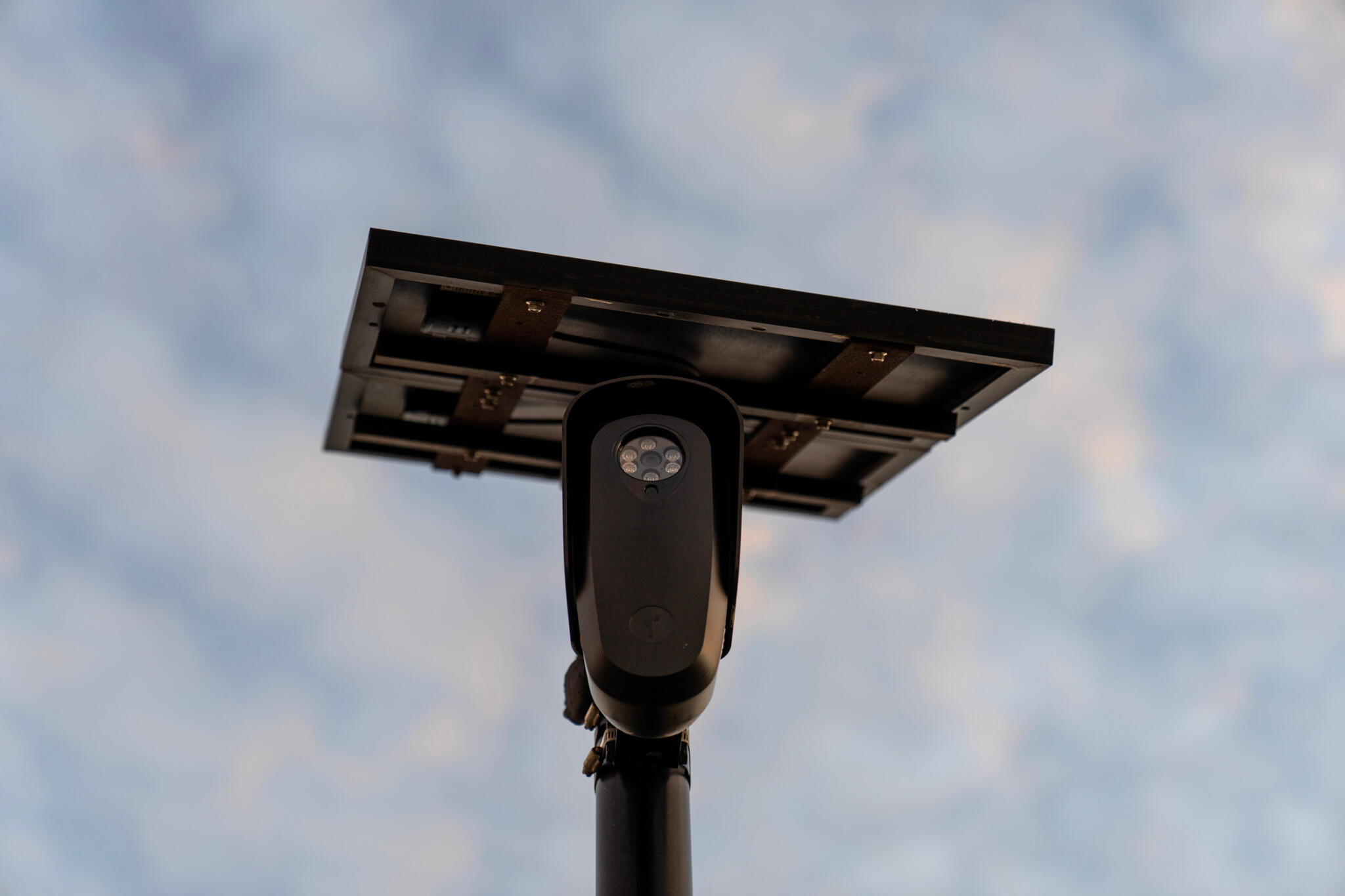
More than a dozen municipalities in Massachusetts have turned off Flock cameras or ended their contracts with Flock Safety, the company that makes the automated license plate readers.
The moves come after several communities, like Hopkinton, Auburn and New Bedford, voiced concerns over privacy and inappropriate use of the technology by officers.
Littleton resident Amy Tarlow-Lewis told WBUR she is worried about being regularly surveilled.
“We didn’t agree to be surveilled, and now I’m paying for my own surveillance, and the people that are being surveilled the most are the people who live here, who are paying for it, who are not the ones that [police] are looking for,” she said. “I have two young teenagers that drive. You’re surveilling my kids all the time.”
Roughly 100 communities in Massachusetts have installed these cameras in recent years.
State Rep. Steven Owens, of Watertown — a city that canceled its contract with Flock Safety earlier this year — introduced a bill that aims to create new rules around the use of automated license plate readers.
His proposal includes requiring police to obtain a court order in order to share data with outside agencies. Currently, it is up to individual law enforcement agencies to decide whether or not to share footage with Flock Safety’s sprawling database, according to the company.
Owens said the cameras and its database are “ripe for abuse” as it allows agencies outside of Massachusetts to track people. For example, he said people in states with bans or restrictions on reproductive or gender-affirming care could be monitored for seeking legal care in Massachusetts.
Matthew Ross, a Northeastern University associate professor of public policy and economics, said the cameras appear to function as a “loophole around the Fourth Amendment.”
“Because they’re a third-party private entity and because in most states across the country filming in a public place is perfectly legal, Flock is basically able to run these license plate readers and collect the data themselves,” he said. “Because they’re collecting them, the data themselves and the criminal justice agency is then purchasing a subscription to that data; it’s not the same thing as the criminal justice agency, for instance, having to go get a warrant to track someone’s phone, right?”
Flock Safety did not offer responses to questions, instead pointing WBUR to its website.
Former Newton Police Chief John Carmichael joins WBUR’s Morning Edition to discuss why he believes Flock cameras are a worthwhile investment, despite the growing public backlash.
Interview highlights
On why Carmichael believes Flock cameras are critical law enforcement tools:
“Well, the technology is vital for law enforcement to help with their investigations. Not only investigations on a criminal sense, but also for public safety.
“When we look at some of the other situations police are involved in, such as missing persons, missing persons with complications, people prone to wander, kidnapping, ambert alerts, these can be very valuable tools for law enforcement to use and implement in the field to help them with their investigations and help them to locate people.”
On community concerns over privacy and surveillance:
“I wouldn’t put this at the level of surveillance as … other law enforcement technology: GPS systems, getting a search warrant for cell site location information. This is a system that, yes, registration plate and that information is put into a database. However, there’s nobody there monitoring it, so nobody’s looking at this information in real time. …
“I wouldn’t say that this is surveillance in the sense that you think of following somebody. It is picking up the data, but it’s not being accessed unless something happens after the fact, and law enforcement is going in there and trying to solve a crime, or again, find a missing person or do something like that.”
On news of a New Bedford police officer inappropriately using Flock cameras:
“The issue there with the officer misconduct, it sounds like that person is either in the process of being investigated or there’s been discipline imposed. … I don’t think that’s a reason in and of itself to get rid of the technology. I don’t think we would do that in any profession where there was misuse of something.”
On whether he believes the value of Flock cameras outweigh community concerns:
“I do. But again, that just doesn’t come with a blanketed approach. There’s caveats to that, and the caveats are that as law enforcement agencies, we have to do a better job of establishing trust from the community and letting them believe that what you’re doing is right. I can tell you that the misuse and the misconduct doesn’t help, but those are things that are being addressed.
And as far as the other stuff with sharing information, you can put safeguards in or guardrails in place to prevent other agencies from seeing it. You can keep that within the agency or you can share it with other law enforcement agencies, and why wouldn’t we? Crime can be transient. If we’re looking for somebody in a kidnapping situation or a major crime, we would want that information out there so that we can better public safety.”