Efficiency experts would love to be able to double their work output. Blood donation centers have it figured out already.
Most Red Cross blood drives, either at donation centers like the Red Cross office in Concord or at temporary drives in schools or social centers, include equipment for “double red” or “power red” donations so that certain people can double their donation.
“This allows someone to safely donate two units of red blood during one visit,” said Jennifer Costa, communications director for American Red Cross of Northern New England.
The Red Cross says there’s a blood shortage in New England at the moment. Donations often decline during winter as bad weather keeps people away, but since blood can only be stored for a maximum of 42 days, there’s a fairly constant need for volunteer donations all year.
A typical donation takes about an hour and removes one pint of whole blood, which later gets separated into red blood cells, which carry oxygen; plasma, which is the liquid portion; and platelets, which make blood coagulate. These can be given separately as needed, meaning a single donation can help several patients.
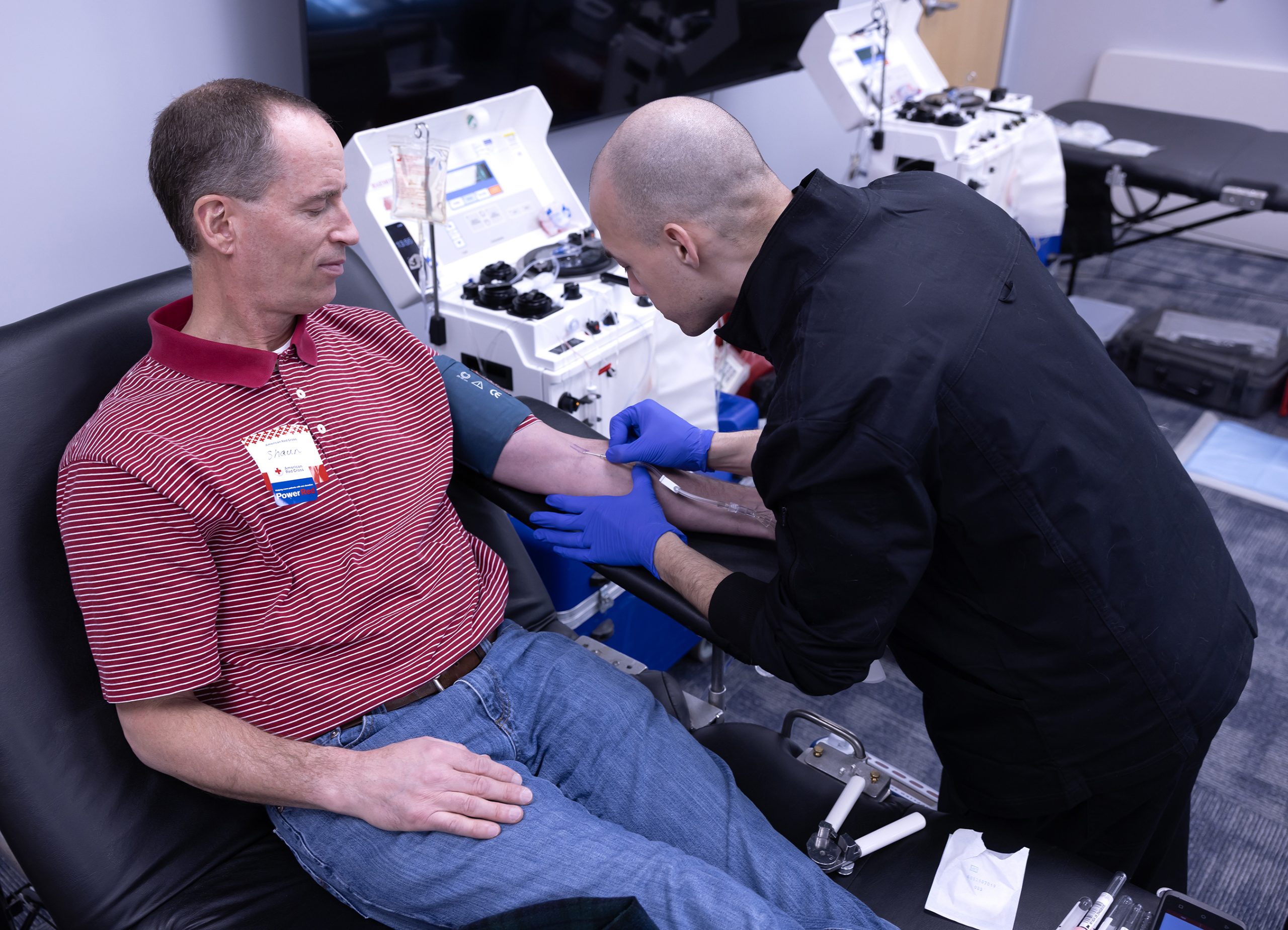
The machine uses a centrifuge to remove the red blood cells and returning everything else to the donor along with a shot of saline. The saline compensates for removing twice as many blood cells. Credit: GEOFF FORESTER / Monitor
Double-red donations involve drawing two pints of blood, using a centrifuge to remove the red blood cells and returning everything else to the donor along with a shot of saline. The saline compensates for removing twice as many blood cells.
“We often hear from donors they feel more hydrated when they’re done,” said Costa.
There’s another advantage: the needle is smaller than for regular donations.
There are some restrictions put in place to ensure that the extra removal doesn’t cause problems: The minimum age and weight of double-red donors is slightly higher than for regular donations, as is the minimum level of hemoglobin in the blood. Further, only some blood types are eligible: A negative, B negative and both O positive and negative.
Double-red donation takes about half an hour longer than a typical donation of a pint of whole blood, and you can only do it three times a year, compared to six times a year for regular donations.
Note that double red is different than platelet removal, a special donation process that’s only done at certain locations and which draws from both arms.
To find a blood drive, search locations at RedCrossBlood.org.