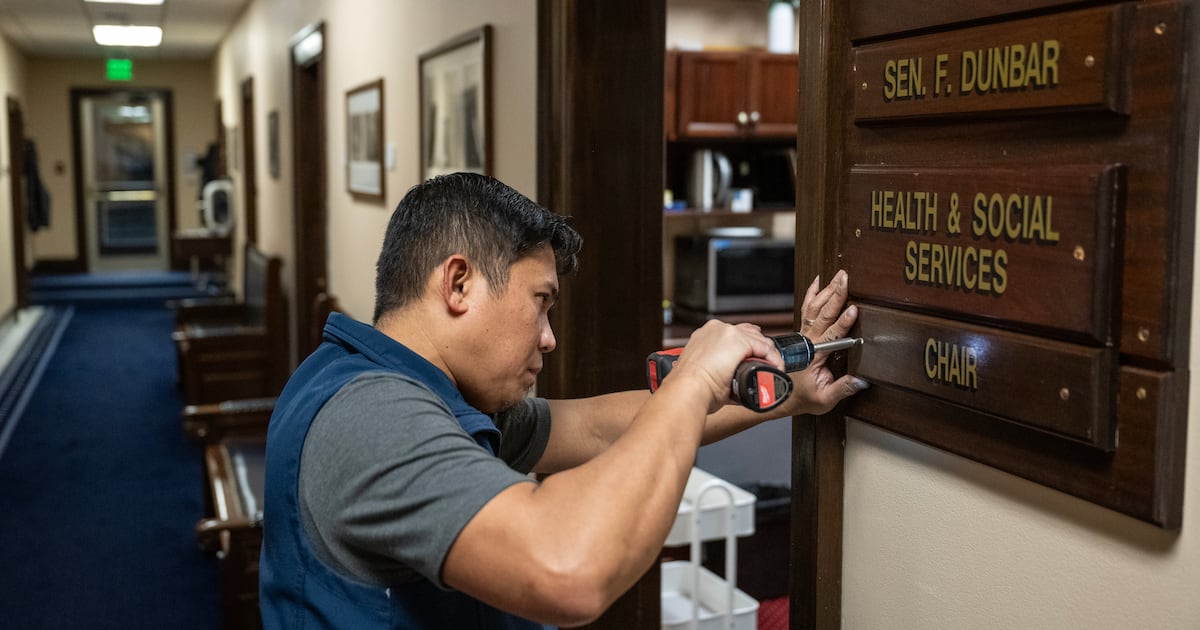
Capitol maintenance worker Romel Lumba works on an office sign as the Alaska State Legislature opened its session in Juneau on Jan. 21, 2025. (Marc Lester / ADN archive)
Alaska lawmakers will convene in Juneau on Tuesday for the second session of the 34th Legislature.
Facing a tight revenue outlook and tensions with lame-duck Gov. Mike Dunleavy, several lawmakers say their priorities are minimizing draws from savings while funding core state services.
Alaska’s House and Senate are governed by bipartisan caucuses that bring together Democrats and independents with moderate Republicans, relegating most of Dunleavy’s political allies to the chambers’ respective minorities.
Still, Dunleavy has said he will use his final few months in office to lay out a yet-to-be-seen fiscal plan that will attempt to resolve a problem that has dogged nearly his entire eight-year tenure as governor: The state does not bring in enough annual revenue to cover the cost of basic services, infrastructure maintenance and a statutory Permanent Fund dividend.
Dunleavy has yet to share any details on his plan, but budget documents released last month indicate he foresees the plan generating $1.6 billion in new revenue beginning in fiscal year 2028.
The governor is expected to address lawmakers in his final State of the State address Thursday.
Heading into the session, lawmakers say they will likely draw from the state’s $3 billion savings account to cover the cost of a shortfall in last year’s budget that arose from lower-than-expected oil revenue, and to make up for Dunleavy’s recent vetoes of funding for transportation, disaster relief and fire suppression.
To do so requires support from 45 out of 60 lawmakers, meaning the majority caucuses will be courting support from minority members.
Senators wait outside House chambers for the start of a joint session of the Alaska House and Senate, which voted to override Gov. Mike Dunleavy’s education bill veto at the Alaska State Capitol in Juneau on May 20, 2025. (Marc Lester / ADN)
Balancing the budget
Dunleavy’s budget draft for the year called for drawing on more than $1.8 billion in savings, including more than $300 million in supplemental appropriations for the current fiscal year and $1.5 billion for the coming fiscal year.
Majority lawmakers acknowledged that a draw from savings was likely inevitable to meet the state’s obligations for the current fiscal year, but like last year, they will favor a smaller Permanent Fund dividend that could keep the 2027 fiscal year budget balanced.
Dunleavy in this year’s budget draft proposed a $3,650 dividend per eligible recipient, at a total cost of $2.3 billion. Majority lawmakers said this week that they would be favoring a dividend closer in size to last year’s — $1,000 per recipient — which could allow them to pass a balanced budget without significant cuts to state services.
“To be honest, we cannot afford as large of a Permanent Fund dividend as we’ve been paying and fund basic services, so we will have a choice in the very near future: Do we tax to pay a Permanent Fund dividend?” Anchorage Democratic Rep. Zack Fields said during a legislative panel hosted by the Resource Development Council on Thursday.
“You have to pay the dividend you can afford,” said House Majority Leader Chuck Kopp, an Anchorage Republican. “That is where the Legislature is at,” he added.
Sen. Bert Stedman, a Sitka Republican who co-chairs the Senate Finance Committee, said the committee would “take a very hard line” on protecting existing state savings, given volatility in oil prices.
The Dunleavy administration last month projected that oil prices would average $62 per barrel in the 2027 fiscal year, but geopolitical events since then, including the U.S. government brokering the sale of millions of barrels of Venezuelan oil, could inject further uncertainty into Alaska’s oil revenue and the budget process.
Among the first decisions lawmakers will have to make when they convene Tuesday will be whether to call a joint session to override Dunleavy’s September veto of a bill that would apply the state’s corporate income tax to companies that operate online. If allowed to go into effect, the bill could generate tens of millions of dollars annually, further changing the state’s revenue picture.
Lawmakers’ five-day window for an override vote will conclude Jan. 24.
Construction begins on one of the two Glenn Highway bridges over the Knik River on April 23, 2025. (Loren Holmes / ADN)
Transportation funding
Transportation funding is front and center for lawmakers as the session begins.
Dunleavy last year vetoed tens of millions of dollars appropriated by lawmakers to the state’s match for federal transportation projects. For every dollar the state spends on these projects, it gets $9 from the federal government, meaning that Dunleavy’s veto puts hundreds of millions of federal dollars in jeopardy, with far-reaching ramifications for Alaska’s construction industry.
Lawmakers had used a creative method to cover the state’s match in the last legislative session: They reappropriated funding that had previously been allocated to projects that stalled, including to the Juneau Access Project, which was envisioned two decades ago to connect Juneau to the mainland highway system. Dunleavy vetoed the reappropriations, asserting that the money had already been spent, then allocated $28 million of it for a controversial new ferry terminal 30 miles north of Juneau.
Dunleavy’s recent budget proposal calls on lawmakers to backfill that funding from state savings in the Constitutional Budget Reserve. Lawmakers say they are likely to do that — wary of any potential impacts to the upcoming construction season — but warned that reaching the three-quarters vote necessary to draw from the CBR will not be easy.
Earning support from minority lawmakers will likely require concessions from the majority, even as minority members themselves acknowledged the urgency in backfilling the vetoed funding.
In a letter sent Thursday, more than 20 groups representing Alaska businesses signed a letter imploring the Legislature to backfill the transportation funding “immediately upon convening.”
Kopp, the House majority leader, said the topic would “come up quickly in leadership discussions with the Senate majority.”
Senate Majority Leader Cathy Giessel, an Anchorage Republican, called the transportation funding “a hugely serious issue for the long-term future of Alaska.”
“It is true that Alaska businesses will fail if we don’t get that funded for the next year of construction,” said Giessel.
Stedman called the potential funding deficit “an issue of pure lunacy” and pinned responsibility for addressing it on Dunleavy.
“I was shocked when he did what he did,” Stedman said. “It makes no economic sense.”
“Obviously he has a master plan, of which we don’t know who the master is,” Stedman said. “He made a mess. I want to see his solution.”
Supporters of a veto override vote hold signs outside the Alaska State Capitol in Juneau as the special session begins on August 2, 2025, in Juneau. (Marc Lester / ADN)
Public schools
Education took up a significant portion of lawmakers’ time last year, as they adopted an increase to the state’s school funding formula and then twice overrode Dunleavy’s attempts to veto it.
Districts across the state say the funding approved by lawmakers last year was not enough to make up for their eroding buying power.
Though a funding boost similar to last year’s is not likely, lawmakers say that schools are often top-of-mind for their voters and some legislative initiatives are possible, including possibly pegging school funding to inflation.
Voters “do appreciate the (veto) override, but I think the schools in general have a lot of issues that people would like to see fixed,” said Rep. Julie Coulombe, a minority Republican who represents an Anchorage Hillside district.
Fields said his downtown and South Addition constituents are “very appreciative of the veto override” but “they understand it’s not sufficient, that we have a lot more work to do this session.”
An education funding task force convened by lawmakers last year will hold its first meeting of the session Friday, with presentations on chronic absenteeism, open enrollment and homeless students, providing a window into areas where lawmakers see possibilities for legislation.
Pension reform
It has been 20 years since Alaska eliminated its defined benefits program, which promised every public safety worker, teacher and state employee a lifetime pension. Instead, the state now offers a 401(k)-style savings plan.
The defined benefits program was nixed amid a massive unfunded liability, and opponents of the system have since warned that such plans saddle states with unsustainable commitments, but unions and labor advocates have been warning in ever-more-urgent pitches that without a pension plan, the state will continue to struggle to fill public sector roles.
This could be the year that advocates for restoring public pensions finally notch a win. Champions of a return to defined benefits include both the House and Senate majority leaders. In the final days of last year’s session, the House passed the public pension bill, sending it to the Senate, where it is already scheduled for a hearing in the Senate Labor and Commerce Committee on Friday.
Though the plan has proponents in the Senate majority caucus, support for it is not uniform. Even if it passes the Legislature, it is not likely to be viewed favorably by Dunleavy, who himself collects a pension from his years as a public school educator in Alaska but has indicated he does not support a reintroduction of defined benefits.
Governor Mike Dunleavy and Brendan Duval, CEO and founder of Glenfarne Group LLC, talked about construction of an Alaska LNG pipeline during the Alaska Sustainable Energy Conference at the Dena’ina Center in Anchorage on Thursday, June 5, 2025. (Bill Roth / ADN)
Natural gas pipeline
Alaska lawmakers say they will be reviewing aspects of a long-examined Alaska natural gas pipeline this session as the project moves ahead with support from the administration of President Donald Trump.
The Senate Resources Committee will focus on the pipeline’s viability and its potential impact on the state, said Giessel, the committee’s chair.
Giessel is recommending that the Legislature contract Pegasus, a global consulting firm, to review and analyze the project for lawmakers. The Legislative Budget and Audit Committee could approve a new consulting contract as early as Tuesday.
Among the issues under discussion will be Dunleavy’s proposal to lower property taxes along the route of the gas pipeline in an effort to support its development.
“My concern is, are we ready for a megaproject? For the flood of people that will come in to build the project? It won’t be predominantly Alaskans — we don’t have enough people,” said Giessel.
“Yes, this would be a wonderful thing for the cost of our energy. Yes, we need to pursue it, if the cost of the project coming out in the end is affordable for Alaskans,” she said.