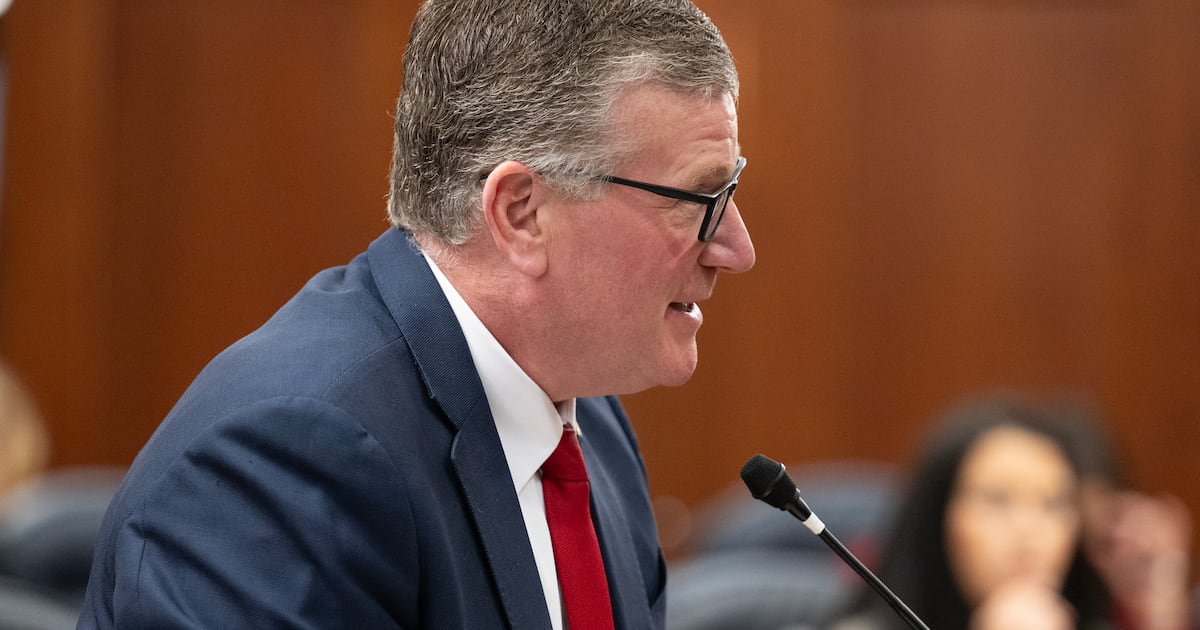
House Majority Leader Chuck Kopp, R-Anchorage, speaks on the house floor at the Alaska State Capitol in Juneau on January 20, 2026. (Marc Lester / ADN)
Alaska House Majority Leader Chuck Kopp says that he is confident the Legislature will pass a new public pension plan this year, two decades after lawmakers eliminated guaranteed pensions for the state’s public employees.
But the bill must first pass scrutiny in the Senate Finance Committee, where two co-chairs, Sen. Bert Stedman, a Sitka Republican, and Sen. Lyman Hoffman, a Bethel Democrat, raised concerns about whether the plan could again back the state into an unfunded liability, much like the one that arose in the early 2000s.
“I fully expect we will have this bill on the governor’s desk this year,” Kopp, an Anchorage Republican, said during a press briefing on Friday.
The new defined benefits plan passed the Alaska House in May in a 21-19 vote, dividing the chamber along caucus lines. It has already zoomed through the Senate Labor and Commerce Committee, but Stedman and Hoffman met the legislation with a series of critical questions when it reached the Senate Finance Committee on Monday.
Both Stedman and Hoffman were serving in the Legislature when it voted 20 years ago to eliminate the state’s existing defined benefits plan in the face of an unfunded liability that exceeded $5 billion. The liability ballooned after state-paid analysts for years underestimated the amount of money that the state should have been paying into the plan.
“We’ve made virtually no progress for the amount of money being spent on that over the last decade,” Stedman said last month.
Though the state has since paid billions of dollars to cover the debt, the unfunded pension liability remains, and it is not expected to be paid off completely until 2039 at the earliest.
Lawmakers at the time voted to close the state’s defined benefits system and replace it with a defined contribution plan, which allows teachers, state employees, police officers and other public-sector workers to contribute to an investment account much like a 401(k), but does not guarantee any specific retirement income.
The move has faced sharp criticism from public-sector workers from its inception. Law enforcement officers and others said that without pensions, it would be difficult to attract and retain new workers. The hiring woes panned out, with police departments and school districts reporting increasing difficulty in filling positions.
Several recent analyses have shown that the new plan leaves most public-sector workers without enough funds to retire securely, though elected officials disagree on the extent to which the lack of a secure retirement is the force driving Alaska residents to seek employment elsewhere.
The elimination of defined benefits has hit particularly hard for Alaska’s educators and some local government workers, who do not pay into Social Security and thus miss out on the country’s primary old-age safety net program. State employees benefit from the Alaska Supplemental Benefits System, which replaces Social Security. Teachers and many local governments in Alaska are not part of the system.
Kopp’s House Bill 78 promises a return to guaranteed retirement income, but under conditions less generous than those that existed prior to 2006. Employees will be expected to contribute more from their monthly paychecks, particularly if the plan becomes underfunded, and they won’t receive the cost-of-living adjustments to their pension checks that ensure retirees can live comfortably once their careers conclude, regardless of inflation.
Kopp, who leads a bipartisan majority in the House, has served as a police officer in Anchorage and Kenai and made public pensions his flagship focus in recent years, including by working for a pro-pensions advocacy group before winning a state House race in 2024.
Kopp is not alone in supporting the legislation, which has also been identified as a priority by Senate Majority Leader Cathy Giessel and many members of the bipartisan majorities in the House and Senate.
House Finance Committee Co-Chair Andy Josephson, an Anchorage Democrat, called the pension plan an “imperative reform.”
“Our caucus is completely unified on this,” Josephson said Friday. “We’re going to go all the way with this.”
Giessel carried similar legislation in 2024, when the Senate passed a defined benefits bill in an 11-7 vote (two members were absent). Stedman and Hoffman were the only two bipartisan majority members who voted against the bill at the time.
Stedman says that allowing teachers and local government workers to enter the state’s Supplemental Benefits System would provide them with a more secure retirement, without saddling the state with a new pension plan.
“We can’t decline any citizen from accessing Social Security. That’s a fundamental retirement mechanism and safety net for the vast majority of American citizens and teachers,” Stedman said.
The pension bill could again pass the Senate without support from all majority members, but Kopp said his goal is to cobble together enough yes votes to override a veto from Gov. Mike Dunleavy, if needed.
Dunleavy, who himself receives a monthly pension check from the state from his time as a public school educator, has previously questioned lawmakers’ effort to reinstate defined benefits. He has not commented publicly on the current plan.
To override a veto from the governor would require support from 40 out of 60 lawmakers. That remains a tall order.
Concerns about this year’s plan largely fall into three categories. First, could the plan lead to an unfunded liability like the one that the state faced in the early 2000s? Second, will the plan actually help fill public-sector vacancies, as its sponsors promise? And third, how much will the plan cost?
On the first concern, Kopp promised that the plan built in enough safeguards, including a sliding scale of employee contributions that could go as high as 12% if the plan becomes underfunded. On the second concern, Kopp pointed to surveys conducted among public employees and teachers showing that a pension is among their top concerns, and that they broadly favor a defined benefit plan to a defined contribution plan.
On the third concern, Kopp said the plan would cost just under $90 million a year in new expenses over what the state currently spends in retirement contributions on behalf of public employees. But he asserted that funding would largely be canceled out by reducing the large expenses the state is incurring due to an inexperienced workforce.
According to data provided by the Department of Administration to Kopp’s office, the state has been spending increasing sums on premium pay driven in part by worker shortages. Premium pay, which includes overtime, holiday, hazard, double-time, differential, standby and on-call compensation, went from under $84 million in the 2020 fiscal year to nearly $150 million in the 2025 fiscal year.
Kopp said a defined benefits plan could help reduce that sum, while also reducing the amount of money the state must pay due to federal fines and other missed opportunities that arise from understaffing and an undertrained workforce.
The plan as written would allow current state employees to choose between staying in the existing defined contribution system and moving to the new defined benefit plan. It was amended last month in the Senate Labor and Commerce Committee so that all new employees hired after the bill’s passage would be required to enter the new defined benefit system, without an option to elect the defined contribution plan instead.
Opponents of the plan include the Reason Foundation, a free-market think tank, and Americans for Prosperity, a conservative advocacy group. Both national organizations have vociferously opposed a return to defined benefits in Alaska, arguing that such a policy would again saddle the state with unsustainable costs, and would not resolve the underlying concerns of workers.