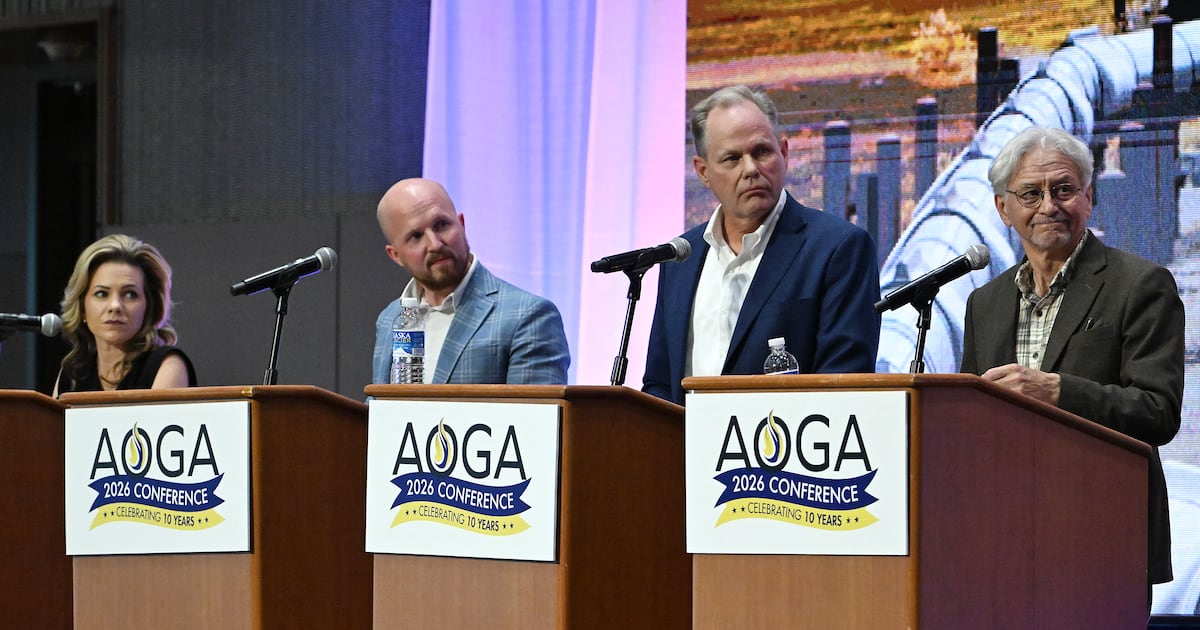
Gubernatorial candidates, from left, Bernadette Wilson, Jonathan Kreiss-Tomkins, Dave Bronson and Tom Begich shared their vision for the state during a forum at the Alaska Oil & Gas Association 10th Annual Conference at the Dena’ina Center in Anchorage on Wednesday, Aug. 26. (Bill Roth / ADN)
The top four vote-getters in Alaska’s crowded gubernatorial primary were on stage together for a forum hosted by the Alaska Oil and Gas Association on Wednesday, days before the state Division of Elections finalized the names that will appear on the November general election ballot.
Democrats Jonathan Kreiss-Tomkins and Tom Begich, and Republicans Bernadette Wilson and Dave Bronson, spoke to an audience of industry executives and politicos at the Dena’ina Civic and Convention Center in Anchorage as part of the annual AOGA conference, offering a preview of the issues that will shape the race leading up to the general election.
Election officials indicated Wednesday that thousands of ballots remain uncounted, with five days until the state’s target deadline for certifying primary results.
Under Alaska’s election rules, the top four vote-getters in the open primary advance to the general election. However, candidates have until Aug. 31 — the same day results are set to be certified — to drop out of contention, a move that could elevate the fifth-place finisher on to the November ballot.
Both top-finishing Republicans have committed to staying in the race while the Democrats have indicated they are still weighing whether one of them should drop out to give the other a stronger shot at victory.
It’s been nearly three decades since Alaskans last sent a Democrat to the governor’s mansion.
With 156,535 ballots counted as of Wednesday, Kreiss-Tomkins, a former state House member from Sitka, remained in the lead with 22.2% of the vote. Begich, a former state Senate member from Anchorage, has 20.5%. Wilson, a talk radio host and businesswoman, has 10.2%. Bronson, a former Anchorage mayor, has 8.2%.
Treg Taylor, a Republican former Alaska attorney general, is in fifth place with 7.4% of the vote. Click Bishop, a Republican former labor commissioner, is in sixth place with 7% of the vote.
With current Republican Gov. Mike Dunleavy termed out from seeking reelection, 17 candidates appeared on the Aug. 18 primary ballot, including 12 Republicans, two Democrats and three independents. While the Republicans collectively garnered nearly half of all votes counted as of Wednesday, none of them had dominant support.
Still, some political leaders and observers on both the left and right have called for the candidates who finished behind members of their own party to drop out of the race.
“There’s some similarities between Dave and Bernadette. There’s some similarities between myself and Jonathan,” Begich said after the forum. “Will it lead the two Democrats to consolidate? It might. But by the same token, having four voices there talking about these issues may be an even better decision. I don’t know what the answer to that question is yet.”
Both Wilson and Bronson have indicated they would not drop out, ensuring at least two Republicans will appear on the November ballot.
Wilson for months has urged Republican candidates to drop out if they finish behind her, but Bronson said in a video posted on social media Wednesday that he chose to remain in the race because Wilson — though she was the top GOP vote-getter — did not have a mandate from Republicans.
“Because of the historically large Republican field, 80% of the Republican votes were cast for someone other than the leading Republican candidate. No single candidate received a mandate based on the election results alone,” said Josh Church, a Fairbanks financial adviser who is Bronson’s running mate.
Bronson said he and Church “love this state too much to walk away.”
“We hear the calls for unity, and we are answering them. We are staying in this race because we believe Alaskans deserve a choice,” Bronson said.
Bronson, whose one term as Anchorage mayor was mired by controversy and dysfunction, has said his experience in executive office sets him apart from Wilson, who has worked for conservative political organizations and campaigns but never held elected office. Wilson, for her part, has dubbed herself an “outsider.”
While they come from different backgrounds, Bronson and Wilson have similar policy priorities. Both said they oppose additional taxes on oil and gas companies operating in Alaska. They also said they would oppose any broad-based revenue sources, such as sales or income taxes. They suggested that regulatory reform and new resource development projects could eliminate the state’s longstanding structural deficit.
Gubernatorial candidates, from left, Bernadette Wilson, Jonathan Kreiss-Tomkins, Dave Bronson and Tom Begich shared their vision for the state during a forum at the Alaska Oil & Gas Association 10th Annual Conference at the Dena’ina Center in Anchorage on Wednesday, Aug. 26. (Bill Roth / ADN)
The Democrats said that new revenue measures would be needed to balance the state’s budget and fund public services.
Kreiss-Tomkins said he would support updating the state’s corporate income tax to raise an additional $150 million annually from oil and gas companies, while also applying new taxes on individual Alaskans.
“I think a broad-based tax and revenues of that nature are likely going to be necessary to balance our budget,” Kreiss-Tomkins said.
Begich said he would look to raise taxes on Alaska’s oil and gas producers before turning to individual Alaskans’ pocketbooks. According to Begich, $400 million annually could be raised through a combination of updating the state’s corporate income taxes and eliminating tax credits on long-producing oil fields. Only then would he consider whether a tax on Alaskans was needed, he said, adding that he opposes a statewide sales tax.
His position was greeted with a chilly response from the audience of oil executives at the AOGA conference. Begich told them they may not like his tax policy “at first, but you’ll like it in the end” because it would provide greater stability and ensure “a pipeline of jobs” to the oil and gas industry.
Revenue measures are likely to shape the next governor’s term in office. Dunleavy for most of his two terms in office has proposed deficit spending, while opposing new revenue measures advanced by lawmakers. Dunleavy’s parting proposal was to close the budget gap with a statewide sales tax. That idea was rejected by both Democrats and Republicans in the Legislature.
The Democrats onstage Wednesday promised to work cooperatively with the Legislature and the industry. Wilson and Bronson, meanwhile, struck combative tones, portraying Democrats as dangerous to the state.
“I don’t believe compromise is a dirty word,” Kreiss-Tomkins said, while Begich said he sought to “have an administration that supports all Alaskans, regardless of their political affiliation.”
Bronson described the election as a choice between socialism and capitalism. Wilson said “the greatest policy threat is — God forbid — this state elect a Democrat to this governor’s office. That is the greatest threat facing this state.”