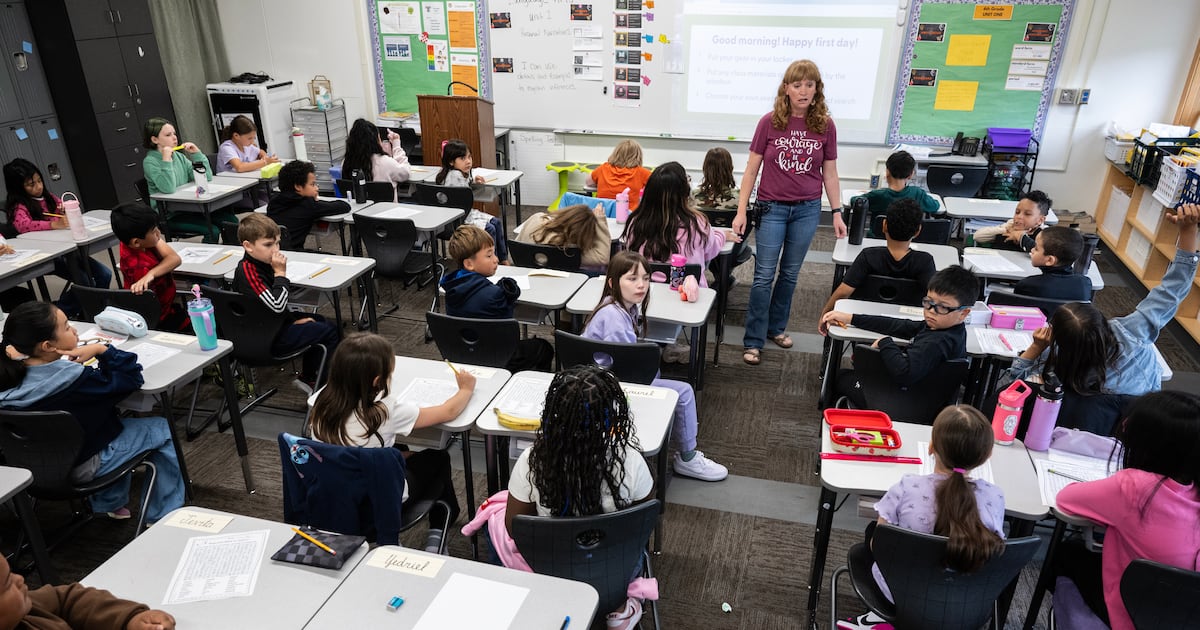
Fourth grade teacher Amanda Kyle talks with her class on the first day of school at Turnagain Elementary School on Aug. 14, 2025. (Marc Lester / ADN archive)
State officials are touting improved reading scores from Alaska students. Overall, 60% of kindergarten through third grade students reached or exceeded the literacy screening benchmark for their age group, the state education department said in a prepared statement last month.
After the implementation of the Alaska Reads Act three years ago, scores are gradually increasing.
State Education Commissioner Deena Bishop said Alaskans can continue to expect higher test scores from students in future years.
“While we take time now to celebrate the progress in early literacy, we know long-term success requires consistency and sustained effort,” Bishop said in the Alaska Department of Education and Early Development statement. “Improving student achievement is a marathon, not a sprint or an education fad.”
Students in kindergarten through third grade are required to take the Amplify mCLASS DIBELS literacy screener three times a year. Among students tested last school year, 13% who scored well below benchmark at the beginning of the year had reached the target by the end of the year. Another 9% of students who were at or below the benchmark scored above it by the end of the year.
Dr. Deena Bishop, Alaska commissioner of education, was a speaker during the Commonwealth North Education Forum at the Anchorage Museum on April 23, 2025. (Bill Roth / ADN archive)
Bishop and Gov. Mike Dunleavy said the increasing scores are a sign that the Alaska Reads Act is serving its purpose to help every third grade student achieve reading proficiency.
“The Alaska Reads Act is the starting point for which to base future standards, and to ensure Alaskan students have the tools and knowledge they need to succeed in today’s world,” Dunleavy said in the statement. “I am proud of the work we have begun, and am looking forward to seeing continued growth in achievement. Policies, and execution of those policies, make all the difference.”
Laura Capelle, president of NEA-Alaska, the statewide branch of the national teachers union, was pleased to see improved reading scores, but hopes to see additional support for students in other subject areas as well.
“Looking at this as just a function of legislative policy, I think is short-sighted,” Capelle said. “We can look forward to this continued progress if we make it so we are not losing more educators that we’re bringing in, and that the educators who stay, stay long term.”
Capelle said stable funding for schools and competitive pay for teachers would improve outcomes.
While statewide performance data on the literacy screener is not available, the education department said Alaska students are “demonstrating average or better growth on DIBELS 8 throughout the 2025-2026 school year.”
Results from third through ninth grade students on Alaska’s statewide standardized test — STAR, the Alaska System of Academic Readiness — show minor growth in some subjects and grade levels.
Nearly 40% of fifth grade students demonstrated proficiency in both math and reading, the highest mark for any single grade level. But taken as a whole, STAR results show little year-over-year growth on any subject. Among all Alaska students who were tested last year, proficiency in math, science and English language arts changed by less than a single percent.
Capelle said “stagnant” STAR results are to be expected without predictable funding for Alaska schools.
Statewide, more than twice as many students failed to reach proficiency in reading than those who read at advanced levels.
The Alaska Department of Education and Early Development introduced STAR in 2022, and it’s administered to students in the spring. Before STAR, third through ninth grade students take MAP tests — which stands for Measures of Academic Progress — in the fall and winter. A brief prepared by department staff to accompany the STAR results said younger students are showing greater improvement.
“The results show upward momentum in student achievement, particularly in grades 3–5,” the brief said. “Achievement in the higher grades remained relatively flat, underscoring the need for continued focus on preparing students for their next steps.”
Alaska’s public school students take a variety of statewide and national standardized tests each year. Results from last year’s National Assessment of Academic Progress, which is given to students in fourth, eighth and 12th grade, have not been published yet.
Chemistry teacher Logan Pitney talks to a classroom full of students on the second day of school at South Anchorage High School on Thursday, Aug. 20, 2026. (Bill Roth / ADN)
None of Alaska’s standardized tests are mandated. Alaska statute allows students to opt out of standardized tests for any reason. According to data published by the education department last year, about 80% of public school students take standardized tests, while closer to 15% of correspondence students tested on math and English language arts.
“The assessment results and gains in students’ early literacy reflect the implementation of the Alaska Reads Act (2022), which focused state policy and practice on the Science of Reading, professional development for educators, high-quality instructional materials, accountability for student learning, and communication with parents and families,” the statement from the education department said.
The Alaska Reads Act requires teachers to give additional screenings, intervene with struggling readers and communicate with parents of those students. It also mandates district reading improvement plans, department-level support for the lowest-performing quarter of schools, early education programs and a virtual learning resource for educators. When it passed, it mandated additional supports without the funding intended to pay teachers for that extra work. Educators and lawmakers alike have been critical of the program’s rollout.
Capelle worried that student performance could drop this year in larger classrooms. Last year, several districts cut staff and closed schools to balance their budgets, increasing class sizes for older students in those areas.
“No doubt, it’s an unfunded mandate,” Capelle said of the Reads Act. “Where we have more children in classrooms this year than last year, we can expect that it’s going to be more difficult for those students to get the support they need.”