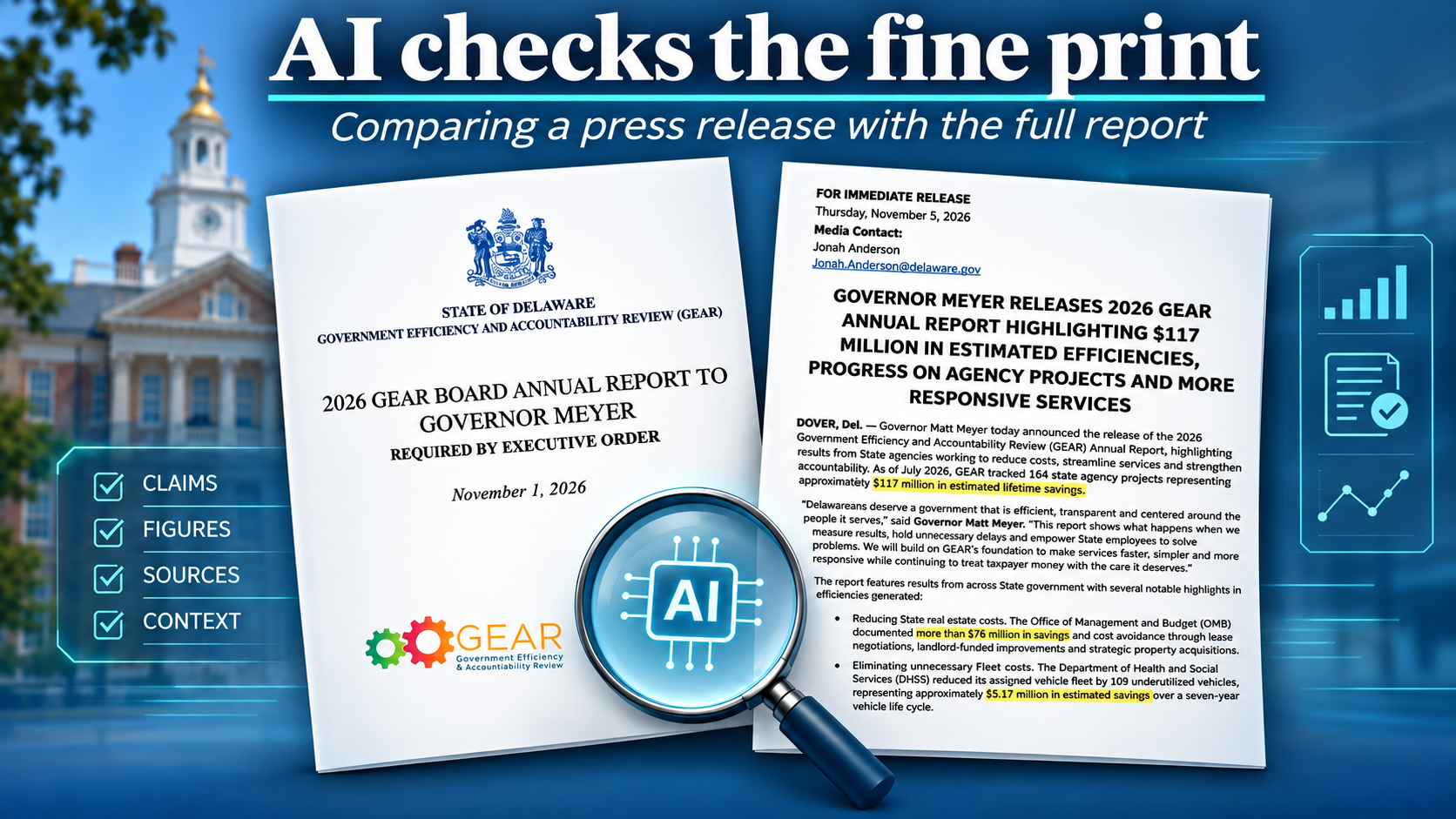
Delaware’s latest government efficiency report shows how artificial intelligence can help voters look beyond official press releases, examine the facts and make better-informed decisions about government performance.
DOVER, Del. — For generations, voters have relied on government officials, news organizations and political campaigns to explain how government is performing and how their tax dollars are being spent.
But those explanations often come through press releases designed to highlight accomplishments, defend policies or promote the priorities of elected officials.
The full story may be buried in lengthy government reports, budgets and financial documents that few citizens have the time or expertise to examine.
Artificial intelligence is beginning to change that relationship between voters and government.
Today, an ordinary Delaware voter can upload a government press release and the full report behind it into an AI tool and ask a simple question: “Does this press release accurately represent what the report says?”
What once might have required hours of research can now begin in minutes, giving voters a new opportunity to evaluate government claims for themselves.
Delaware LIVE recently tested that capability using Gov. Matt Meyer’s Nov. 5 announcement of the state’s 2026 Government Efficiency and Accountability Review (GEAR) annual report.
The results demonstrate how AI could become a valuable tool for government accountability — particularly for voters who want to judge elected officials by results rather than political messaging.
The $117 million question
The governor’s two-page press release highlighted approximately $117 million in estimated lifetime savings from 164 government improvement projects.
It pointed to reductions in state real estate expenses, the elimination of underused government vehicles, faster permitting and improved public services.
Those accomplishments are supported by the underlying 79-page GEAR report.
But when the press release and full report were compared using AI, an important qualification emerged.
The full report explains that the $117 million represents planning estimates rather than savings actually recorded in state budgets.
That’s a distinction taxpayers should understand.
Reducing the time employees spend processing government paperwork may make an agency more efficient. Eliminating unnecessary vehicles or negotiating lower rents can directly reduce spending.
But making an existing employee more productive does not automatically mean government costs taxpayers less.
The press release correctly described the savings as estimated, so the claim itself was not false. However, the full report provided information that could change how voters interpreted the number.
AI made that difference easier to discover.
What voters might not have learned from the announcement
The AI comparison also identified significant financial issues discussed in the full report but omitted from the governor’s announcement.
Among them:
- A technology modernization initiative expected to cost more than $150 million. Delaware has already appropriated $130.5 million toward replacing aging state financial, payroll, pension and human resources systems. The report says total costs may exceed $150 million.
- Rapidly rising state employee health benefit expenses. Gross spending on GLP-1 weight-loss medications is projected to increase from $84.1 million in fiscal 2026 to $127.5 million in fiscal 2027.
- Additional costs associated with handgun permitting. The report estimates that implementing Delaware’s permit-to-purchase law would require 29 additional civilian employees and 10 sworn personnel positions.
- The possibility of another permanent government office. GEAR proposes transitioning toward a multidisciplinary service-improvement operation, with decisions about permanent staffing and funding potentially coming in fiscal 2028.
None of these omissions establishes that the administration was deliberately misleading voters.
Government press releases are intended to summarize selected accomplishments, not reproduce every finding in a comprehensive report.
However, the comparison illustrates something important: What government chooses to tell voters may be accurate without being the complete picture.
And voters now have a practical way to investigate that difference.
Voters no longer have to accept the summary
For years, one of the challenges of government transparency has been that information can technically be public while remaining difficult for ordinary citizens to understand.
A school district may publish a 200-page budget. A county government may release a complicated financial review. State agencies may post reports filled with statistics, technical language and explanations of programs unfamiliar to most taxpayers.
Making those documents public is important. But availability alone does not guarantee understanding.
AI tools can help close that gap.
A voter can ask an AI system to explain a government budget in plain English, identify spending increases, compare current and previous reports or distinguish actual savings from projected financial benefits.
The same tools can help residents examine campaign statements, legislative proposals and the financial implications of public policies.
For example, a Delaware voter might ask:
- Did this agency actually reduce spending, or did it simply spend less than originally projected?
- Does the governor’s announcement describe accomplishments from the current administration or include work completed under previous governors?
- What important financial risks appear in the full report but not in the public announcement?
- Has a new government program achieved the goals that were promised when it was created?
- How much will a proposed law cost taxpayers to implement?
These questions are not inherently Republican or Democratic.
They are the questions citizens should be able to ask of any government, regardless of which political party is in power.
A new advantage for the independent voter
The opportunity may be especially valuable for voters who do not automatically accept the interpretation offered by either political party.
Campaigns and elected officials naturally emphasize their accomplishments and criticize their opponents. Political organizations select facts that support their arguments.
Voters are left to determine which claims are accurate, which are exaggerated and which leave out important information.
AI cannot eliminate political bias, and AI systems can introduce inaccuracies or biases of their own. But when used to examine original documents, they can help voters move beyond competing political messages and focus on evidence.
Consider Delaware’s GEAR report.
A voter skeptical of government spending can use the document to question whether projected efficiencies have actually reduced the cost of state government.
A voter supportive of the administration can point to legitimate improvements in permitting, property management and public services.
Both conclusions can be informed by the same report.
The important development is that voters no longer have to depend exclusively on someone else’s interpretation to begin examining the evidence.
The technology still requires a skeptical eye
AI is not an infallible fact-checker. It can misunderstand financial information, overlook important context, misinterpret tables or reach incorrect conclusions.
A responsible voter should ask the system to identify the specific page or passage supporting an answer, then check that information against the original document.
When AI identifies a difference between a press release and the underlying report, that finding should prompt further questions rather than an immediate accusation of dishonesty.
The GEAR comparison is an example.
It revealed legitimate accomplishments, important financial qualifications and significant information that the press release did not discuss.
It did not establish that the governor or his administration falsified the report.
That’s an important distinction in a political environment where accusations can spread much faster than corrections.
The goal should be better-informed voters, not faster accusations.
Government accountability between elections
Voters generally have an opportunity to hold elected officials accountable at the ballot box every two or four years.
But the decisions that determine government performance happen throughout those years — when budgets are adopted, contracts are awarded, programs are expanded and regulations are implemented.
AI creates new possibilities for citizens to follow those decisions without needing advanced training in public finance or government administration.
A parent could examine whether increased school spending produced better educational outcomes.
A homeowner could compare county reassessment claims with underlying property and tax data.
A business owner could evaluate whether promised permitting reforms actually shortened approval times.
A taxpayer could review whether government efficiency initiatives eliminated expenses or simply moved employees and resources to different activities.
And as voters become more comfortable examining original documents, public officials may face greater pressure to provide clear, measurable and defensible explanations for their decisions.
That could strengthen accountability even when no election is approaching.
A more informed Delaware electorate
Delaware’s small size makes this opportunity particularly relevant.
State government, county councils, school boards and local municipalities make decisions that directly affect taxes, education, economic development, public safety and the cost of living.
Many of those decisions are documented in reports that are publicly accessible but seldom closely examined outside government.
AI will not replace informed judgment, public debate or independent journalism.
But it can put powerful research capabilities directly into the hands of voters who previously lacked the time, resources or expertise to examine government claims on their own.
The recent GEAR announcement demonstrates both the opportunity and the responsibility that comes with those capabilities.
The administration highlighted approximately $117 million in estimated efficiencies. The full report supported the figure but added important qualifications about what those savings represent.
Neither document needed to be dismissed. Instead, the comparison provided a more complete understanding of both.
For voters, that may be the most important lesson.
Government transparency is no longer simply about whether officials make information available. It is increasingly about whether citizens can use that information to independently evaluate what their government tells them.
And with AI, Delaware voters have a new way to do exactly that.
Editor’s note: Delaware LIVE used artificial intelligence to compare the Meyer administration’s Nov. 5, 2026, press release with the full 2026 GEAR annual report. The comparison examined financial claims, qualifications and significant information not included in the announcement. It was a document-based analysis, not an independent financial audit. AI-generated findings require verification against original sources.
Delaware LIVE collaborates with a network of professional journalists to cover a diverse range of stories across various fields. Staff Writers include experienced journalists and young professionals. If you have questions, please feel free to contact [email protected] or our publisher, George D. Rotsch, at [email protected]