For Brian Kresge, the president of Maine’s oldest active synagogue, a tense and at times head-spinning year of politics hit a new low during Shenna Bellows’ 10-day U.S. Senate bid.
As a candidate for governor, the Democratic secretary of state assured Jewish Mainers she did not think Israel’s assault on Gaza amounted to a genocide of Palestinians, Kresge said. Where Graham Platner scandalized the Jewish world with a tattoo akin to a Nazi symbol, she once led the Holocaust and Human Rights Center in Augusta. But when asked on television this month if she believed Israel was perpetrating a genocide, Bellows nodded and said, “Yes.”
“I just feel like she lied to us,” said Kresge, 50, recalling the opposite position she voiced during a May event at his Congregation Beth Israel in Bangor. “I’m not alone in feeling like that was the biggest betrayal of this election cycle,” he added.
A Bellows spokesperson said, without providing evidence, that her genocide assessment was not new. But the reversal, also observed by a prominent rabbi, was enough to undercut Bellows’ deep ties with Maine’s small Jewish population — and underscore a political reality that outlasts Platner and her.
In recent years, amid intense conflict in the Middle East, Jews across the United States have seen surging antisemitism. Some, historically committed to both the Democratic Party and the Jewish state, have found themselves newly distant from one or the other while grappling with Israel’s nosediving standing among Americans and progressive politicians.
For months in Maine, where Jews are fewer and on average more liberal, that dilemma centered on Platner, a candidate who engendered intense feelings pulling in each direction: hope for a Democratic Senate majority to counter President Donald Trump, and apprehension about alleged brushes with antisemitic extremes of the left and the right.
This story draws on interviews with 22 Jewish Mainers who are a part of various communities around the state, including conversations with 11 since Platner’s exit. Now that he is out of the race, Jewish residents across the political spectrum described feelings of relief, mixed with lasting misgivings about the Maine movement that long embraced him.
State Rep. Laurie Osher, at her home in Orono, met with Platner and eventually supported him before he dropped out. (Rich Abrahamson/Staff Photographer)
“We’ve realized that so many people who we didn’t think were antisemitic had no problem with the antisemitic rhetoric and the dog whistles to antisemites in the Democratic Party,” Laurie Osher, a progressive Democratic state representative from Orono, said.
Platner routinely called for halting U.S. military aid to Israel and accused its government of genocide, an assessment several human rights groups have made in evaluating the Israeli military’s killing of tens of thousands of Palestinians in the Gaza Strip; Israel vehemently rejects the charge, saying it has targeted Hamas in self-defense.
In the last two weeks, Jewish Mainers with a range of opinions about Israel watched every major contender to replace him echo those positions on the Jewish state. Troy Jackson, all but certainly the next nominee, hastened to make his stances clear in a social media post hours before Platner announced he would drop out.
Sen. Susan Collins, a Republican whom he is now seeking to unseat, last month reaffirmed her steadfast support for Israel and referred to “rising antisemitism in our country that Graham Platner certainly is part of.”
For his part, Platner condemned antisemitism and maintained he had not known about the Nazi likeness of his chest tattoo until his Senate run. He frequently brought up his Jewish friends and relatives during his uneven efforts to win Jewish voters’ trust.
But in his campaign’s wake, many said their faith in more than him was shaken, if not broken.
Graham Platner at a press conference announcing the Maine AFL-CIO’s endorsement of him in Portland on May 1. (Brianna Soukup/Staff Photographer)
‘HE BLEW US OFF’
On a Tuesday afternoon in September — before Platner revealed, covered and politically survived an inked skull and crossbones that resembled the insignia of the forces who carried out the Holocaust — he found himself sitting around a kitchen table in Bangor with an adviser and a handful of liberal Jews.
They had invited him to address their anxieties about his campaign’s early focus on the American Israel Public Affairs Committee, a U.S. lobbying group usually in tune with Israel’s right-wing government. Three Jewish attendees, including Osher, later said they disagreed with the organization, which has directed hundreds of thousands of dollars in donations to Collins, but saw his repeated attacks on it as mirroring an antisemitic trope about the power of moneyed Jews.
“I felt like he blew us off, basically,” Osher said, chalking his attitude up to cultural differences.
Osher said she eventually saw him single out AIPAC less. A former Platner staffer said he took the concerns seriously and noted that he widely criticized the roles of money and special interests in politics, beyond AIPAC. But Platner raised eyebrows again with a June social media post saying Collins was “bought and paid for by Benjamin Netanyahu,” Israel’s prime minister.
Bangor was home to Maine’s first synagogue, founded by German immigrants in 1849. Today, the state has 15 synagogues and roughly 19,000 Jewish residents, most of whom belong to none of them, a 2024 study found. They disagree about Israel in complicated ways: 57% of adult Jewish Mainers felt some emotional attachment to Israel, while 44% at least somewhat disagreed with the statement that they were Zionists.
Anya Davidson, a 42-year-old school nurse in rural Kennebec County, grew up in Brunswick and later lived in Israel for nine years, becoming a dual citizen. A Democrat, she said Israel only began to factor much in her U.S. political decisions after the Hamas-led Oct. 7, 2023, attack on the country.
Anya Davidson, a school nurse who lives in Readfield, lived in Israel for nine years. (Joe Phelan/Staff Photographer)
“It’s really a hard place to be right now, I think, as someone who supports Israel and liberal values,” Davidson said, adding that she is not aligned with Netanyahu but cannot abide questioning of Israel’s existence as a Jewish state. “It’s a really hard place to be and feels very lonely.”
Since Israel’s devastation of Gaza using American-made arms, critics of the longtime ally have made alleged U.S. complicity with its human rights abuses central to progressive politics. Anti-Israel activists protested the last Democratic president, took over elite college campuses — and confronted accusations of veering into antisemitism.
What most prominently set Platner apart was the tattoo, which he said he got while drunk with fellow Marines. “I am not a secret Nazi,” Platner said in October, before having the tattoo covered. He said it had caused no concern among Jewish in-laws or in military screenings.
Other accounts and evidence contradicted his claim not to have known about the resemblance to the Nazi Totenkopf symbol. Most Jewish voters interviewed for this article said they had doubts about Platner’s defense. To them, the tattoo was among the most personally resonant — but not the deepest or most impactful —entry in the string of troubling revelations about him.
Jewish friends in Israel contacted Osher with sympathy: “Isn’t Platner terrible?”
“And my response is always: ‘Susan Collins is not good for the Jews,’ to use the vocabulary of my dad,” she said last month. “As Jews, in the bigger picture, we believe that there should be a just society.”
‘YOU’RE NOT DONE’
As Kresge saw Platner pulling ahead from Gov. Janet Mills in the Democratic Senate primary, he floated having the fellow veteran, whom he had assailed in a Bangor Daily News op-ed, on his podcast about Jewish Maine.
Platner would probably be the Democratic nominee, Kresge realized. “That prompted me to say, ‘Well, gosh, maybe we need to build a bridge here.’”
The campaign was interested in a podcast appearance, the former staffer confirmed to the Press Herald.
Platner seemed eager to court Jewish voters all spring. But his charm offensive with the group, a small and subtle portion of a busy barnstorming calendar, could only go so far.
In a cordial phone call to meet and preview questions, Kresge said, Platner “constantly gaslit” him by modulating his usually fiery tone on Israel. (“Graham was utterly consistent with his public position,” the former staffer wrote in a statement.)
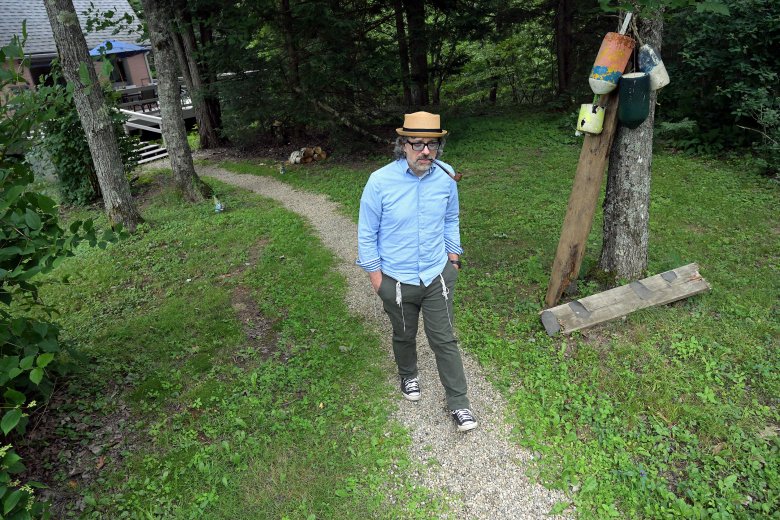
Brian Kresge reached out to speak with Platner after seeing him pull ahead from Gov. Janet Mills in the Democratic primary. (Rich Abrahamson/Staff Photographer)
Kresge, a left-leaning independent voter and rabbi in training who in 2018 ran unsuccessfully for the state Legislature as a Republican, decided against having Platner on his podcast, which he feared could be construed as lending his support. He also declined what he deemed a kind invitation: to attend a seder Platner was organizing for the second night of Passover.
But others took him up on it. In early April, dozens of people gathered in an American Legion hall in Bath for the ritual Jewish meal led by Steven Koltai, who heads Maine’s nascent chapter of J Street, the liberal Zionist advocacy group founded as a counterbalance to AIPAC.
A video released by Platner’s campaign, complete with uplifting Hebrew music, showed Platner wearing a white yarmulke and connecting the freedom of the Israelites’ exodus from Egypt to a campaign-style call to action.
Where some observers saw tokenization, attendees were heartened. Linda Werner, 74, a retiree in Portland, approached Platner afterwards.
“This was a wonderful night, it was a great start, but you’re not done with the Jewish community. You need to do more,” Werner recalled telling him. “And he agreed.”
A swath of Maine’s Jewish population remained staunchly opposed to Platner, no matter his outreach efforts.
At Etz Chaim Synagogue at the base of Munjoy Hill, Rabbi Gary Berenson said he would not speak with Platner. Instead, he ruffled feathers among some progressive board members by inviting Collins to give a rare political talk. She came on Thursday. Collins mingled with attendees, stressed her support for Israel and fielded questions on such topics as immigration enforcement, Berenson said.
Rabbi Gary Berenson of Etz Chaim Synagogue throws bread into Portland Harbor in 2024 as part of a Rosh Hashanah ritual. (Shawn Patrick Ouellette/Staff Photographer)
A jocular 74-year-old who grew up ensconced in Portland’s Jewish community, he said he had consistently voted for Trump and Collins, since the Democratic Party had, in his eyes, abandoned Israel. That was his biggest gripe with Platner and his ideological ilk.
For all the talk of Israel by Platner and his Jewish critics, and for all his conversations with Jewish voters, he would not say as a candidate how far his views went.
Speculation about his ultimate aims split between skeptics who assumed he opposed Israel’s status as a Jewish state and supporters who thought he might share their traditional Democratic aspiration for a two-state solution, with Israel alongside a future Palestinian state.
In late June, Laurie Osher met with representatives from the national J Street organization. She pressed the group to endorse him, placing hope in its process, which interrogates whether candidates favor two states, to suss out where exactly he stood.
The group never backed Platner. A J Street spokesperson wrote that it makes endorsements “on a rolling basis,” and its timing does not signal a judgment.
‘I LEARNED IT FROM HIM’
And then, after all the drawn-out anguish and arguments and attempted reconciliation, Platner was out after the report of a detailed, on-the-record rape allegation he denies. In his withdrawal letter to election officials, dated July 10, he mentioned “taxpayer-funded genocide” and signed off with three parting messages, among them: “Free Palestine.”
The Maine Sunday Telegram two days later featured an advertisement from the Anti-Defamation League, picturing a Totenkopf alongside the message “THE TATTOO SHOULD HAVE BEEN ENOUGH.”
Shawn Roderick, a spokesperson for Collins, said in a statement that Platner’s replacement “will have to explain why his totenkopf tattoo, a symbol previously worn by concentration camp guards, was not disqualifying.”
That Platner retained widespread liberal support until the final blow — he got a record number of votes in the Maine Senate primary on June 9 — has prompted renewed soul-searching among liberal Jews in the state.
Benny Stiebel of Portland, a member of the activist group Jewish Action Maine, was concerned about Platner’s skull-and-crossbones tattoo. (Daryn Slover/Staff Photographer)
To Benny Stiebel, 45, a member of the left-wing activist group Jewish Action Maine and an insurance adjuster in Portland who shares Platner’s posture toward Israel, Platner was a stain on the anti-Zionist movement.
“Antisemitism only helps Israel,” Stiebel said. “The fact that they’re going to be able to point to this very problematic person who, not just the tattoo, but had all of these other horrible things about him evidently, and say, ‘This is what anti-Zionism looks like,’ is a problem.”
Anya Davidson was dismayed to find that Platner’s rhetoric about Israel was no fluke for Maine Democrats. She said last week that she remained likely to vote for Collins in November, despite preferring a Democratic Senate majority to challenge Trump.
“Other people who are trying to now get his seat weren’t necessarily focused on it but are using that now because they see that it worked with voters,” Davidson said, referring to Platner’s statements about military aid, genocide and AIPAC.
Israel’s centrality to burnishing one’s credentials on the American left was on full display Thursday night in the televised debate among the Democrats then vying to replace Platner — before Jackson consolidated support at the weekend’s county Democratic meetings.
In the hour featuring the four most prominent candidates, the News Center Maine moderators did not ask about Israel or Gaza. Each candidate besides Jackson, the former Maine Senate president and Platner’s heir apparent, nonetheless found a chance to raise the issue on what would turn out to be among their campaigns’ final days. (Jackson’s campaign did not respond to requests to specify his position on Israel.)
Jordan Wood, who lost the Democratic congressional primary in Maine’s 2nd District last month, brought up Israel first in response to a question about what he took from Platner. “I was very hesitant to use the word genocide,” he said. “I learned it from him.” (Wood also mentioned his support for a two-state solution.)
Nirav Shah, the former director of Maine’s Center for Disease Control and Prevention, took his turn while answering a question about finding federal spending cuts. He raised a legislative amendment that about half of U.S. House Democrats backed last week to stop U.S. aid for Israel.
From left, then-U.S. Senate hopefuls Shenna Bellows, Troy Jackson, Nirav Shah and Jordan Wood prepare for their televised debate at the News Center Maine studio in Portland on Thursday. (Robert F. Bukaty/Associated Press)
In between them, Bellows — whose spokesperson said she, too, wants a two-state solution — found her own moment, and her own approach. She said the movement Platner led was “about seeing the harm of Oct. 7 and seeing the harm that what Netanyahu is doing in Gaza is genocide.”
Looking intently at the camera, she added: “We can hold both of those ideas, and we can speak the truth, not try to figure out which talking points will win.”
Brian Kresge said he watched the debate and thought it was too late for Bellows to recover some relationships with his synagogue. He had trusted her. He had tried with Platner. He doesn’t expect to hear from Jackson, and doesn’t want to talk with him anyway.