It was a sign of the times — an ugly one.
“A few weeks ago, a man was standing on a street corner in Las Vegas, holding a sign with the words: ‘Hitler was right,’” recalled Jolie Brislin, regional director of the Anti-Defamation League, referencing an incident that took place Oct. 16 on the corner of Lake Mead Boulevard and Hills Center Drive in Summerlin, near several Jewish temples.
“ADL started getting calls and messages from people who were upset and angry — and frankly, scared,” she continued. “They were asking ADL, ‘How did we get here?’ ‘How is this happening in our own community?’ ‘What are we going to do about it?’
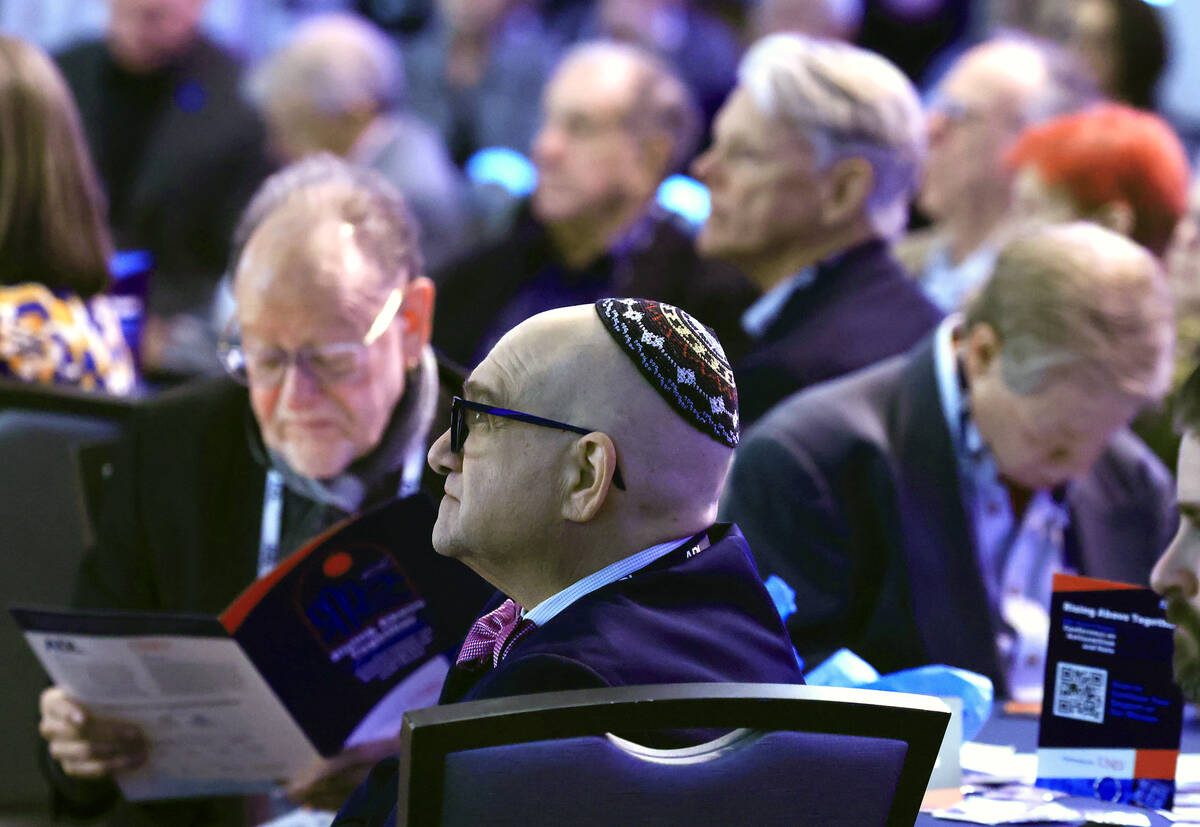
“Look around this room,” Brislin said, scanning a capacity crowd of 400. “This is what we are doing about it.”
Brislin’s words opened Friday’s Rising Above Together: Conference on Antisemitism and Hate, where national leaders, educators, community advocates and experts met to address these concerns during a full day of dialogue, panels and breakout sessions on the second floor of UNLV’s Student Union.
“The Jewish community cannot fight antisemitism by only talking to other Jews about antisemitism,” Brislin explained, highlighting the conference’s purpose. “We need people from across the community to understand what’s happening, recognize it when they see it and feel empowered to speak up against it.”
UNLV President Chris Heavey put it more simply: “We know that this is the right time to be having this conversation.”
Promise and pain
A joint venture between the ADL and UNLV, the gathering explored the causes, reverberations and ways to combat the surge of antisemitic incidents in America following Hamas’ Oct. 7, 2023, terrorist attacks on Israel.
“We’ve hit high-water marks in five of the last six years — we are breaking the wrong kind of records,” ADL CEO Jonathan Greenblatt noted in his keynote address with Heavey. “In 2025, there were more than 6,200 such incidents — roughly 17 a day. Jews are the most-targeted religious minority in America. Despite the fact that we’re just 2 percent of the population, our community is affected by 15 percent of the overall hate crimes in America.”
Clark County Commission Chairman Michael Naft underscored the ramifications of this dramatic increase.
“Jewish Americans are facing intimidation, threats, harassment and acts of hate simply because of who they are and what they choose to believe,” he said. “That should concern every one of us — regardless of religion or political belief.”
With a background in clinical psychology, Heavey excavated the mental and sociological roots of antisemitism.
“I think there is a lot of anxiety out in the world,” he said. “That anxiety often gets translated into insecurity, and then that insecurity gets combined with ignorance, and it makes people very vulnerable to looking for scapegoats and targets for that.
“I think the most fundamental task of humanity is learning to live and work with people who are different from ourselves,” he continued. “But that is a challenging task, creating a sufficient degree of understanding and familiarity to not be frightened, especially when we get insecure. I also think the politics of extremism driven by social media are really a toxic mix that are leading to some of the regression that we’re seeing now as a culture. These kinds of events are really a chance to push back against that.”
Though college campuses across the country have been roiled by protests and divisiveness in the fallout of Israel’s war with Hamas, Greenblatt credited UNLV with maintaining a constructive discourse.
“UNLV is one of those places that has not been an environment so characterized by hostility,” he said in an interview with the Las Vegas Review-Journal after his address. “In fact, if you look at the 150 universities that we assess, that we measure every year, there’s something good going on here.
“There may still be room for improvement,” he continued, “but just having a conference like today’s shows me that — even if in those months and years after Oct. 7 there’s been a lot of pain — there’s also a lot of promise.”
Moving forward
When talk turned to how to best address antisemitism, Democratic Nevada Sen. Jacky Rosen spoke of crossing the aisle in 2019 and forming the first-ever bipartisan Senate task force on the subject with her Republican colleague James Lankford from Oklahoma.
“Since then, we’ve grown our task force from the two of us to include more than half of the senate and equal numbers of both parties,” she said. “We’ve made major strides in elevating the fight against antisemitism in the national and international conversation.”
For Kelechi Odunze, UNLV’s student body president, the answer is asking more questions.
“UNLV is one of the most diverse universities in the country — and that diversity is our greatest strength — but diversity alone doesn’t create belonging,” he said. “Belonging takes work. It takes all of us taking the time to come together, to speak truth to power on issues that may divide us, because division is actually our greatest opportunity to learn from one another.”
And that’s really what this day was all about.
“I really believe that there’s opportunities by bringing people together to help shape a collective sense of responsibility,” Greenblatt said. “We’re all looking out for one another, so even though these issues are not great — like, the level of antisemitism, some other manifestations of bigotry — the reality is that only by coming together, only by talking stuff through, do we move forward.”
Contact Jason Bracelin at jbracelin@reviewjournal.com or 702-383-0476. Follow @jasonbracelin76 on Instagram.