By 10 a.m. on the first Saturday in May, a fire was crackling behind the community hall on the Odanak First Nation reserve in Quebec.
The flames were hot and ready to cook the Canada goose lying across the lap of Yves Landry.
“I’m gonna pluck it and cook it over the fire, like, traditional way,” he said.
Elodie Reed
/
Vermont Public
Wôlinak First Nation citizen Yves Landry plucks a goose that he hunted with his son and some other folks earlier this spring.
Elodie Reed
/
Vermont Public
Yves Landry uses his grandfather’s leather needle to sew up the goose.
Yves is a 72-year-old Abenaki citizen of Wôlinak First Nation. That reserve is located about a 45-minute drive northeast of the Odanak reserve, along the St. Lawrence River.
And it’s the area where Yves, his son and other folks went geese hunting this spring.
“We got some 60 or something like that,” Yves said.
He has been hunting geese since he was young.
But he said the places he used to go with his dad and uncles — a couple lakes just outside of the Wôlinak reserve — are no longer accessible. The Quebec government put the lakes inside an ecological zone in the ’90s.
“They didn’t consult the Abenaki in Wôlinak,” Yves said. “Today, they could not do this.”
Elodie Reed
/
Vermont Public
The Wôlinak First Nation reserve, photographed here in May 2024, is about a 45-minute drive northeast along the St. Lawrence River from the Odanak First Nation reserve. Both Abenaki communities are headquartered in Quebec, but have ancestral homelands across the Northeast.
In Canada and the United States, colonial governments have dispossessed land from Indigenous peoples, forced cultural assimilation on those communities and dramatically changed the environment around them.
Today, the reserves for Odanak and Wôlinak First Nations add up to a combined 2.5 square miles.
But the First Nations say they haven’t ceded their territory, or Ndakina, in Quebec and New England. And through their joint Ndakina Office of W8banaki, they’re working to regain access to what they can. Including those two lakes where Yves Landry grew up hunting geese.
Elodie Reed
/
Vermont Public File
A map at the Musée des Abénakis on the Odanak First Nation reserve shows the ancestral lands of Northeast Native communities pre-colonization. Abenaki territory stretches down from present-day Quebec through Vermont as well as into New Hampshire, Maine and Massachusetts.
“We’re trying to be … steward of the place,” said Yves, who works for the Ndakina Office. “So we could go back and do our activities, but with in mind protecting what is supposed to be protected.”
Odanak and Wôlinak First Nations are also increasingly trying to teach Abenaki citizens how to hunt, fish and trap and gather plants on their territory. And — to prepare and eat those foods, through an annual community banquet.
From there, the younger generations might be able to carry their culture forward. Like 25-year-old Isaak Lachapelle-Gill and his 27-year-old cousin, Sigwanis Lachapelle.
They’re both citizens of Odanak First Nation and also work for the Ndakina Office. And for the banquet, they made a mainstay of many North American Indigenous nations: the bread bannock.
“The recipe is easy to steal,” Isaak joked. “It’s water and …”
Before he could finish revealing the secret, though, Sigwanis jumped in: “Hey hey hey!”
Elodie Reed
/
Vermont Public
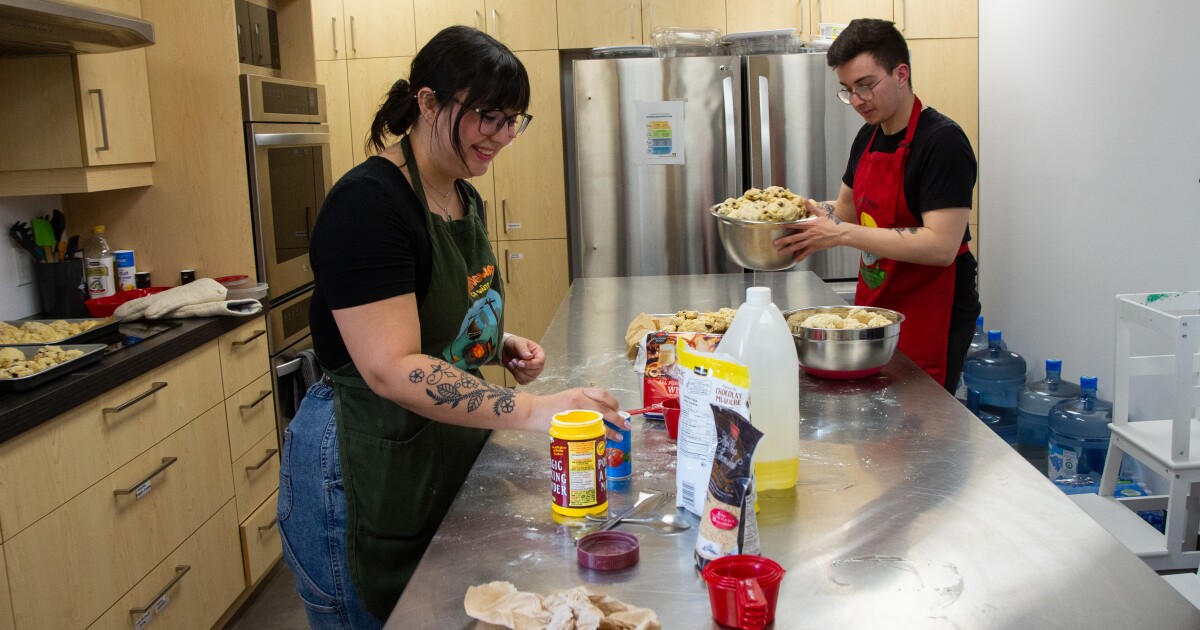
Sigwanis Lachapelle made some bannock with chocolate chips in them, the way her mom used to when she was young.
Elodie Reed
/
Vermont Public
Sigwanis Lachapelle pulls out the last batch of bannock before the Wlipogwat banquet.
Isaak was the main organizer of the banquet project, and he had a lot of help from Sigwanis.
“So the project’s name is Wlipogwat,” she said. “So Wlipogwat means ‘it tastes good’ or ‘it has good taste.'”
And Isaak explained that a lot of Abenaki citizens maybe haven’t necessarily tried meat from muskrats or beavers — or they haven’t tried it in a long time.
“So they want to taste it again,” he said. “Maybe they’ll get the interest to go trap it for themselves, or at least be involved more in some of the community gatherings that happen.”
Elodie Reed
/
Vermont Public
The Wlipogwat menu included things like blueberry soup, muskrat tacos and three sisters salad with ramps and fiddleheads.
Though Sigwanis and Isaak say they don’t want to put too much pressure on themselves or fellow Abenaki citizens.
“It builds a lot of stress saying, ‘I need to learn every single thing there is so that like the culture doesn’t die,'” Sigwanis said. “But it’s just one — like, you need to put one foot in front of the other.”
Elodie Reed
/
Vermont Public
Isaak Lachapelle-Gill tries out the result of boiling sumac fruit in water, and it turns out to be pretty good.
Elodie Reed
/
Vermont Public
The sumac fruit that would go on to flavor Isaak Lachapelle-Gill’s “Sumacade” for the banquet.
Isaak added: “The point of the project is trying — trying the recipes.”
Trying recipes such as: a lemonade made from sumac flowers.
Isaak put the crimson cones in a pot of boiling water. And when he dipped in a spoon several minutes later, he was pleasantly surprised by the taste.
“It’s actually kind of good,” he said. “Damn! I’m happy.”
Elodie Reed
/
Vermont Public
Sigwanis Lachapelle photographs her cousin Isaak Lachapelle-Gill as the pair near the end of preparations for the Wlipogwat banquet that Isaak organized for the Abenaki communities at Odanak and Wôlinak First Nations.