by Brenna Witchey and Jake Ramsey, Oklahoma Watch
October 28, 2026
In November 2023, Bob Holbrook was in his home office when his wife called him across the house to a window overlooking 10th Street in Wewoka.
Outside, four police cars surrounded a home, their doors open like shields as officers raised their guns.
Holbrook said he thought such scenes happened only in movies.
The standoff was one of many altercations between local law enforcement and gang members in the area during the fall of 2023.
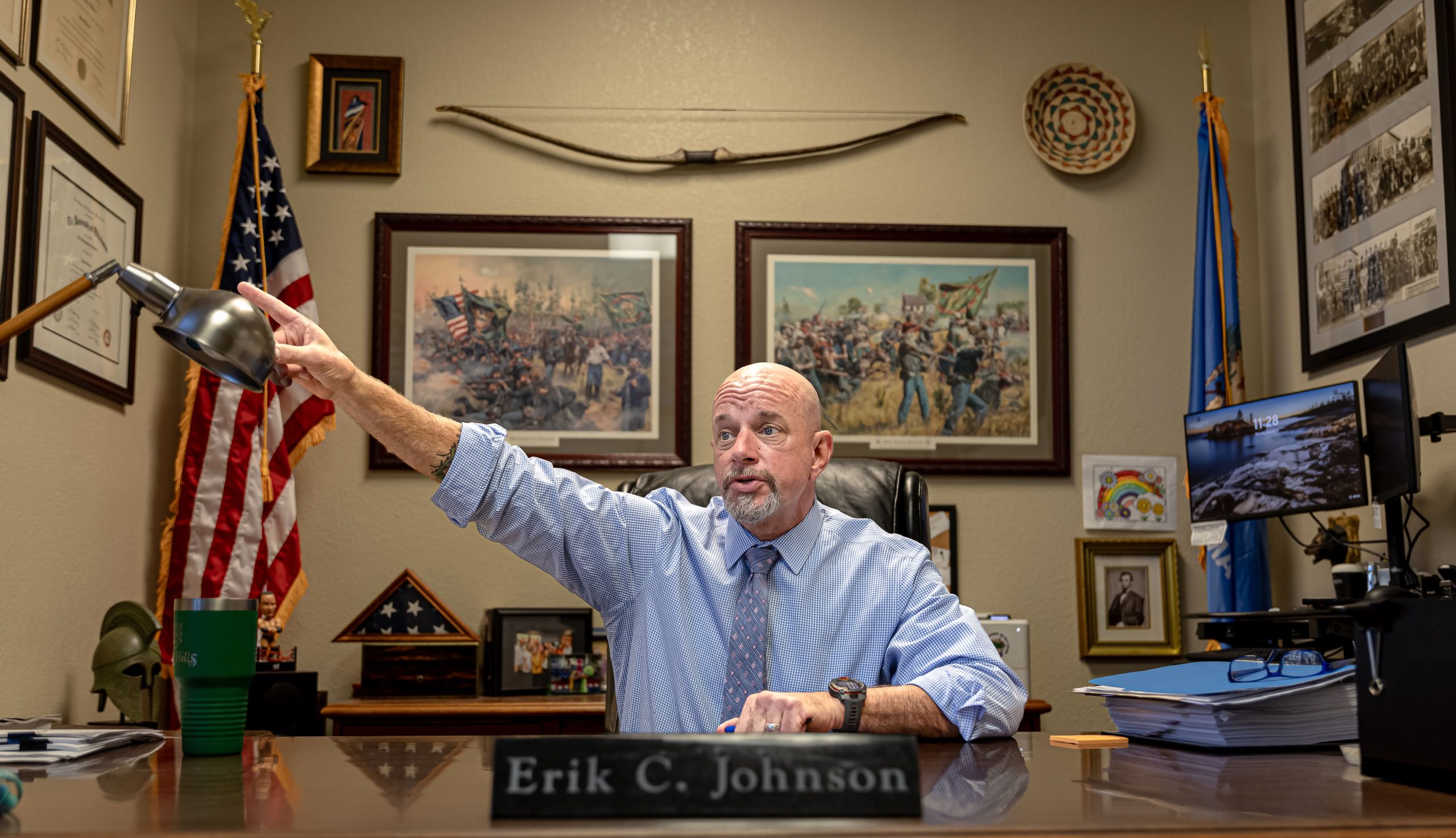
At the time, District Attorney Erik Johnson worked with law enforcement agencies in Seminole County to curb shootings and arson through sweeps, drug stops and warrant services. Officials also started after-school programs to give children chances to develop. The efforts worked, and the town hasn’t seen a similar spike in crime since.
Now the state has cut funding for those programs, and local police face budget cuts this fiscal year. Johnson and other leaders are scrambling to fill the void and keep children away from dangerous activity.
“In the absence of a nurturing environment, in the absence of a good family, in the absence of coaches or teachers that are involved, it pushes kids towards a criminal life,” Johnson said.
Wewoka’s History: From Oil Boom to Poverty
The gang violence that drew statewide media coverage in late 2023 did not arise in isolation.
Wewoka has a history of gun violence, especially among young people. In 1995, two teens killed another teen. In 2016, 19-year-old Curtlon Panoske killed a 17-year-old. In 2023, a 16-year-old was accused of fatally shooting Quante Smith. In April, a 17-year-old was accused of fatally shooting another teen.
“We have a lot of gang activity here, and we have a lot of shootings,” Wewoka police Capt. Trey Jordan said. “It’s pretty common for us per shift to get a shots fired call. It’s horrible, but it’s realistic here.”
When local media visited the town in 2023, officers locked the police department’s doors and did not answer reporters’ questions. Oklahoma Watch made several attempts to reach the department and requested incident reports and arrest records under the Oklahoma Open Records Act. In-person visits led to interviews, but the department had not provided the records by publication.
Jordan said he isn’t sure why gang violence is so prevalent in Wewoka but suggested it could stem from the town’s location along U.S. Highway 270 and its limited resources for children.
“Anybody can get a gun,” Johnson said. “There’s very few checks or preventions from allowing somebody to get a gun.”
Johnson pointed to loose gun laws, a lack of parental involvement and few school resources, among other problems.
“I see no alarm bells being rung,” Johnson said. “That’s what the emergency is.”
Wewoka has not always lacked resources.
In the 1920s, Wewoka was a booming oil town with more than 10,000 residents. When production dwindled, people left. The town now has about 3,000 residents, and Jordan said several hundred houses are abandoned.
A drive through Wewoka illustrates the problems area leaders discussed. Houses sit vacant, and some buildings are boarded up and dilapidated. Still, the town has popular spots such as the local Sonic and the family-owned Mother Jugs Grill. A small downtown street has boutiques, shops and restaurants, though a vacant, boarded-up building stands next to them.
The loss of industry has left families with few job opportunities, and the jobs that are available pay little, with the average weekly wage being $921 in Seminole County, according to the United States Bureau of Labor Statistics.
The median household income in Wewoka is $37,986, about three-fifths of the state’s median household income. Nearly 30% of residents live below the federal poverty line, almost double the statewide rate. About 82% of adult residents have at least a high school diploma, and 9% have a bachelor’s degree or higher.
Low wages also hamper the police department’s ability to hire more officers.
Wewoka police officers negotiated a 15% raise, which Jordan said is well below the state average of about $58,000 (the amount varies slightly by tracking source).
“We’ve all even agreed to go backwards in salary if we could just get more officers to help,” he said. “But then you go backwards in salary, you get the officers you don’t want, because nobody wants to work in a high volume area and it not be worth it.”
Jordan said the loss of the juvenile offender program and a shortage of officers raise a major concern that a spike in gang-related crime could happen again.
“The situation in Wewoka was bad,” Johnson said. “Fueled by poverty, lack of opportunity. I mean, what’s a kid gonna do that’s raised with really no parents in the home? In poverty, doesn’t know where he’s going to get his next meal?”
The Juvenile Offenders Program
For five years, Seminole County District Judge Brett Butner ran a weekly program for juvenile offenders on Wednesday evenings. Participants did yoga, attended study hall and ended the night with trivia and dinner.
“They complained a lot, as you would expect,” Butner said. “You get 16-year-old males in high school that are in trouble with the court and running around. The idea of doing yoga is probably not at the top of their list, but they learned to really like it.”
Julia Curry, owner of Oklahoma Court Services, also led yoga and joined the children on an annual educational field trip. She and other volunteers raised money for the trip and bought each child a Christmas gift.
Butner partnered with the Seminole School District’s restorative education program, which Charity Smith directs, and held study hall at the school.
“They’re killing rural Oklahoma.”
Brett Butner, Seminole County District Judge
Smith said she wanted to partner with Butner because she knew his goal was to keep the children from reoffending and appearing before him in court again.
“They’re troubled kids, and they have a background, and so it’s about understanding them and understanding what they are even coming from,” Smith said. “And then looking at what could we do to try to see if we could change this pattern for them.”
Each year, on the last Wednesday before school started, Butner took the children to buy new shoes.
On Sept. 18, Butner received an email from the Oklahoma Department of Mental Health and Substance Abuse Services notifying him that the program’s contract would end Sept. 30. The program couldn’t operate without the department’s funding.
“It was brutal,” Butner said. “It was a gut shot.”
The Seminole program wasn’t the only one affected. The department ended contracts with district court juvenile diversion programs in Cleveland, Rogers, Pontotoc, Johnston, Marshall, Murray, Adair, Cherokee, Wagoner, Garfield and Grant counties. Each contract was worth $15,000, and the department redistributed the money to programs with critical needs.
The department defined critical needs as those necessary to meet statutory obligations, provide direct patient care, address crisis behavioral health needs and prevent significant gaps in care for people with serious mental health and substance abuse conditions.
Butner said the department told him to seek other funding through the Oklahoma Office of Juvenile Affairs, money earmarked as a result of State Question 781, county assistance or local philanthropists.
Office of Juvenile Affairs employees in Butner’s county have continued to administer drug tests to the children during the transition. Butner argued, however, that Oklahoma statute makes the Department of Mental Health the agency primarily responsible for helping counties create drug court programs like his.
Although the statute lists the department as the primary agency, a department spokesperson said it does not require the department to fund specific programs.
As a judge, Butner is barred from raising money because it would violate the judicial code of conduct. The money Curry and other volunteers raised wasn’t enough to sustain the program.
The 781 funds Butner recommended have become entangled in an ethics controversy involving Rep. Danny Williams, R-Seminole, leaving the funding in limbo.
“They’re killing rural Oklahoma,” Butner said.
781 Funds Paused Amid Ethics Inquiry Involving Williams
A public notice the Oklahoma Ethics Commission published Oct. 8 shows that a nonprofit called House of Hope received funding from the State of Oklahoma Mental Health Grant, or 781 funds.
Williams administers those funds in Hughes and Seminole counties and chairs House of Hope.
The notice included allegations that Williams violated ethics rules. He must respond by Oct. 28. If he doesn’t, the failure will be deemed an admission of the allegations.
Johnson has paused distribution of 781 funds in Seminole County until the Attorney General’s Office concludes its review of Williams’ use of the money.
“I’ve asked the Attorney General’s Office to review this in its entirety because I’m uncomfortable with how some of those 781 funds had been utilized in Seminole County on the House of Hope,” Johnson said.
Curry said she has applied for a competitive federal grant for the Seminole program and has not heard back.
Johnson said changing conditions in towns like Wewoka will take money and institutional courage aimed at schools and mental health programs.
“We’re in a war for these kids,” he said.
This article first appeared on Oklahoma Watch and is republished here under a Creative Commons Attribution-NoDerivatives 4.0 International License.
!function(f,b,e,v,n,t,s)
{if(f.fbq)return;n=f.fbq=function(){n.callMethod?
n.callMethod.apply(n,arguments):n.queue.push(arguments)};
if(!f._fbq)f._fbq=n;n.push=n;n.loaded=!0;n.version=’2.0′;
n.queue=[];t=b.createElement(e);t.async=!0;
t.src=v;s=b.getElementsByTagName(e)[0];
s.parentNode.insertBefore(t,s)}(window, document,’script’,
‘https://connect.facebook.net/en_US/fbevents.js’);
fbq(‘init’, ‘1234567890123456’);
fbq(‘track’, ‘PageView’, {“page_title”:”A String of Violence Rocked a Small Town Three Years Ago. Now, Funding Cuts May Cause More Problems In Wewoka.”,”user_role”:”guest”,”event_url”:”https:\/\/oklahomawatch.org\/2026\/10\/28\/a-string-of-violence-rocked-a-small-town-three-years-ago-now-funding-cuts-may-cause-more-problems-in-wewoka”,”post_type”:”post”,”post_id”:763210});