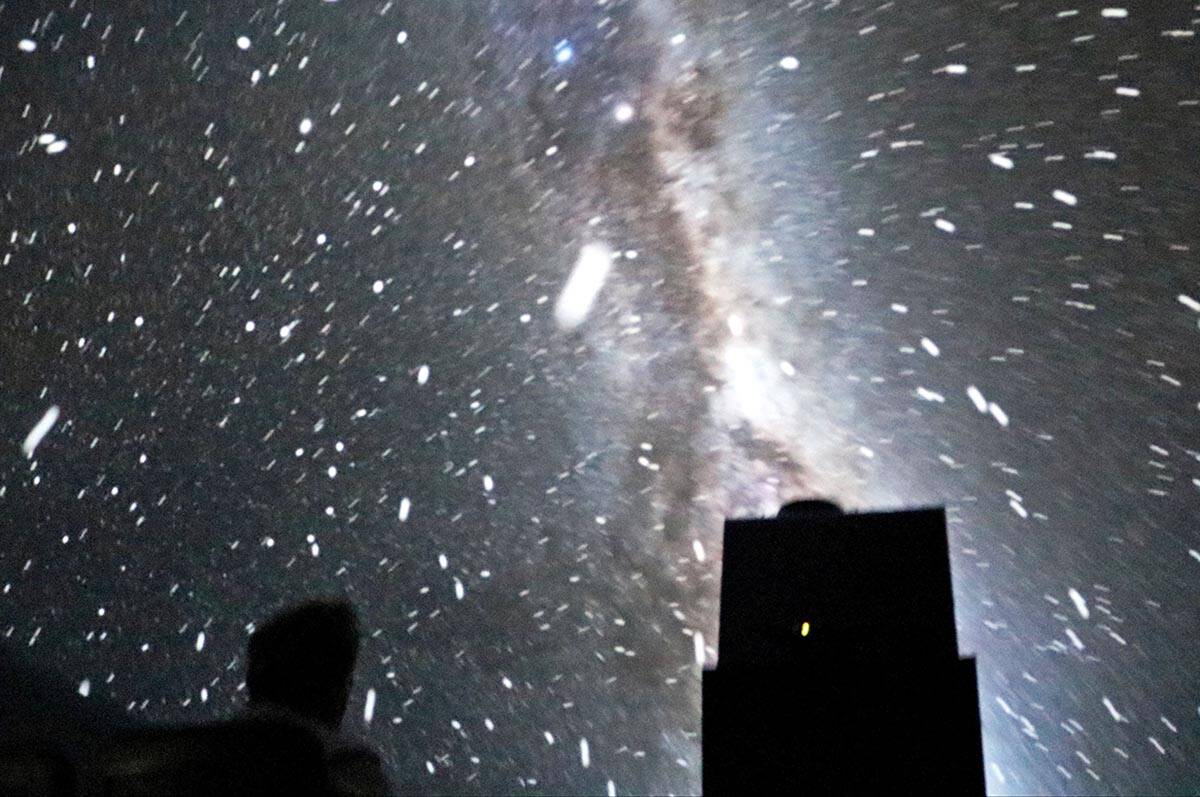
The planets are aligning — literally — and the celestial show can be seen in the Las Vegas Valley through the end of February.
The event has been dubbed a “planetary parade,” a term referring to nights where multiple planets can be viewed simultaneously with the naked eye.
But eager stargazers should temper their expectations, according to Andrew Kerr, manager of the College of Southern Nevada’s Dale Etheridge Planetarium in North Las Vegas.
Though all seven planets can be seen this week, he said not all will be visible at once, and seeing most of them will depend on the viewer’s location in the valley and whether the night skies are clear.
“The planets are very spread out across the sky, not exactly what people are expecting based on the planetary parade concept,” Kerr said.
How to see the planets
Most of the seven planets can be seen best shortly after sunset — which is currently around 5:30 p.m. — and with a clear view to the western horizon, Kerr said. Stargazers in the east valley will have the best chance of seeing more planets because their view will be blocked the least by the Spring Mountains, he added.
As a rule of thumb, Kerr said, “as long as it’s not blinking or moving, you’re probably seeing a planet.” To help locate the planets, he recommended using an online sky map.
Mercury and Venus will be visible in the west after sunset, Kerr said. Both will appear as some of the brightest points in that area of the sky, and Venus will be to the left of Mercury, he said.
Above those three planets in the western sky will be Neptune and Saturn, Kerr said. Saturn can be identified by a possible slight yellow tint and as the only bright spot above Mercury and Venus, while seeing Neptune will require a powerful telescope; it is the farthest planet from Earth.
Toward the southeast, Kerr said, Jupiter will be visible and appear as the brightest star-like object in the sky. Uranus will be almost due south and high in the sky below the Pleiades star cluster, but it will only visible through a telescope, he said.
To see Mars, amateur astronomers will have to be looking shortly before dawn breaks and have a clear view to the east, according to Kerr. He said the red planet will look like a pale pink star low to the horizon.
This month won’t be the only time valley residents can spot multiple planets in the sky at once, Kerr said.
Around mid-March, he said, Mercury and Mars will likely be visible in the east before the sun rises, while Venus, Saturn and Neptune will be in the west right after sunset.
If the valley sees clear skies on Friday and Saturday nights, Kerr said the planetarium will set up telescopes around 9 p.m. to help visitors view the planets and other phenomena. The planetarium is on CSN’s North Las Vegas campus, near East Cheyenne Avenue and North Pecos Road in the northeast valley.
Kerr added that members of the Las Vegas Astronomical Society will set up their telescope outside the planetarium to stargaze the night of March 14 to help visitors see space.
But people shouldn’t wait for rare astronomical events to start taking an interest in viewing the night sky, Kerr said.
“Just going outside and looking at the sky on any night of the year and taking time to appreciate the stars you can see, the planets you can see, it’s well worth it,” he said. “Even if it’s just a couple of minutes, just go outside and enjoy.”
Contact Spencer Levering at slevering@reviewjournal.com or 702-383-0253.