From most news accounts, it was just another day on December 11 when the state Supreme Court upended 115 years of direct democracy in Arkansas by holding that the Arkansas Legislature — a Republican Legislature, at least in this instance — can amend or even obliterate any law ever generated by Arkansas voters.
That includes all the articles of the state Constitution that originated with initiative petitions circulated among the state’s voters and then adopted by them. These people-powered amendments represent about a fourth of the 104 amendments made to the Arkansas Constitution since it was ratified in 1874. Without citizens’ initiatives, Arkansans would likely not enjoy a minimum wage higher than the federal rate or access to medical marijuana.
U.S. District Judge Timothy Brooks ruled a month before the December 11 order that no, the Legislature cannot amend or repeal a constitutional provision enacted by citizens through the initiative process. Brooks, however, was appointed by neither Donald Trump nor Gov. Sarah Sanders, but rather by Barack Obama. That made Judge Brooks’ holding meaningless in Republican Arkansas.
Brooks’ ruling is baloney, said the novice Arkansas Supreme Court justices, all but two of them appointed or endorsed by Sanders. Their lengthy opinion scrapping direct democracy omitted the soaring phrases of the Arkansas Declaration of Rights, one of the strongest statements of human rights in the land, which begins “All political power is inherent in the people” and ends with the admonition that only the people can ever alter, reform or abolish the institutions of government, including the Constitution. They also skipped over Brooks’ decision and all the precedents and the extensive initiative and referendum history that should be known by justices and lawyers educated in Arkansas. The court seemed not even to be aware of the history of initiative and referendum, in Arkansas or anywhere else.
That sweeping decision registered only two dissents among the seven justices, and those dissents were couched weirdly as “concurring” opinions. (Two sitting justices recused for unknown reasons, and Sanders appointed her supporters as substitutes for them, as has become her habit.) The two justices who halfway dissented but nominally affirmed the decision pointed out the absurdity of the decision, but concluded by saying “I respectfully concur,” because they concurred with the nominal result that a constitutional amendment legalizing medical marijuana met constitutional requirements. The usual language when a justice disagrees is “I respectfully dissent,” but no loyal Republican can afford to dissent on such an important issue for the party and for its leaders, so they recorded themselves as “concurring” with the opinion written by Associate Justice Cody Hiland.
Cody Hiland accepts appointment to the Arkansas Supreme Court from Gov. Sarah Sanders. Credit: Brian Chilson
Hiland, incidentally, was the chairman of the Arkansas Republican Party when Sanders appointed him to fill a vacancy on the state’s highest court in 2023. Before that, Hiland had been U.S. attorney for the Eastern District of Arkansas, appointed by President Donald Trump. Is it worth noting that the Arkansas Constitution, in an amendment ratified by voters in 2000, prohibits partisanship in the election and appointment of judges and in any appellate or trial court’s judgments? The Supreme Court and its ethics commission have since made it clear that they consider that constitutional prohibition unenforceable.
How a bunch of judges could reach a decision so contrary to universally established law — that a legislative body cannot arbitrarily amend or even abolish constitutional law but only propose such changes to the voters — is a mystery.
A century of history
The proposal to establish Arkansans’ rights to drive initiatives and referenda was placed on the ballot as a constitutional amendment at the general election of 1910 and adopted overwhelmingly by the voters. George Donaghey, the great progressive who followed the flamboyant bigot Jeff Davis in office, was elected governor in 1908 on a promise to amend the state constitution to empower voters to draft and to enact by majority vote the state direct-democracy laws that were the primary goals of the national progressive movement led by William Jennings Bryan.
Two-term governor George Washington Donaghey. Credit: Butler Center for Arkansas Studies
When Gov. Donaghey and the legislators — all Democrats — took office in 1909, they put forth a short constitutional amendment to make Arkansas the first (and ultimately the only) Southern state to implement the great progressive and populist program of giving the people hegemony over the legislative branch by allowing voters to circulate petitions to put statutes and constitutional amendments on the ballot and to refer acts passed by the Legislature to the voters. Once voters enacted a proposed constitutional amendment, neither the governor nor the Legislature would be able to alter it in any way.
Donaghey had run for governor criticizing the Legislature, where corruption had erupted on a large scale in the first decade of the new century. There were charges of bribery in the construction of the new state Capitol, and lawmakers had lengthened every session so that they could collect per diem while partying in the capital city. Legislators regularly absorbed contributions from railroads and liquor interests.
Regardless, grumbling lawmakers approved Donaghey’s resolution, and it went on the 1910 general-election ballot as one of the Legislature’s three proposed amendments that are allowed every two years by the constitution. Other Democratic leaders joined Donaghey in endorsing the proposal and Bryan, the eminent orator and three-time Democratic candidate for president, came to Arkansas and stumped the state with Donaghey. Bryan said elected legislators both in statehouses and in Congress were beholden to wealthy special interests, so common people should be able to refer legislative acts to the voters and also to write laws, including constitutional amendments, to protect the interests of working people and then to vote them into law entirely independent of the Legislature.
With Donaghey at his side, the great orator Bryan made 55 speeches in five days and drew cheering crowds estimated at up to 125,000. Newspapers gave long, verbatim accounts of the great man’s speeches. The amendment establishing the people’s right to draft and pass their own laws passed overwhelmingly at the 1910 election. That resolution carried NO language that would empower the Legislature to amend or scrap any constitutional provision. That is still not possible anywhere in the land — except now in Arkansas.
Jokers reveal themselves
Even before the actual election in 1910, Donaghey and other champions of direct democracy recognized that drafting oversights — they were referred to as “the jokers” that no one had caught beforehand — would make the initiative and and referendum amendment unworkable even though it was now in the constitution.
The biggest joker was that it neglected changing the part of the 1874 Constitution, which said that only three amendments could be put on the ballot every two years. The Legislature always put three of its own amendments on the ballot, leaving no room for an amendment circulated by voters.
The amendment also neglected the power of people locally, in cities and counties as well as statewide, to make changes in the laws independently of the mayors, city councils, county judges and quorum courts. That was to be done at a convention to rewrite the whole state constitution in 1917-1918. Delegates were chosen and assembled in 1917, amid the closing battles of World War I and raging flu and smallpox epidemics, but recessed until the next summer. The modernized constitution, which included an initiative and referendum law that made all the effective changes to offset the “jokers” and also gave women the right to vote, was quickly drafted in the summer of 1918 and placed on the ballot at a special election. The initiative and referendum provisions in the proposed constitution were declared to be in perfect harmony with the Oregon initiative and referendum law, which was considered the model, but turnout was low and the proposed constitution was defeated.
The initiative and referendum provisions of the defeated constitution were still considered the model when the Legislature assembled again for the1919 legislative session, and this time the legislators, cheered on by the new reform governor, Charles H. Brough, drafted a new constitutional amendment to replace the defective one from 1910.
If the justices last December were really interested in how bizarre language implying that two-thirds of the Legislature might amend or dissolve a constitutional amendment arising from initiative petitions somehow got into the law, they might have consulted the actual record of the legislative drafting that created it. It was basically the version included in the failed 1918 constitutional revision. The legislative authors drafted new provisions enabling local governments to refer local laws to the voters in a referendum and a requirement that 10% of Arkansas voters, instead of only 6%, sign petitions to put constitutional amendments on the ballot. It clearly separated the requirements for petitioning constitutional amendments and for referring legislative acts to the voters.
Tom M. Mehaffy, a prominent Little Rock lawyer and later a Supreme Court justice for 15 years, helped draft the initiative and urged voters to approve it. In a piece he wrote for the Gazette, there was no mention of language that could be interpreted as empowering the Legislature to throw out constitutional law established by initiative petitions and the voters. That would have been a shocking idea since it was contrary to the whole notion of voter sovereignty propounded by William Jennings Bryan.
The reason for the perplexing language, as a Gazette legislative article explained, was that just before the House and Senate voted on the 1910 resolution, several sentences were moved around in the document. One moved sentence was about the Legislature amending referred measures (those measures they send to the voters themselves, not the initiated measures driven by citizens) near a sentence saying the word “measure” where the term encompassed both an initiated constitutional amendment or statute and referred documents written by either the state or by local legislative bodies.
That last-minute sentence reconfiguration was what Republican justices, or at least Hiland, jumped on back in December. Since an initiated constitutional amendment was a “measure,” Hiland’s opinion said, it meant that the Legislature could change any part of the constitution drafted by voters or abolish it with the votes of two-thirds of the members of each house.
Elites revolt
It helps to understand how and why this mess started, which was with a labor-management scuffle over minimum-wage laws. Arkansas was the first of the 11 states of the old Confederacy to enact a minimum-wage law. Gov. Winthrop Rockefeller, the most liberal governor in Arkansas history and still in his first term, summoned a special legislative session in February 1968 to establish a minimum wage of $1.20 an hour by 1971.
The Arkansas Legislature was then comprised 132 Democrats and three Republicans, but nearly all the Democrats, who liked to say they represented working men and women, had to go along with the Republican governor’s bill. They rejected nearly all the other progressive bills proposed by the governor, including a hike in the top income tax rate from 5% to 12%, but they could not afford a vote that said Rockefeller — not them — represented the interests of working stiffs. So the Senate passed Rockefeller’s bill by a vote of 24 to 9, and the House approved it 82 to 4.
Arkansas and Virginia to this day are the only states of the old Confederacy to set minimum wages. Workers in the other states are protected by the federal minimum wage, which was last raised, to $7.25 an hour, in 2009 by a Democratic Congress under President Barack Obama. After the Arkansas wage law’s original enactment in 1968, Arkansas raised the state minimum wage from time to time, eventually to $6.25 an hour.
That upward trajectory ended with the general election of 2010, after the election of a Black Democrat as president two years earlier moved Arkansas voters to dramatically shift both houses of the Legislature from historically Democratic to large Republican majorities. The Arkansas House turned red in 2010, followed by the Senate in 2012. The newly Republican Legislature would be enacting no more minimum-wage bills.
Marchers push back on legislators’ attempt to roll back a voter-approved minimum wage increase in 2019. Credit: Brian Chilson
That is when the people rose up and exercised the right given them by the great progressive victory of 1910.
A poll 15 years ago showed that a large majority of Arkansans, including most nominal Republicans, favored a good minimum wage. A Methodist preacher in North Little Rock, Arkansas Advocates for Children and Families, Arkansas Community Organizations, and others drafted an initiated act establishing a higher minimum wage, collected the signatures of the required 8% of Arkansas’s registered voters and won big in the general election of 2014. That initiated act raised the state minimum wage from $6.25 an hour at businesses with four or more employees to $8.50 an hour by 2017. Then the same reformers circulated petitions again, put another wage bill on the ballot, the voters again approved it, and the minimum wage soared to $11 an hour by 2021.
That was the beginning of the end for Arkansas direct democracy.
Enough was enough! The chamber of commerce and business interests had to put a stop to the wage madness. No other Southern state except Virginia was so tender to poverty-level workers as Arkansas. The Legislature could still simply amend or repeal the minimum-wage law since it was merely a statute and not a part of the constitution, but the change required a supermajority of 67 votes in the House and 24 in the Senate. Very few legislators, even Republicans, wanted to send such a clear message to voters back in their districts that they opposed a good minimum wage for common people, including Walmart employees.
The solution was to make it difficult and even scary for worker sympathizers to collect voter signatures to put wage bills or any other bill on the ballot. Having sympathetic Republicans in the two state jobs — attorney general and secretary of state — that regulated the petition and ballot process helped. They could throw up procedural roadblocks to the petition process that would discourage, delay and even intimidate petitioners gathering signatures. This is the playbook that’s been in place for more than a decade.
Since 2016, the Legislature passed bill after bill to make it harder and scarier for people to collect signatures on ballot proposals. Even that wasn’t enough for opponents of direct democracy. A remarkably robust citizens’ showing in 2024, when a grassroots group collected enough signatures to put on the ballot a measure rolling back Arkansas’s near-total abortion ban, sent conservative lawmakers and elected officials scrambling. The state ultimately wiggled out of honoring the people’s will, kicked that measure off of the ballot, and then set out to put initiatives and referenda further out of reach.
The Legislature finally went all the way and just manifestly flouted the clear language of the initiative and referendum law, making anything ever initiated and passed by the voters subject to the wishes of at least two-thirds of the Legislature.
The wolf pelt precedent
Thus arose the case of State of Arkansas v. Good Day Farm, where groups seeking to put on the ballot a constitutional amendment legalizing medical marijuana sales pointed out that the state Supreme Court had ruled, unanimously, back in 1951 that the Legislature had no power to amend the constitution and could not arbitrarily change any part of it without a vote of the people. That ruling came after the Legislature in 1949 passed a bill requiring the Game and Fish Commission to pay bounties for wolf pelts, in violation of the initiated constitutional Amendment 35, adopted by the voters in 1944, which made the commission and the agency independent and protected them from such interference by the Legislature or the governor.
Only the people — never the Legislature acting alone — could change the Constitution, the seven Supreme Court justices said unanimously in 1951 in the case of Arkansas Game and Fish Commission v. Edgmon. The court decreed that the little drafting oversight in the 1920 amendment could not be used to claim that the Legislature could alter or scrap any initiated constitutional provision without submitting it to the people.
It was at this point that the drafting oversight from years before was investigated and rejected. One sentence of the “General Provisions” section of the lengthy amendment, entitled “Definition,” said the word “measure” referred to “any bill, law, resolution, ordinance, charter, constitutional amendment or legislative proposal or enactment.” In a later paragraph that obviously referred to initiated acts — not constitutional amendments — at the state or municipal level but used that word “measure,” the amendment said that when the Legislature or a local governing body amended or repealed a measure, it had to get the votes of at least two-thirds of the legislative body, not the usual simple majority.
Those were the sentences that were moved around just before the 1919 Legislature voted to put it on the ballot. Legislators tested the garbled amendment in 1949 by passing the wolf-pelt law that violated the autonomy of the Game and Fish Commission, whose independence was established by one of several initiated constitutional amendments enacted to avert political meddling by governors and Legislatures in the work of major state agencies like highways, public lands and prisons. The unanimous Arkansas Supreme Court of 1951 suggested that it was ridiculous to suppose that the Legislature and the voters in 1910, 1919 and 1920 intended to let the Legislature so easily do away with the hard-won fruits of direct democracy.
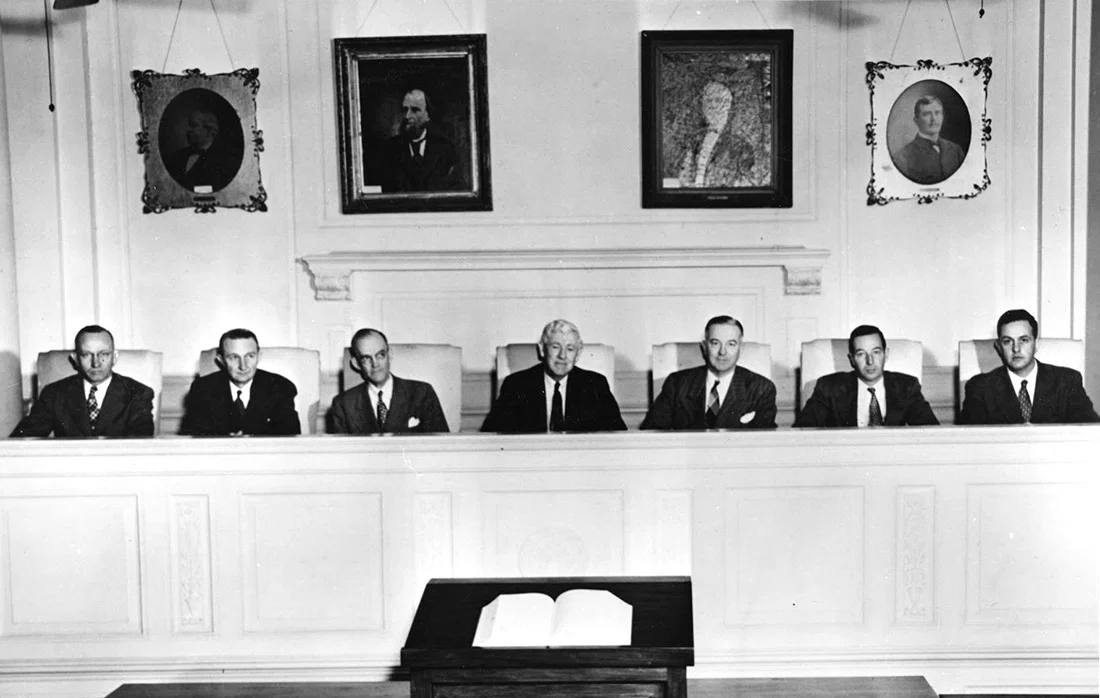
A roster of simpletons
That precedent enshrining Arkansans’ power, in place for more than a century, flipped in December thanks to Hiland and his young cohorts. This roster of justices paid no heed to the wolf-pelt debacle of 1949. They determined the amendment’s language about the Legislature’s power to amend initiated statutes has to apply to the Constitution as well because the definition paragraph had included any part of the constitution that got there by the initiative process as a “measure.” Hiland called the decision by the seven justices in 1951 “demonstrably erroneous.”
The current Supreme Court, the weakest on judicial experience in modern history, thus overruled a longstanding precedent and implied that the 1950 justices were not constitutional scholars but just simpletons who didn’t know what they were doing.
So, who were these simpletons?
These justices of the Arkansas Supreme Court in 1950 would likely be wholly unimpressed with today’s bench. Credit: Photo courtesy of the Encyclopedia of Arkansas
* Chief Justice Griffin Smith, who wrote the Edgmon decision, may have been the most eloquent justice in Arkansas history, a crusader who did not feel bound by precedent but by what he believed was right and what the constitution actually meant. Smith had dissented in 1941 when most of the court affirmed the criminal conviction of Joe Johnson, a Jehovah’s Witness, for desecrating the American flag at a Searcy County field office at Marshall. Johnson had refused to salute the flag when he went to the county welfare office to get commodities for his starving children at the outbreak of World War II but before America entered it, because he said his religious beliefs dictated it. The Bible prohibited the worship of graven images, which Jehovah’s Witnesses thought included flags. The prevailing justices cited a U.S. Supreme Court decision that had upheld a flag desecration conviction. Soon afterward, the U.S. Supreme Court came around to Smith’s theory that such convictions violated the free-speech and religion clauses of the Constitution.
* Robert A. Leflar, the great constitutional scholar, owner of two Harvard law degrees, longtime dean of the University of Arkansas Law School, author of criminal code revisions and initiated acts in the 1930s, the head of the state constitutional revision commission in 1967, president of two constitutional conventions, and the author of the most famous of the initiated amendments curtailing political meddling in state institutions — Amendment 30 of 1942, the so-called Fulbright Amendment, which protected state colleges and universities and charitable, penal and correctional institutions from political meddling by the state Legislature and governor.
* George Rose Smith, the longest-serving Supreme Court justice in Arkansas history (38 years, from 1949 through 1986), where he soon established a reputation for erudition, a strict interpretation of the law, humor and grammatical grace. He offered $100 to anyone who could ever find a single grammatical error in one of his opinions, where never a needless word or phrase appeared. He never had to cough up a buck. He often wrote clever little notes to journalists (including the present author) pointing out their grammatical miscues.
* Edwin Eagle Dunaway, a Columbia University honors law graduate, state legislator during the Great Depression, prosecuting attorney, civil rights lawyer and a justice of the Supreme Court. Dunaway was deeply involved in litigation flowing out of the U.S. Supreme Court orders ending racial segregation in schools and elsewhere in the 1950s and 1960s. When the Legislature was passing bundles of laws protecting the white schools from Black children and teachers in 1955-59, Dunaway challenged them in state and federal courts. His suits challenging Act 10 of 1958, which required employees of public schools and colleges to sign an affidavit every year listing all the organizations to which they belonged or contributed, which was aimed at the NAACP, won before the U.S. Supreme Court, which agreed with his argument that it violated the Fourteenth Amendment, which assured people equal protection of the laws.
* J. Seaborn Holt, the longest-serving of three Holt cousins from Boone County (along with Frank and Jack Jr.) who spent much of their careers as Supreme Court justices. Holt practiced civil and criminal law for 54 years, including terms as a U.S. attorney and 23 years as a Supreme Court justice. An ascetic and nearly humorless man — “He neither smokes, drinks nor chews, and no one be found who ever heard him tell an off-color joke,” said a midcentury book on famous Arkansas people — Holt, unlike others in elective office, paid little attention to the upheaval of public opinion in the years after the U.S. Supreme Court’s rulings that sought to end racial discrimination in public life.
When Daisy Bates and others were arrested and fined in 1959 for refusing to obey a legislative act requiring her, as president of the NAACP, to turn over its membership records to Attorney General Bruce Bennett, Holt and Smith dissented when the court held that the statute had to be followed. The act, Holt said, violated the due-process clause of the Fourteenth Amendment and the right of free association guaranteed by the First Amendment.
* Ed F. McFaddin. Like Holt, McFaddin was a practicing lawyer with degrees from distinguished schools — the University of Texas and Columbia University Law School — and was around and deeply involved when the initiative amendment was drafted and ratified in 1920, and he followed the debate over its ratification led by Governors Joe T. Robinson, George Donaghey, Charles Brough and Thomas McRae, all of whom, like McFaddin, would have been appalled if anyone even raised the prospect that the Legislature could repeal any or all of the amendment that they were promoting in 1909, 1918 and 1920.
* Minor W. Millwee was a city attorney, prosecutor and circuit judge before he ran for and was elected to the Supreme Court in 1944. He was opposed by Jim Johnson and beaten in 1958, and Johnson would say years later that at the time he had known nothing about Millwee or the other justices and would learn that all the other justices admired Millwee’s intellect and courage. Johnson said he ran for the court in 1958 to make a point to the state’s voters that they should expect the Supreme Court to stand steadfast against all efforts to mix the white and Black races in the schools or other places just as legislators, the governor and other elected officials had done.
Johnson attacked Justice Millwee as a “flunky” for race mixers. Millwee’s small advertisements urged people to vote for a judge with a record “free of political or partisan bias.” Neither man mentioned Millwee’s vote on the Supreme Court to maintain constitutional integrity in the Edgmon case. (Jim Johnson’s son, current state Sen. Mark Johnson, praised the Arkansas Supreme Court’s December decision curtailing the independence of the constitution from legislative or gubernatorial meddling.)
We concur that you’re wrong
As Justice Rhonda Wood herself pointed out in her concurring opinion, Hiland and the other concurring justices were flatly wrong in overturning the unanimous Edgmon decision in a lawsuit challenging the constitutionality of legislative changes to the permanent voter registration amendment to the constitution that voters ratified in 1964. The voter-registration law permitted legislative changes as long as they did not curtail the voting rights of anyone.
(seated in second row, from left) Nicholas Bronni, Cody Hiland, Barbara Webb, Shawn Womack, Rhonda Wood, Courtney Hudson and Karen Baker at Gov. Sarah Sanders’ state of the state address in 2025 Credit: Brian Chilson
Hiland wrote that the court’s opinion in Martin v. Haas, written by Justice Robin Wynne in 2017, overruled Edgmon and concluded that the Legislature could indeed alter or repeal a provision of the Constitution by a two-thirds vote of both houses.
“Accordingly,” Hiland wrote, “the analysis in Martin v. Haas controls here. To hold otherwise would interpret the same constitutional phrasing differently in two substantially identical contexts. In sum, this court effectively set Edgmon aside seven years ago, and nothing persuades us to chart a different course now.”
That was pure nonsense, as Justice Wood herself noted in her “concurrence.” Actually, Wynne, who died in the summer of 2023, made it clear that the Legislature could never undo a part of the constitution, but that the little change in the legislative act had strengthened, not weakened, the voter-registration law.
Justice Wood, who had participated in that case, wrote: “We did not reach Edgmon in Haas, and we should not reach it here.”
Exactly!
If Hiland and the other justices had read Justice Josephine Hart’s dissent in Haas, they surely would not have made the foolish mistake of saying it reversed the court’s 1950 decision affirming that the Legislature could never change or repeal constitutional law established by the initiative process.