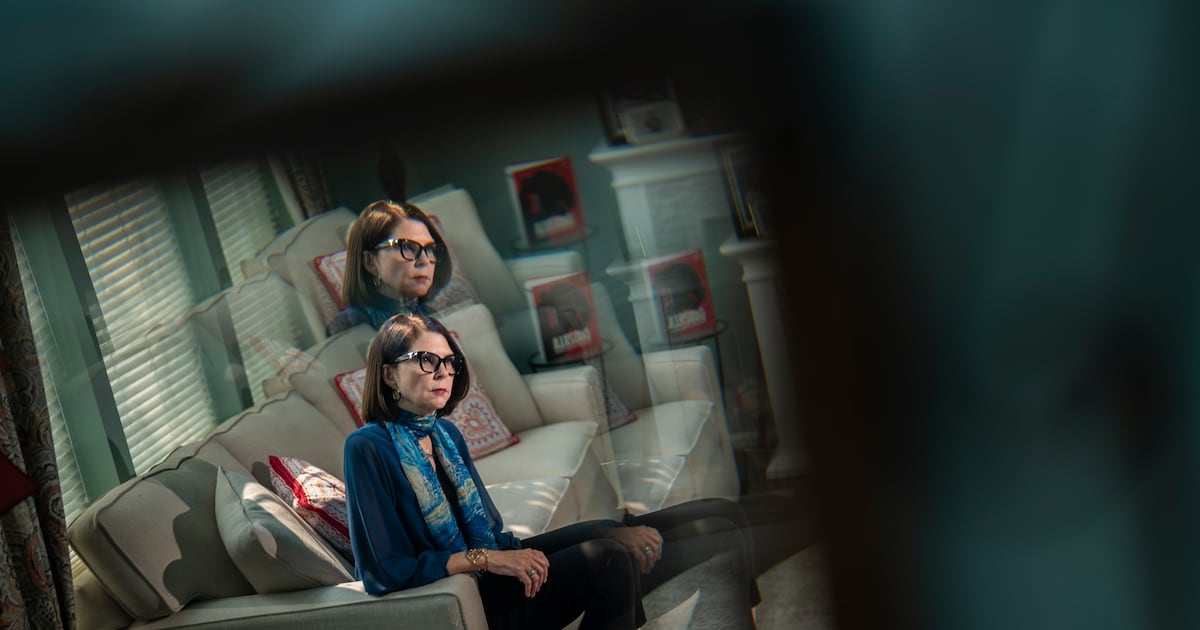
Photos and mementos at Harrington’s home in remembrance of her son. (Jabin Botsford/The Washington Post)
As a clinician, Jill Harrington has counseled first responders through some of their darkest thoughts following traumatic deaths and suicides they experienced on the job or in their families.
There are people who “wouldn’t be on the planet if it wouldn’t have been for her,” said Adam Workman, a veteran and firefighter who has referred first responders in Virginia to Harrington as part of a peer-support network.
But for the past 4½ months, Harrington has been haunted by one life that wasn’t saved: her son’s.
In his moment of need, she said, he didn’t receive what he deserved: “competent and compassionate lifesaving care.”
Her son, 25-year-old Alex LaMorie, was fatally shot by police in Maryland in March. LaMorie, who was autistic, had called 911 to report a scam. Someone online was harassing and blackmailing him for $100, according to authorities. Officers who spoke to him on the phone said he made suicidal statements.
Authorities said LaMorie walked toward responding Howard County police officers and refused commands to drop a knife he was holding.
Twelve cartridge casings were recovered at the scene, according to a report from the Maryland attorney general’s office. An autopsy report showed LaMorie was shot 11 times, with wounds to his chest, abdomen, forearm and hip.
Months after her son’s death, after burying him and contemplating all the ways the shooting could have been avoided, Harrington spoke with The Washington Post about the loss. She described her grief as complicated because she has spent her career trying to help people in crisis.
“I’m living through what I’ve journeyed with people through,” said Harrington, 56.
Jill Harrington has spent her career trying to help people in crisis. (Jabin Botsford/The Washington Post)
This month, Maryland Attorney General Anthony G. Brown (D) declined to criminally charge the three officers involved in the shooting after finding there was insufficient evidence that they committed a crime. The county police’s Internal Affairs Division is conducting an administrative investigation, which is standard, and the officers are on administrative duty, according to a Howard County police spokesperson.
Police are still investigating the alleged extortion scam that prompted LaMorie’s call.
Harrington disagrees with the state’s decision to decline to prosecute. While on leave from work, she has spent her time coordinating with disability and mental health organizations to advocate for improvements to the state’s crisis response system.
“Alex wasn’t committing a crime,” Harrington said. “It’s not just a public safety issue, it’s a public health issue.”
‘The police are going to … help me’
LaMorie identified with the X-Men because, he told his family, the world didn’t seem to understand his differences.
That’s why when LaMorie got the call around November that he had won a lottery out of more than 2,300 applicants to move into Patuxent Commons, a housing project with a commitment to inclusive living for people with and without disabilities, Harrington considered it “a miracle.” It was codeveloped by the Autism Society of Maryland.
LaMorie regularly advocated for other autistic people and served as an advisory board member for the Autism & Grief Project.
Harrington shows a gift Alex gave her. (Jabin Botsford/The Washington Post)
His new home would provide communal activities for him to feel connected to his neighbors and make friends, Harrington said. He had mostly made friends online, but he was wary about being catfished.
Those fears were realized when, on the night of Feb. 28, LaMorie called Harrington sounding “hysterical,” she said.
“She said she was 19, she’s 13,” Harrington recalled her son saying. “I can’t do this to you, Mom.”
He had been communicating with someone on Telegram, an instant messaging application, and that person was blackmailing him, according to the attorney general’s report.
“The police are going to come help me. They have to know that I’m innocent,” Harrington recalled LaMorie telling her.
She heard him escalating. Harrington knew that embarrassment and shame had triggered her son. She spent years being open about suicide prevention skills with him. Harrington has a doctorate in social work and more than two decades of experience in grief counseling with a specialization in suicide “postvention” – helping to prevent suicide for those who have been exposed to it.
LaMorie, who also had mental health support and engagement through special education and behavioral health providers, had a “safety” plan to offer him guidance if he experienced a crisis or suicidal thoughts. His coping mechanisms included listening to music or playing a computer game.
Autistic people are at a higher risk of dying by suicide, with risk factors including loneliness and difficulty using coping skills when upset, according to recent research.
Officers headed to LaMorie’s apartment to initiate a petition for emergency evaluation, which officers can conduct if someone is in a mental health crisis and poses a danger to themselves or others, according to the report.
Days earlier, Harrington and her husband, David Carey, helped LaMorie move in to his third-floor apartment. After getting his call that night, they headed to the apartment. On the way, Harrington said she called 988, the suicide and crisis lifeline, which redirected her to 911, which patched her to Howard County police. She can’t remember exactly what she said, but she knows she conveyed that her son was in crisis.
When they arrived, they could barely see through the flashing lights of police and first responder vehicles gathered outside the building.
Carey said he had “no idea that my stepson was 35 feet away lying on concrete dead.”
Officers eventually told them LaMorie had died, but they received vague information about the circumstances, Harrington said. They worried their son had died by suicide.
Later into Sunday morning, the family learned from building personnel at Patuxent Commons that LaMorie was fatally shot by responding officers, Harrington said.
Carey, an Army combat veteran, said he felt “betrayed.”
Before Harrington and Carey arrived, according to body-camera footage, one officer said “We’re getting cornered” as their weapons were drawn at LaMorie, who was in the parking lot barefoot. They repeatedly ordered LaMorie to drop the knife he was holding. The footage showed LaMorie did not lift his arm to point the knife in their direction.
At least one of the officers said he was not armed with a Taser before joining the other officers outside. One officer asked “Do we have less lethal?” moments before the fatal shooting, according to the attorney general’s report.
The body-camera footage shows less than two minutes of police interacting with LaMorie outside. Harrington and Carey said property management will allow them to view surveillance footage from the building.
“We want to see what happened to our son,” Harrington said. “And not from a police cam.”
‘It’s a failure of the system’
Nearly 14 years ago, another mother in Maryland advocated for change after her 26-year-old son with Down syndrome, Robert Ethan Saylor, was killed when sheriff’s deputies forcibly removed him from a movie theater. The reason: He hadn’t paid for a ticket to a second showing.
After his death, his family and advocates pushed for better training for first responders, and since 2016, law enforcement officers in Maryland receive training on how best to engage people with intellectual and developmental disabilities.
That training also includes people with disabilities as instructors through programs such as the Ethan Saylor Alliance, which is funded by the state.
“Obviously, that’s not enough,” Saylor’s mother, Patti Saylor, told The Post in a recent interview. “It’s a failure of the system as a whole that Alex lost his life.”
Two of the Howard County police officers involved in the shooting were trained in crisis intervention, and the third was a specially trained negotiator, Sherry Llewellyn, a Howard County police spokesperson, said in a statement.
The police department has access to Howard County’s Mobile Crisis Team made up of trained mental health professionals who respond with officers.
The mobile crisis team was not contacted and did not respond with officers to LaMorie’s call because the incident “unfolded quickly and did not allow time,” Llewellyn said in a statement. “They are important partners in incidents of longer duration.”
Statewide, maintaining such programs requires proper funding and adequate staffing, said Angelo Consoli, second vice president of the Maryland Fraternal Order of Police.
“We’ve always said that we wish there was an alternative to it, to where you don’t have to put police officers in a position where they might have to end up taking a life because they’re defending themselves or somebody else,” Consoli said.
When a person with a knife or other weapon gets within a certain distance, Consoli said, officers must react quickly if they can’t keep a distance or don’t have other effective options to stop the threat. The attorney general’s report says LaMorie was 12 to 16 feet from the officers.
Experts say the fact that officers lacked nonlethal alternatives further escalated a crisis. A person experiencing a mental health crisis needs engagement, such as talking with them long enough to help them recover, said M. David Rudd, a psychology professor at the University of Memphis.
LaMorie may have been overstimulated and might not have understood the officers’ commands, said Paul Nestadt, the James Wah professor of psychiatry at Johns Hopkins School of Medicine.
After LaMorie’s death, Howard County police implemented a general order for responding to people experiencing a mental health crisis. It says that officers should consider using nonthreatening body language and keeping their hands by their sides if possible when interacting with a person who may be experiencing a mental health crisis or may be a crime victim.
The order also says an officer should immediately notify an appropriate agency, such as the mobile crisis team or social services, when they’ve observed signs or received information that a person is a possible danger to themselves or others.
Harrington, who comes from a family of military personnel, law enforcement officers and first responders, said supporting police officers and expecting accountability are not mutually exclusive. She knows the officers now carry the weight of killing her son, too.
When Harrington reflects on her son’s last words, captured in the body-camera video, that he did not “want to live anymore,” and to be free of his pain, her mind goes to her own training.
Her son, she said, needed help, not harm.
‘Alex sprinkles’
Every morning, Harrington listens to and meditates on Pastor Rick Warren’s “Daily Hope” podcast, drinks coffee and paints.
She doesn’t consider herself much of a painter, but she was gifted a paint-by-color canvas from a friend and trauma art therapist. The 20-by-20-inch painting of “Starry Night,” her son’s favorite artwork, is now completed.
Harrington completed a paint-by-color canvas of “Starry Night” her friend gifted her after Alex’s death. (Jabin Botsford/The Washington Post)
Weekly, she hears from colleagues, the best in her field, making sure she’s not alone. Harrington knows the “unique impairments of bereavement by violent death”: post-traumatic stress disorder that can include reliving his death, she said. She has to remind herself to eat and to rest.
Her daughter, Madeline LaMorie, has been trying to cope by looking for “Alex sprinkles” – reminders of him in her day-to-day life, like the time a listing for a sweatshirt featuring “Super Mario Kart,” their favorite video game, popped up on an app.
She remembers how the last evening of her brother’s life started. The family celebrated their mother’s birthday at a bowling alley.
“We were laughing and smiling, and he was buying everyone drinks of fountain pitchers, and just had the biggest smile on his face,” Madeline LaMorie said. “That’s what I hold on to when I think about him.”
As Harrington begins her next painting, of lilies, she glances at another gift: a cross figurine with a cardinal on it, hanging on her wall. Harrington, who is Catholic, said cardinals have a spiritual meaning. The day after her son died, she saw a cardinal for the first time at the bird feeder outside her window.
“I don’t want his death to eclipse the rest of his life,” Harrington said. “But maybe his death can also bring light on how to save a life.”