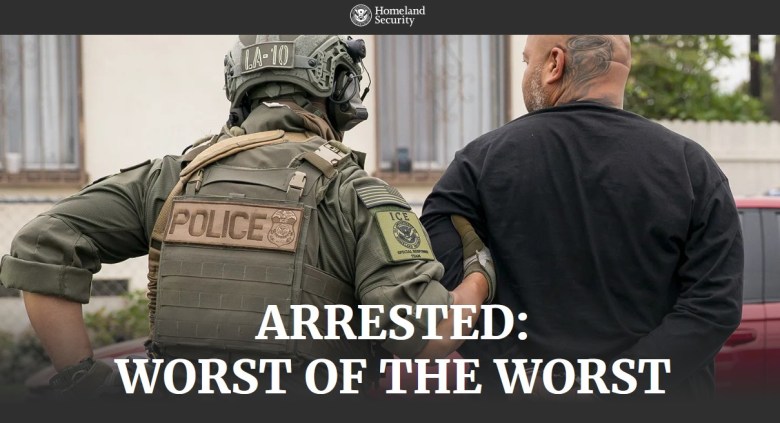
In daily press releases, public statements and a new YouTube video set to ominous music, the White House has waged a campaign to tell the public its immigration enforcement is targeting “the worst of the worst” criminals in Maine, Minnesota and across the country.
The phrase has become a mantra for administration officials as criticism of ICE’s tactics has ramped up. Just last month, the Department of Homeland Security launched a website to track the arrests of immigrants it says are among the country’s worst offenders.
The database is searchable by state, and for Maine, 13 people are listed as having been arrested, with their names and a mugshot included. Most, if not all, were detained long before the recent enforcement surge here.
The website, which DHS calls a “transparent tool,” claims all of the individuals were convicted of crimes, such as drug trafficking and aggravated assault, but it does not provide other information about their cases, such as when and where the crimes took place, making it hard to verify the information.
Tricia McLaughlin, DHS assistant secretary for public affairs, said in a statement announcing the website that it “allows every American to see for themselves the criminal illegal aliens that we are arresting, what crimes they committed, and what communities we removed them from. This is all about transparency and showing results.”
DHS, however, has not been transparent about the 206 people it says it arrested in Maine during an immigration enforcement surge it dubbed “Operation Catch of the Day.” The agency has only released 10 names and their charges, while a few dozen others have been verified by friends and family of those being detained.
And while DHS said its recent operation in Maine was meant to target “the worst of the worst criminal illegal aliens who have terrorized communities,” the agency is disclosing a fraction of all ICE detentions and the website has not been updated since the Maine operation began.
Gov. Janet Mills on Friday called on the Trump administration to release details of all arrests.
TRACKING THE CHARGES
To examine the 13 men and women the Trump administration put forward on its “worst of the worst” website, the Portland Press Herald obtained court records and talked to prosecutors, jail administrators, defense attorneys and others associated with some of the cases.
Our review shows that while all of the subjects do have some sort of criminal record, at least one of them appeared to commit his crimes decades ago outside of Maine; one does not appear to have a felony conviction at all; and several were transferred straight from local law enforcement into federal custody. The sparsity of information provided by ICE made it impossible to verify every single conviction the agency includes on the website.
One man, Charles Ali of Sudan, is listed by ICE as being arrested in Easton, a small town in Aroostook County, and being convicted of cocaine trafficking, but there is no criminal record for him in Maine. He pleaded guilty to distribution of cocaine and cocaine base in New Hampshire almost two decades ago and served time, according to court records.
Records show that ICE intended to deport him to South Sudan in 2017, but his attorneys asked that his deportation be stayed because “he would likely be immediately detained, tortured, and possibly killed by a government that has engaged in a campaign of ethnic cleansing.”
CBP and ICE did not confirm if he is still in custody or if he was deported.
The crimes attributed to Ivan Niyoyitungira (aggravated assault) and Charlene Vermaak (selling amphetamine) were not committed in Maine, either. The Press Herald could not verify if they were convicted of those crimes in other states because of limited online access to their files.
However, Vermaak has several misdemeanor convictions and the Cumberland County District Attorney’s Office had intended to prosecute her on a Class A aggravated drug trafficking felony charge in 2025 before it had to withdraw the case because a key witness refused to testify.
Other defendants were transferred straight from local custody into federal hands, including Darvin Peguero Ruiz and Diorerys De La Rosa Castillo, who each pleaded guilty to drug trafficking crimes in Maine and were moved to federal custody in November and July 2025, respectively.
Ruiz served a 501-day sentence and Castillo served nine months. The jail administrator in Washington County said Castillo repeatedly asked to be deported. Maine law enforcement officials said they presume each has been removed from the country since transferring to the custody of immigration agents, though it’s impossible to verify without confirmation from ICE, which did not answer questions about their cases.
Like Castillo, another person on the list, Marlene Santaella, asked to be deported after she got arrested, according to her defense attorney, Mark Peltier. Santaella pleaded guilty to retail theft after she and two other people were caught stealing from Hannaford and other stores. Police estimated the total value of the merchandise was about $32,000.
Peltier said she wanted to go back to Argentina rather than stay in jail. He said he isn’t sure why her case would be included on a “worst of the worst” list, because he’s represented people accused of more violent crimes.
“If they had to include her as ‘the worst of the worst,’ then they’re really stretching,” Peltier said.
‘A COMMUNICATION TACTIC’
ICE has not responded to an interview request about the “worst of the worst” website or questions about the criteria they used to populate it. The agency has not filled in details about the cases beyond what the Press Herald has pieced together from public records and interviews.
The existence of the website worries Anna Welch, director of the University of Maine School of Law’s Refugee and Human Rights Clinic.
“This is more of a communications tactic to justify the targeting of immigrants in communities across the country,” Welch said, and to “justify the billions of tax dollars that we’re pouring into immigration enforcement, not to mention the human toll.”
She said that’s particularly true since the people on the list have already been detained, unlike “most wanted” lists put out by other federal law enforcement agencies, where the agencies ask for the public’s help to find people.
“Putting pictures, a name, listing out whatever the alleged crimes are — it just gives fodder to that myth of immigration and criminality as being sort of one and the same,” said Welch.
Ruben Torres with the Maine Immigrants’ Rights Coalition also worries about what he calls the potential “side effects” of publishing mugshots in an unsystematic way that may unfairly portray people of color and promote stereotypes.
“Whether or not that’s the goal,” Torres said, “If somebody … happened to find that website, and they only see people of color, then they’re going to associate immigrants and crime as ‘the worst of the worst’ with people of color.”
No new names have been added to the Maine section of the DHS website since we began monitoring it closely on the first full day of the January enforcement surge. During that time, DHS has put out near-daily press releases listing people it considers “the worst of the worst” being picked up in Minnesota, but has only put out one such press release pertaining to people in Maine.
That release highlighted arrests of two people convicted of assault, one person convicted of driving under the influence of alcohol, and one woman arrested for endangering a child, who, contrary to ICE’s statement, was not actually arrested for that charge according to police records. Instead she was issued a summons before ICE detained her.
According to a Lewiston police report, the woman, Elmara Correia, lost track of her 4-year-old son for several hours until a neighbor called the police with concerns. The child’s father told the Sun Journal this week that the boy had opened the front door and joined other kids playing outside. Correia was charged with child endangerment, a Class D misdemeanor offense.
Torres’ group has been tracking ICE’s surge in Maine, and he said the people he’s aware of who have been arrested should not be classified as “the worst of the worst.”
“Folks are seeing people being published on that website, and yet at the end of the day, the actions that are being taken are being taken against their neighbors,” he said.
Staff Writers Morgan Womack and Emily Allen contributed to this story