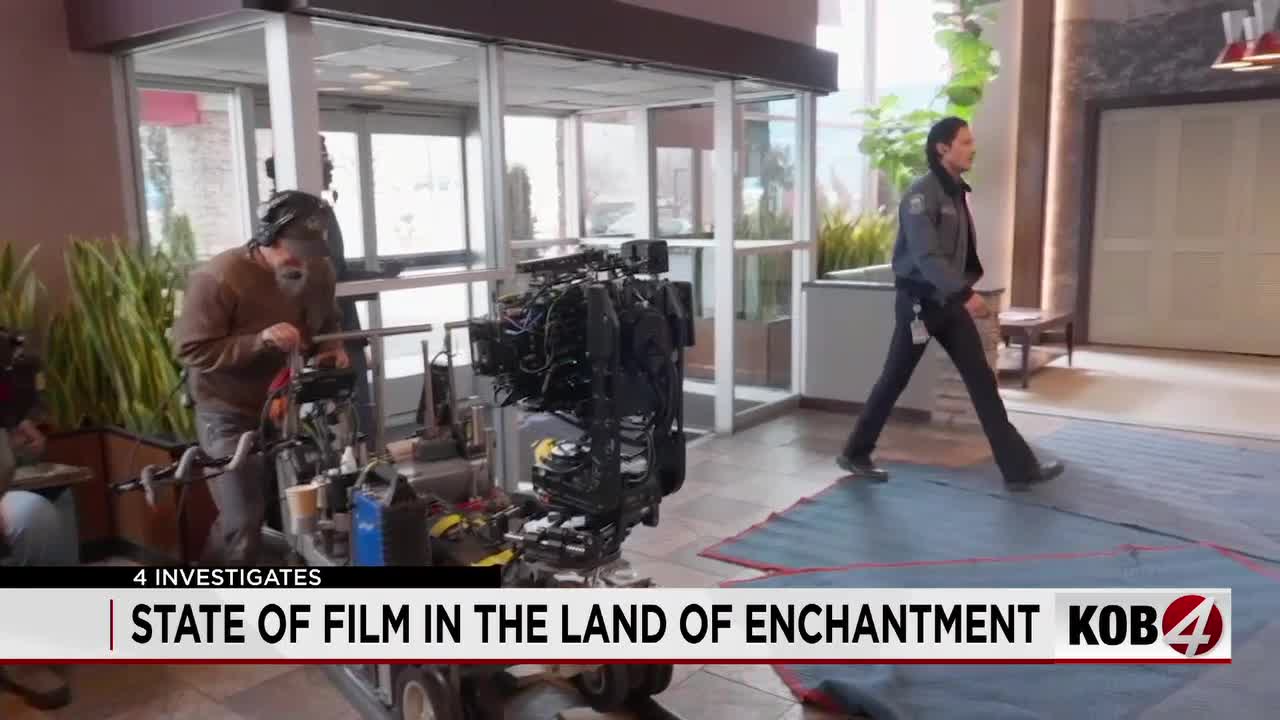
ALBUQUERQUE, N.M. — A slowdown in New Mexico’s once-surging film industry is rippling through the local economy, affecting everyone from transportation crews, set builders, artists, production companies, craft service companies and small businesses that grew alongside Netflix’s expansion in Albuquerque.
Why it matters: A yearslong push by state and local leaders turned New Mexico into one of the country’s most aggressive film tax incentive markets. Now, with fewer productions moving forward in 2026, questions are being raised about how durable that strategy is — and whether public investment has outpaced industry stability.
The backdrop: Netflix’s new hit sci-fi series The Boroughs recently transformed parts of New Mexico into a mysterious setting that, once again, features the Land of Enchantment on televisions across the world.
“We wanted to create a world that felt like you didn’t need to go to the outside world,” locations manager and scout Shani Orona said. “Everything you need is here.”
Orona’s film career migrated back to New Mexico after film tax incentives drew productions — and workers — back to her home state more than two decades ago.
“And I said this is legitimate. This can become a thing,” Orona said. “And this was 22 years ago.”
By the numbers
- 112 film productions were registered in New Mexico in 2022.
- 44 film productions have been registered in 2026 (so far), according to state data obtained by 4 Investigates.
- A record-setting $855 million was spent on productions in FY22, compared to $323 million in FY25, according to the NM Film Office. A film office spokesman said they expect to meet or exceed the FY25 spending in FY26.
- An estimated 8% return on investment for New Mexicans was identified in a legislative analysis of film tax incentives.
- 16 Netflix productions have been brought to New Mexico since 2019.
- Over 2,000 New Mexicans were employed during production of The Boroughs, which ended filming more than a year ago.
A slowdown is being felt beyond the set
The decline has not only been measured in production counts.
Small businesses that expanded during the streaming-era boom are now being forced to diversify, pivot, or leave the state as projects become less consistent.
“Anytime there’s a little bit of slowdown, I’m getting calls from all of my vendors,” Orona said. “[For] small business owners… this is a necessary thing for them.”
Necessary for people like Kimberly Montoya to stay in the film business.
“There’s just not enough work to go around,” Montoya said.
Her company, Kimmy’s Snacks Craft Services, had been built around keeping film crews fed. As productions slowed, she was forced to take her business into a restaurant space inside Revel, an Albuquerque event venue.
All but one of her staff, she said, had previously worked in film.
“Life can’t wait, your bills can’t wait,” Montoya said. “You have to figure something out.”
The instability has become a recurring challenge for film workers who often move from project to project without long-term guarantees.
She knows of two big productions ongoing now, one of them is another Netflix production, Ransom Canyon filming season two.
“They just finished filming that, but then as soon as that stopped filming, where did the people go?” Montoya said. “You have to wait and hope to get on another show. You have to wait and hope again.”
The game is now global
New Mexico’s declining film scene has not been attributed to losing to other states like California or Georgia. Instead, productions across the United States are increasingly being lost to countries offering cheaper labor, currency advantages and more aggressive subsidies — including Canada, the United Kingdom, Ireland and parts of Eastern Europe.
“As always, it’s economics,” Orona said. “Where is it cheaper to make?”
That broader shift has complicated New Mexico’s pitch and moved some of the lever of controls outside of the local government’s reach.
Even as the state maintains some of the country’s most generous film incentives, the global competition for productions has intensified following the streaming contraction, industry strikes and tighter studio spending.
Federal tax incentives were not renewed under the One Big Beautiful Bill Act, limiting the amount film studios can deduct.
There’s a bipartisan effort in Congress to restart a federal tax incentive program to compete with overseas productions.
“It may take some time, like all things in Washington D.C.,” Orona said. “I think something very interesting may come of that.”
Netflix’s expansion chose to “expand slowly”
When Netflix purchased Albuquerque Studios in 2018, the deal was framed as a transformational investment in New Mexico’s economy.
Public officials promoted plans for a major studio expansion backed by city and state public dollars, including LEDA incentives and infrastructure assistance.
In a 2020 press release, the City of Albuquerque said Netflix, “will add up to 10 new sound stages,” to the eight already there, spending “$150 million in capital expenditures.”
By 2025, four new stages were ultimately built.
Renderings released during the expansion process depicted additional buildings and studio infrastructure. At one point, arial images showed those same areas blocked off. Today, those areas have been painted over as parking spaces.
“We chose to phase the project and expand slowly,” said Jamil Walker, a spokesman for Netflix. “There are 12 stages at Netflix Studios Albuquerque that sufficiently support our production needs at the moment.”
Walker noting that The Boroughs constructed a large neighborhood set on the studio’s backlot.
An Albuquerque economic development spokesperson said Netflix has received $5.5 million from the city LEDA funds and $27 million from New Mexico LEDA funds. While Netflix has not yet met its investment requirements to nullify any clawback provisions, the amount of money pales in comparison to $5.1 billion the company claimed in free cash flow in the latest quarterly earnings report.
Netflix is evolving into something more than just a production company. Its latest letter shareholders stated:
“…we’re constantly seeking to allocate our resources to the most attractive opportunities to maximize the value we are delivering to our members. The landscape we are operating in is also more dynamic than ever.”
- Streaming continues to take view share from linear.
- Technology is enabling a massive increase in video content from a wide variety of storytellers.
- There are more ways for consumers to connect to the stories they love, including through open content platforms, interactive and gaming services.
- “Premium” content is increasingly defined by the viewer.
- The lines between entertainment on TV and mobile devices are blurring.
What’s next
Several larger questions will shape the next phase of New Mexico’s film economy:
- Netflix productions have been crucial for New Mexico workers; it alone cannot currently support the state’s film industry. Whatever Netflix does next will deeply impact the state’s film outlook.
- How effective LEDA funding and state-backed infrastructure subsidies have been in producing permanent economic growth.
- Whether the state’s film tax credits are generating enough long-term local wealth to justify continued expansion.
- Whether proposed federal legislation aimed at encouraging domestic film production could shift projects back from overseas markets.
As for The Boroughs, Netflix’s newest number one show, the 2,000 local film workers are waiting to hear if season two will be greenlit.
“We’re hoping that we will,” Orona said.
- For Related Stories: Ryan Laughlin