The race to represent Western and Southern Colorado in Congress may pivot on whether voters view the incumbent as a pragmatist willing to break with his own party or as a reliable vote for the president, even at the expense of his district’s interests.
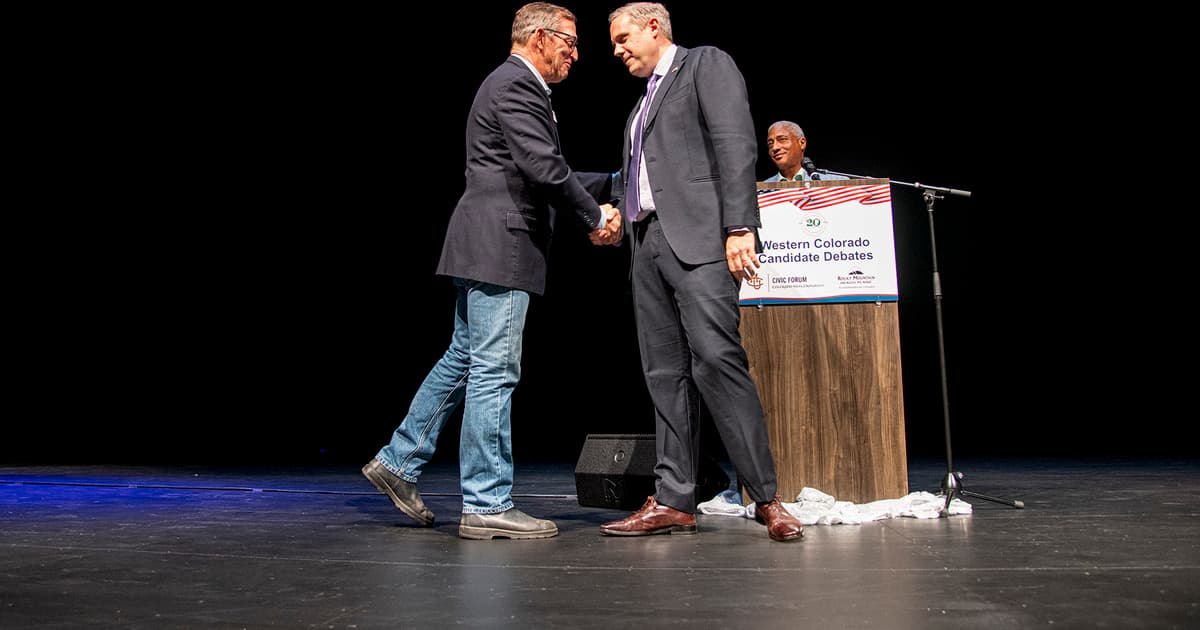
That was the fulcrum of Saturday night’s Club 20 debates in Grand Junction where 3rd Congressional District Republican Jeff Hurd defended his record against his Democratic challenger, Dwayne Romero. Romero, a former Aspen city councilman and Army Ranger, said Hurd’s efforts to cast himself as a dissenting voice overstated his case as an independent thinker.
“You voted against one tariff against Canada and you use that as a performative little showboat piece. You’re trying to be a maverick. You’re not Tom Cruise here, bud,” Romero said, alluding to the protagonist of the 1986 Tony Scott film “Top Gun” and its 2022 follow-up, “Top Gun: Maverick.”
Hurd, a Grand Junction attorney finishing his first term in Congress, noted his willingness to break with his party as well as his reasonableness.
“I’m sorry, I’m more pragmatic. I’m not hardcore,” Hurd said during an exchange over public lands use. Hurd noted that Romero had described his own public lands opinions as “hardcore” and that Romero wanted to limit future lease sales. “My opponent isn’t (pragmatic). He takes a hardcore position. I don’t think that’s consistent, Dwayne, with what the people of this district need and what they deserve when it comes to economic development.”
The congressman also pointed to his opposition to public lands sales and a bill to limit expansion of a quarry near Glenwood Springs. Early in President Donald Trump’s first term, Republicans in Congress made a push to sell millions of acres of public lands.
“I was the one Republican vote in the House of Representatives to not go forward with a massive public land sale, and then we worked behind the scenes to strip that out of the final legislation. It wasn’t even passed out of the House of Representatives. Another example of me standing up for my district and for what’s right in making sure that that provision was not included in the legislation,” Hurd said.
Romero, who runs a property management company in the Roaring Fork Valley, challenged Hurd’s framing of his time in Congress, suggesting instead that Hurd was too deferential to Republican leadership. He also said that rising costs due to federal cuts and the Iran war amounted to “broken promises” from the congressman.
“You said that you would work hard to improve access to healthcare. You also said you would help to improve the cost of living for families in CD3. You also said that you would support moving away from these forever wars, that they recognize the dilemma and the drain on our families and our boys and our girls serving forever overseas,” Romero said.
The debate headlined Club 20’s fall debate calendar, and could be the only time that the two candidates share a stage leading up to the elections. Denver-based 9News said Romero declined a debate that would have been set in Pueblo, the other major population center in Colorado’s 3rd Congressional District.
William Woody for CPR NewsDwayne Romero, Democratic candidate for Colorado’s 3rd Congressional District, speaks during a debate with incumbent Jeff Hurd during a Club 20 event at the Asteria Theater in Grand Junction. Sept. 19, 2026.William Woody for CPR NewsU.S. Rep. Jeff Hurd, incumbent candidate for Colorado’s 3rd Congressional District, speaks during a debate with challenger Dwayne Romero at a Club 20 event at the Asteria Theater in Grand Junction. Sept. 19, 2026.
One Big Beautiful Bill or One Big Liability?
Hurd and Romero spent significant portions of Saturday’s debate painting starkly different pictures of President Donald Trump’s One Big Beautiful Bill, which Hurd supported as a freshman member of the House of Representatives.
“You said your first step in Congress is going to be to, in your words, rescind the legislation that we passed last year that included middle class tax cuts. No tax on tips, no tax on overtime, child tax deduction increase, child tax credit increase, tax relief for social security recipients. Why do you and the liberals who are supporting you believe it was wrong to cut taxes for working families?” Hurd asked Romero.
Romero regularly criticized Hurd’s vote for the legislation, which is also known as H.R. 1, for cuts that it would make to healthcare and food assistance, describing the middle-class tax cut portion of the legislation as “sugar” to cover up less popular parts of the legislation. Romero defended his claims that he would reverse Trump’s signature piece of legislation.
“(Hurd) promised to protect federal lands. He promised to protect our forest. He promised to also defend our cost of living. He promised to help provide access to healthcare and he promised to get out of forever wars,” Romero said. “So with all that being said, yes, I definitely would go full scale in returning and restoring those federal funds and the priorities by which we should live by here in Colorado.”
The One Big Beautiful Bill, now a law, was one of the first major votes for Hurd in congress. It provided extensive tax cuts, mostly to high-income Americans, and also included some of Trump’s signature promises, including no taxes on tipped wages through the end of 2028. Democrats, however, have criticized the bill for cutting close to $1 trillion from Medicaid over the next 10 years while also cutting food assistance benefits.
“It shields the real desire that you’ve done, which is to kick off 120,000 people in Colorado off of healthcare,” Romero said.
Hurd challenged Romero’s claim, noting that the cuts to Medicaid funding don’t take effect until 2027. Since the passage of the bill, state officials, including Gov. Jared Polis, have estimated that more than 100,000 residents would lose access to healthcare over the cuts and that costs for healthcare would increase by double-digit percentage points.
“It’s a good bill. I was proud to support it and you disagree on it,” Hurd said.