Your support helps us to tell the story
From reproductive rights to climate change to Big Tech, The Independent is on the ground when the story is developing. Whether it’s investigating the financials of Elon Musk’s pro-Trump PAC or producing our latest documentary, ‘The A Word’, which shines a light on the American women fighting for reproductive rights, we know how important it is to parse out the facts from the messaging.
At such a critical moment in US history, we need reporters on the ground. Your donation allows us to keep sending journalists to speak to both sides of the story.
The Independent is trusted by Americans across the entire political spectrum. And unlike many other quality news outlets, we choose not to lock Americans out of our reporting and analysis with paywalls. We believe quality journalism should be available to everyone, paid for by those who can afford it.
Your support makes all the difference.Read more
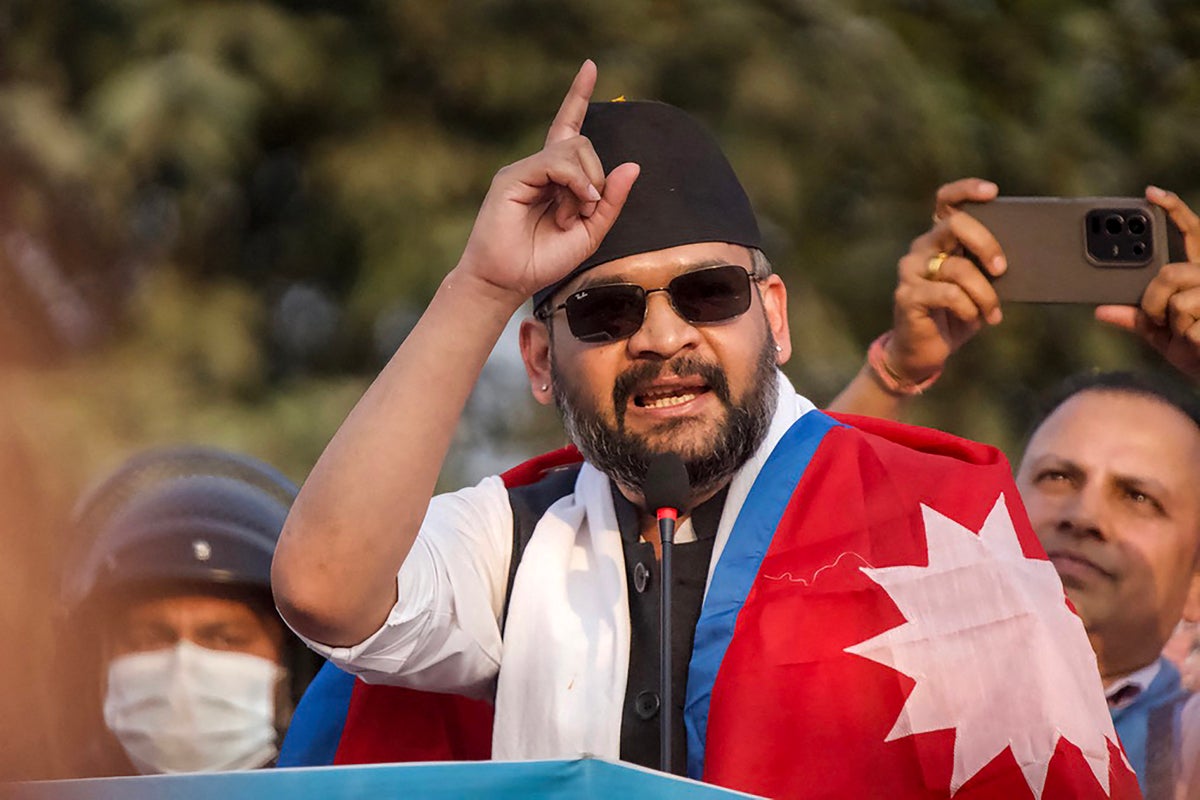
A Nepali rap star who emerged as a strong voice during last year’s Gen Z-led civil unrest, looks set to become the country’s next prime minister after official results showed his party securing a lead in the recently-held parliamentary elections.
Partial results released by Nepal’s election commission indicate that Balendra Shah‘s centrist Rastriya Swatantra Party (RSP), formed less than four years ago, has taken a dominant position in the vote count.
The party had already secured 117 of the 165 directly elected seats in the House of Representatives of the federal parliament and was also leading the party-list vote used to allocate proportional representation seats, according to the Associated Press (AP).
The outcome marks a dramatic upheaval in the politics of the Himalayan nation of about 30 million people as Shah defeated veteran four-time prime minister Khadga Prasad Sharma Oli.
Oli, 74, congratulated Shah in a post on X, wishing him a “smooth and successful” term.
open image in gallery
Nepal’s rapper-turned-mayor challenged veteran leader KP Sharma Oli in a head-to-head battle for 5 March elections in the former prime minister’s own constituency (AFP via Getty Images)
Sakina Batt, a 35-year-old resident of Kathmandu, describes witnessing the political upheaval amid hope for a dramatic turnaround for the country under Shah’s leadership.
“It was so overwhelming because earlier whenever there used to be elections we hardly used to know, we hardly used to get that kind of a vibe,” she tells The Independent. “But this time it felt like there were so many people participating, and taking interest in politics.”
For decades, power has largely rotated between established parties, including the Nepali Congress and communist groups such as the Communist Party of Nepal (Unified Marxist–Leninist) also known as UML, whose leaders have dominated national politics since the 1990s.
Much of the credit for reviving hope among people has been given to Shah, popularly known as “Balen”. Supporters of RSP’s prime ministerial candidate started celebrating his win in several constituencies, offering flower garlands, bouquets, scarves and smearing him with vermilion powder.
“The future prime minister (Shah) has clearly spoken that there will be no compromise when it comes to developing the country,” RSP party member and volunteer Khagendra Chapagain, who was at the party headquarters in Kathmandu, told the Associated Press.
open image in gallery
Supporters of the Rastriya Swatantra Party (RSP) celebrate as counting begins in Kathmandu on 6 March 2026 a day after Nepal’s parliamentary election (AFP via Getty Images)
The 35-year-old’s trajectory is unusual even in a political era shaped by social media and anti-establishment movements. A trained civil engineer who first rose to prominence as a rapper, Shah later became the mayor of Kathmandu before emerging as a leading figure in the youth-driven protests that shook the country last year.
His rise coincided with a period of anger among younger voters, many of whom accuse Nepal’s political establishment of corruption, patronage networks, and failure to address unemployment.
Batt compares Shah to the protagonist of a popular 2001 Hindi language film, Nayak, which features a common man becoming a chief minister of a state for a day and using the limited time to fight corruption.
“He reminded me so much of Nayak because he did the things that would irk the powerful people, like, taking down the illegal houses and illegal buildings and giving it back to the government and building roads. So many things he did like Anil Kapoor in that film,” she says, comparing Shah to the popular Bollywood actor who played the protagonist.
Sudeep Bista, a pilot in Nepal, however, is sceptical about Shah’s elevation.
“So far we have seen Balen only on the domestic platform dealing with internal issues of Kathmandu alone. He seemed fearless and was committed to rectify all the issues that had been persistent over the past decades,” he tells The Independent.
“He did win the support of the general public and the end result has just unfolded with a massive mandate.”
In November 2025, as Kathmandu’s mayor, Shah triggered a major diplomatic and political storm by posting a rant on Facebook using expletives against US, India, China, and Nepal’s political parties. Venting out at the neighbours and domestic parties, he said: “F*** America, F*** India, F*** China, F*** UML, F*** Congress, F*** RSP, F*** RPP, F*** Maobaadi. Go to hell, you guys all combined can do nothing.”
open image in gallery
Electoral officials sit on the floor as they count votes at the counting centre after voting ended in Nepal’s general election in Kathmandu on March 5, 2026 (AFP via Getty Images)
The post drew swift condemnation from political leaders and the public, with many describing it as “the height of irresponsibility” for a public official looking to run for the prime minister’s post, reported the Hindustan Times. Shah later deleted his post.
“He seemed very blunt at times on his work delivery and speeches… But how he will fare on the international stage is … going to be a real challenge,” says Bista.
Before entering electoral politics, Shah was known primarily as a performer in Nepal’s hip-hop scene.
He began attracting national attention in 2013 after appearing in a rap battle known as Raw Barz. The performance made him a familiar name in the country’s music community and helped build an audience for songs that frequently criticised political corruption and social inequality.
Over time, his music developed a political following, particularly among young Nepalis. One track, Nepal Haseko (Nepal Smiling), later became associated with the protest movement that erupted across the country in 2025.
The song in Nepali language said: “What is the use of a society without happiness? let’s wipe out the dark past, make a revolution, you (people) are the masters.”
open image in gallery
Relatives and supporters take part in the cremation ritual of Gen-Z protesters who were shot dead during Last Monday’s deadly protest, at Pashupatinath Temple on 16 September 2025 in Kathmandu, Nepal (Getty Images)
During the protests the track was widely shared online and eventually attracted more than 10 million views on YouTube.
Another song, Balidan (Sacrifice), which focuses on themes of impunity and corruption, also gained millions of views.
Batt says Shah’s rap reflects a deep understanding of Nepal.
“Most of his raps are about the country being corrupted and youth leaving abroad for employment,” she says. She adds, “Rappers are…observers. Whatever they rap, there is a fact involved in that.”
“He kind of understands his country, kind of understands his people, and he kind of knows the feelings and the emotions of the youth.”
Shah’s public image, defined by his beard, dark clothing, and trademark black sunglasses, also became widely recognised, especially among younger supporters.
At one point shops in Kathmandu reportedly ran out of sunglasses similar to those he wears – marketed online as “Balen Shah glasses”.
“Lot of girls have a crush on him,” laughs Batt.
Shah’s transition from music to politics happened in 2022.
Running as an independent, he won Kathmandu’s mayoral election with 61,767 votes, beating the Nepali Congress (38,341) and UML (38,117) candidates. The shock result reflected the strong anti-establishment sentiments in the capital.
During his tenure as mayor, Shah pursued a series of initiatives aimed at improving municipal management in the city. These included addressing longstanding waste disposal problems, coordinating with private companies and the Ministry of Urban Development to clear uncollected garbage.
“There were gross violations all across the city. Businesses being run in basement parking spaces and buildings being built without any design approvals,” says Nabin Manandhar, spokesperson for the Kathmandu Metropolitan City Office, which operates under the executive authority of the mayor. Most violations have been removed, and remaining ones are monitored, he tells the Kathmandu Post.
However, his approach attracted criticism as well. His administration’s demolition of illegal structures and the relocation of squatters from riverbanks drew accusations that some of his policies were heavy-handed. Rights groups criticised the use of police against street vendors as the city attempted to regulate unlicensed businesses and keep roads clear.
Shah also took measures to reform public schools. Historically accused of nepotism, private schools now use an online scholarship system based on merit, social disadvantage, and prior government school attendance.
Surendra Bajgain, who oversaw education, tells the outlet: “The transparency adopted in scholarship schemes in Kathmandu Metropolitan City’s schools is among the local unit’s important initiatives.”
Nepal’s current election follows a period of political upheaval triggered by the September 2025 protests.
The protests initially erupted after the Oli government imposed a ban on social media platforms. The move quickly ignited wider anger over corruption, inequality and lack of opportunities for young people, escalating into wider confrontation
At least 77 people were killed during the unrest, many of them protesters who were shot by police, reported Al Jazeera. Government buildings and other state institutions were also attacked during the clashes.
The crisis forced Oli to resign from office. The protests significantly reshaped Nepal’s political environment as many young voters saw the election that followed as a chance to challenge the older order.
Shah chose to run in Jhapa-5, a constituency in eastern Nepal long associated with Oli, with him winning decisively against the veteran politician, receiving 68,348 votes compared with Oli’s 18,734.
For supporters, the result symbolised a generational shift.
The RSP combined large rallies with an extensive digital strategy aimed at younger voters.
Strategy teams and hundreds of campaign workers organised road shows across multiple districts and managed the party’s online messaging. Supporters also produced AI-generated campaign music that was played at rallies.
Shah himself generally avoided interviews with traditional news outlets, instead communicating through social media, podcasts and televised appearances.
He has a large online following, with millions of followers across Facebook, Instagram, YouTube and other platforms.
More than 40 per cent of Nepal’s population is under the age of 35, yet most senior party leaders are in their seventies.
Over 900,000 first-time voters joined Nepal’s nearly 19 million electorate, with youth unemployment at 20.6 percent, prompting Shah’s pledge to create 1.2 million jobs and curb labor migration.
But analysts warn that the scale of expectations facing Shah is enormous.
“The problem or challenge with this new party would be to deliver things, given the limited resources and the limited institutional support,” independent analyst Keshab Prasad Poudel tells AP.
“Because people have high expectations, that doesn’t necessarily mean that the new party can fulfil it.”