Your support helps us to tell the story
From reproductive rights to climate change to Big Tech, The Independent is on the ground when the story is developing. Whether it’s investigating the financials of Elon Musk’s pro-Trump PAC or producing our latest documentary, ‘The A Word’, which shines a light on the American women fighting for reproductive rights, we know how important it is to parse out the facts from the messaging.
At such a critical moment in US history, we need reporters on the ground. Your donation allows us to keep sending journalists to speak to both sides of the story.
The Independent is trusted by Americans across the entire political spectrum. And unlike many other quality news outlets, we choose not to lock Americans out of our reporting and analysis with paywalls. We believe quality journalism should be available to everyone, paid for by those who can afford it.
Your support makes all the difference.Read more
North Korea launched multiple ballistic missiles toward the sea on Sunday, in the country’s latest weapons testing activity this year.
South Korea’s Joint Chiefs of Staff said the launches happened on Sunday morning from the North’s eastern Sinpo area. It said South Korea has bolstered its surveillance posture and is closely exchanging information with the US and Japan.
South Korea’s presidential office said its National Security Council plans to hold an emergency meeting to discuss the launches.
Japan’s Defense Ministry also detected the launches, saying the weapons were believed to have landed in the waters off North Korea’s east coast. It said Tokyo strongly protested to Pyongyang, saying Sunday’s launches threaten regional and international peace and violated UN Security Council resolutions that bans any ballistic activities by North Korea.
(AFP/Getty)
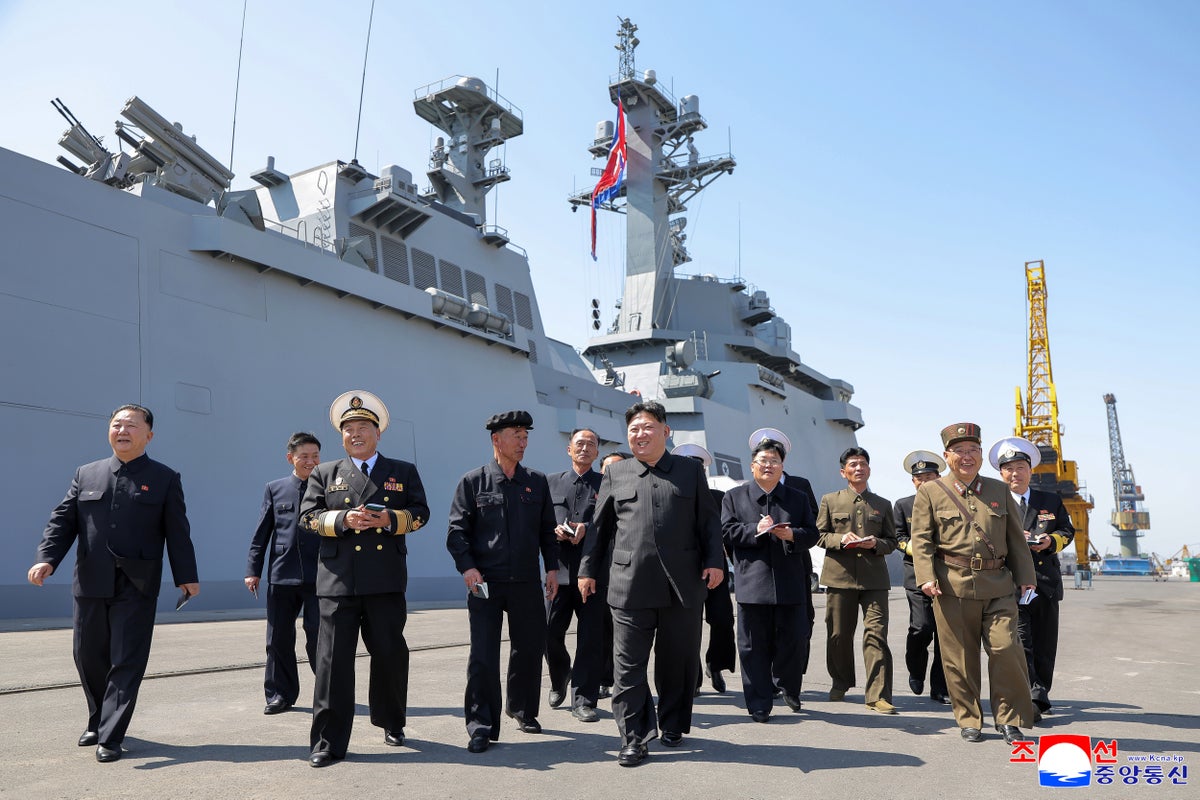
Last week, North Korea said leader Kim Jong Un supervised missile tests from the country’s destroyer. After the test, Kim said his government remained focused on the “limitless expansion” of its nuclear forces and issued unspecified new tasks to sharpen the country’s nuclear attack and rapid-response capabilities.
International Atomic Energy Agency Director General Rafael Grossi said last week that his agency has confirmed “a rapid increase” in activities at nuclear facilities in North Korea.
Pyongyang’s intense missile activity – this was the fourth such launch this month and the seventh of the year – is meant to display its self-defence capabilities while gaining international leverage, some experts said.
“The missile launches may be a way of showing that – unlike Iran – we have self-defence capabilities,” said South Korean former presidential security adviser Kim Ki Jung.
“The North also appears to be exerting pressure preemptively and make a show of force before engaging in dialogue with the United States and South Korea,” he said.
The seven-week-old US-Israeli war against Iran, which has as one aim the curbing of Tehran’s nuclear programme, could reinforce Pyongyang’s nuclear ambitions, experts and former South Korean officials say.
US president Donald Trump, preparing for a summit in China next month, and South Korean President Lee Jae Myung have repeatedly expressed interest in holding talks with North Korean leader Kim Jong Un. There are no publicly known plans for any meetings.
Lee recently conveyed regret to the North for drone incursions from the South, receiving rare praise from Pyongyang.
It was not clear what kind of ballistic missiles were fired, but Sinpo has submarines and equipment for test-firing submarine-launched ballistic missiles. The North last fired a ballistic missile from a submarine in May 2022, and it flew as far as 600km (370 miles).
In late March, North Korean leader Kim said Pyongyang’s status as a nuclear-armed state was irreversible and expanding a “self-defensive nuclear deterrent” was essential to national security.