Your support helps us to tell the story
From reproductive rights to climate change to Big Tech, The Independent is on the ground when the story is developing. Whether it’s investigating the financials of Elon Musk’s pro-Trump PAC or producing our latest documentary, ‘The A Word’, which shines a light on the American women fighting for reproductive rights, we know how important it is to parse out the facts from the messaging.
At such a critical moment in US history, we need reporters on the ground. Your donation allows us to keep sending journalists to speak to both sides of the story.
The Independent is trusted by Americans across the entire political spectrum. And unlike many other quality news outlets, we choose not to lock Americans out of our reporting and analysis with paywalls. We believe quality journalism should be available to everyone, paid for by those who can afford it.
Your support makes all the difference.Read more
Pakistan is reportedly keen to host the second round of peace negotiations between the US and Iran to end the war in the Middle East, just days after the first such attempt failed to result in a breakthrough.
Both the US and Iran could return to Islamabad as early as the end of this week, a source aware of the talks says, adding that the date was yet to be decided as the conflict continued to simmer. The war, now in its seventh week, has jolted markets and rattled the global economy as shipping has been cut off and airstrikes have torn through military and civilian infrastructure across the region.
Iran and the US came “very close” to an agreement and were “80 per cent there” during last weekend’s meeting in Pakistan’s capital Islamabad, held four days after the announcement of a ceasefire, sources say. It was the first direct encounter between US and Iranian officials in more than a decade, and the most senior engagement since Iran’s 1979 Islamic Revolution.
US vice president JD Vance represented the administration of US president Donald Trump. Iran was represented by parliamentary speaker Mohammad Baqer Qalibaf and foreign minister Abbas Araqchi.
If the talks enter the second round with more signs of willingness from all parties to end the conflict, Pakistan would’ve successfully managed to break the deadlock and push US and Iran closer to peace.
“We have reached out to Iran and got a positive response that they will be open to a second round of talks,” a senior official in the Pakistani government says. Officials say they have sent a proposal to both US and Iran to re-send their delegates to resume the talks.
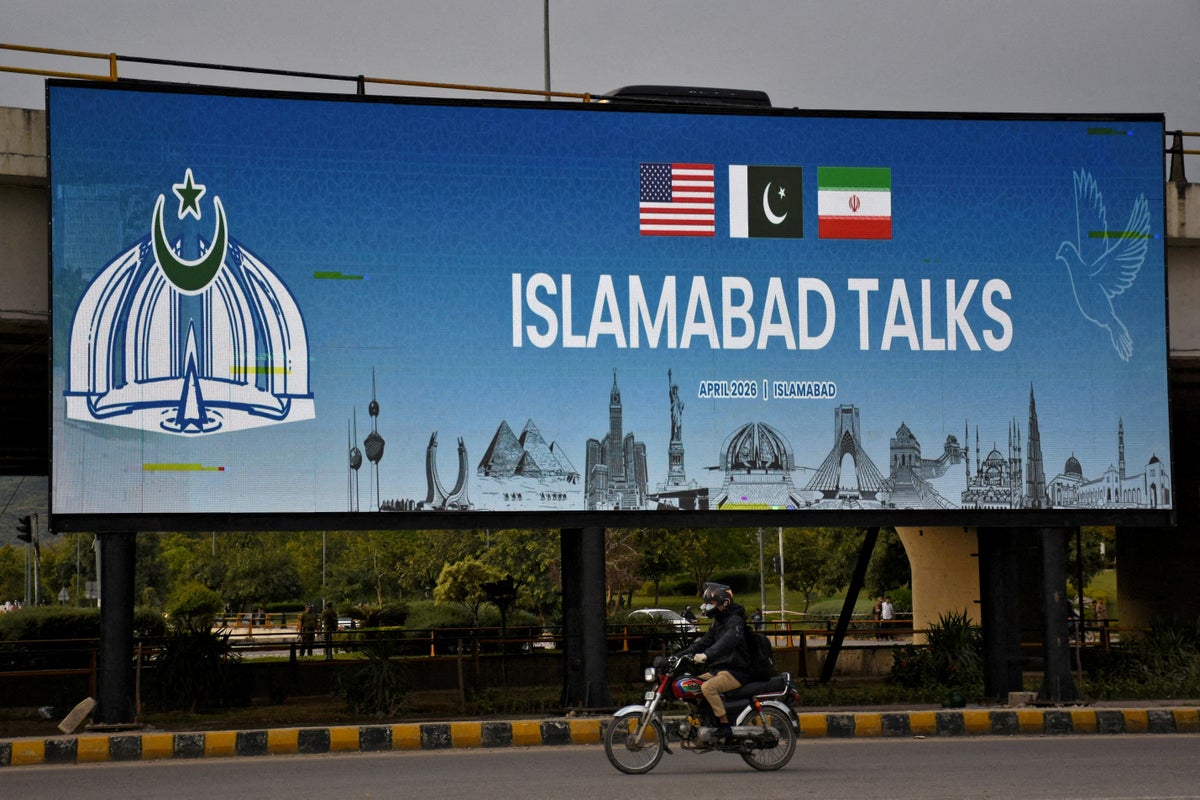
Giant hoardings with “Islamabad Talks” written on them still hang outside the luxurious venue of the Hotel Serena in the capital.
US vice president JD Vance speaks during a press conference after hectic negotiations with Iran (Reuters)
Islamabad is also coordinating with the two sides on the timing of the next round and the meeting would once again likely be scheduled for the weekend. Nearly a dozen sources aware of the negotiations have said the dialogue was still alive, just days after Vance said the US was waiting to see if Iran will accept their “final and best offer”.
“No firm date has been set, with the delegations keeping Friday through Sunday open,” a senior Iranian source told Reuters. The chatter within Islamabad’s circles has confirmed that the Pakistani government is continuing to push the Americans and the Iranians to once again sit down to reach an agreement and an extension to the ceasefire, if not a complete resolution.
“There were ups and downs. There were tense moments. People left the room, and then came back,” the security source said. Pakistani representatives, including army chief Asim Munir, and foreign minister Ishaq Dar, moved between the sides through the night to keep things on track, five Pakistani sources said.
The reopening of the Strait of Hormuz, Iran’s nuclear programme, and international sanctions was among the top concerns for Vance. The major transit point for global energy supplies was blocked by Iran after the US attacked the Islamic Republic and killed its supreme leader Ayatollah Ali Khamenei.
Iran’s Parliament speaker Mohammad Bagher Qalibaf and Iran’s foreign minister Abbas Araghchi are greeted by Pakistan foreign minister Ishaq Dar and Army Chief Field Marshal Gen. Asim Munir upon their arrival at Nur Khan airbase in Rawalpindi (AP)
The US has aggressively pushed for Iran to give up its nuclear ambitions and proposed a 20-year moratorium on uranium enrichment by Iran as part of a proposed nuclear agreement, even though Tehran has denied seeking nuclear weapons.
Tehran officials reportedly countered with a significantly shorter period – a 5-year freeze on the programme, Axios reported.
Vance told Iranian officials that they should dismantle all major nuclear enrichment facilities, turn over its highly enriched uranium, accept a broader peace, agree a security framework that includes regional allies, end funding for regional proxies, and fully open Hormuz without charging an exorbitant toll.
In return, Iran said the US should guarantee a permanent ceasefire, ban future strikes on Iran and its allies in the region, lifting of primary and secondary sanctions, unfreezing of all assets, recognition of its right to enrichment, and continued control of Hormuz, sources told Reuters.
The two sides were inching closer to an understanding but the tense negotiations collapsed over Iran’s nuclear programme, the Strait of Hormuz and the amount of frozen assets to which Tehran is seeking access.
The standoff deepened on Tuesday as the US declared it had blockaded Iran’s ports and Tehran threatened to strike targets across the region.
Though last week’s ceasefire appeared to hold, the showdown over the strait risked reigniting hostilities and deepening the region-wide war’s economic fallout. The ceasefire will expire on 21 April.
Experts in Islamabad say even though no immediate resolution was reached, Pakistan still managed to bring the high-voltage conflict to a pause.
“Pakistani officials are engaged with both the countries and still pursuing their efforts. Despite no breakthrough, it has seen success: we have seen that no airstrikes have resumed from Israel or America on Iran so far,” Abdullah Khan, managing director at the Pakistan Institute for Conflict and Security Studies, tells The Independent, adding that Pakistan also pursued Iran to not target the Gulf nations anymore.
It is enough progress for the next round, Khan says. “Americans have clearly given their list to the Iranians and there’s little that needs to be agreed to. We can say that the majority of the issues were agreed upon and on the nuclear issue and some critical ones that need agreeing to.”
Pakistan still has a winning move or two left, says Pakistani diplomat Asif Durrani.
“On the uranium enrichment issue, the US wants Iran to forgo their nuclear research or development of industrial uranium. The US demands 20 years while Iran has offered five years. Somewhere in the middle of the road perhaps some agreement is possible, say 10 years,” the former Pakistani ambassador to the UAE and Iran says.
“Hopefully good sense will prevail [in the upcoming round of mediation by Pakistan] as the US has realised it does not enjoy the geographical advantage which Iran has and neither does Israel. More importantly, neither Israel nor the US are ready to put their boots on the ground. If that’s the situation, it’s a stalemate for the US and for Israel,” he says.
“It (Pakistan) enjoys loyalty to Iran as the only regional ally and has a great deal of trust with the Trump administration. Vice president JD Vance went on Fox News last night and he praised the Pakistani government, specifically naming the prime minister and chief of defense forces. It shows that Pakistan will continue to play that role until that deal is done as far as the negotiation is concerned,” says Dr Kamran Bokhari, senior resident fellow at the Middle East Policy Council in Washington, DC.
He adds that it only makes sense for Pakistan to host another round of talks as a third party mediator.
And if there are signs of any potential breakthrough this time around, the US president could make a grand entry, he says.
(AFP/Getty)
“The President of the United States will only come if there’s a deal to be signed and not if this is just another meeting. He will show up once most things are settled, and in fact, almost all things are settled, and then it’s just there for, you know, the signing ceremony,” Bokhari says.
Till then, his war with Iran will be managed by Vance and other diplomats who could be planning another visit to Islamabad, he says.