(function(w,q))(window,”_mgq”);
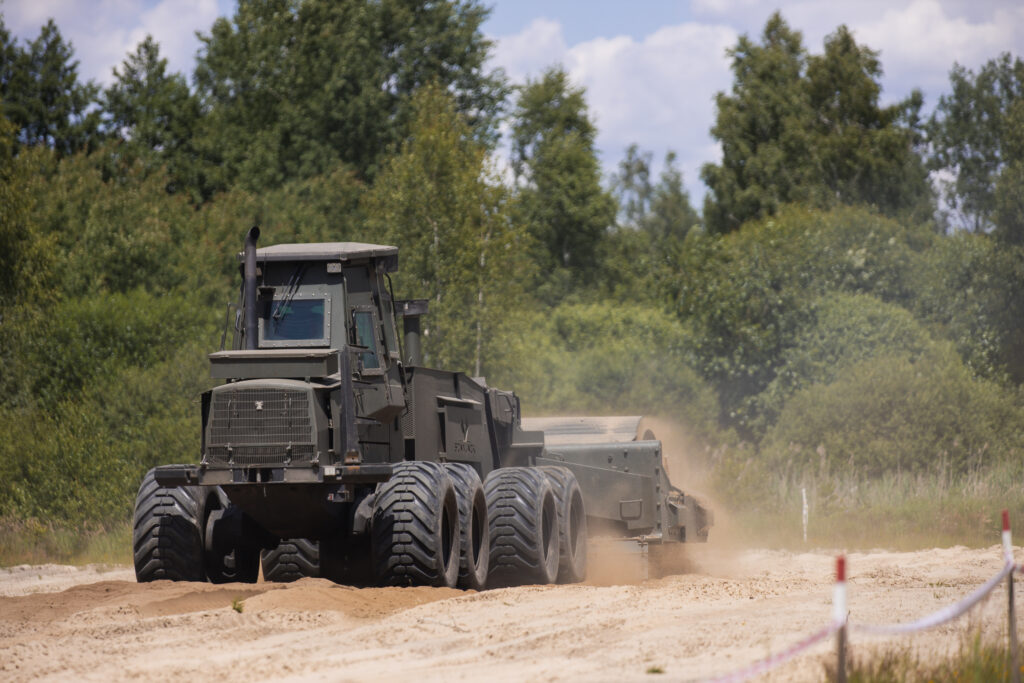
The cameras were up and the film was rolling, and so was the ScanJack 3500—the biggest machine on the field, four wheels, roughly the size of a bus. It crawled along the sandy ground for over five minutes, engine deafening, its chains churning the soil and raising a cloud of dust and sand, pace glacial, every lens trained on it and waiting.
It was the one moment all day that went exactly to plan—a machine doing on cue what the brochure promises.
When it finally reached its mine and set it off, the bang caught the whole press corps out: we twitched as one, then burst out laughing, a little sheepishly, at having flinched. It was the one moment all day that went exactly to plan—a machine doing on cue what the brochure promises—and we had been walked over specially to see it.
This was the second UTTC Technology Week, its media day of live trials on 17 June at a field in Lviv Oblast nobody would name. The Ministry of Defense staged it with the Ministry of Economy, Environment and Agriculture and the UN Development Programme, and the pitch was the future of demining: minefields cleared by drones, AI, and robots, with people kept as far from the bang as possible.
The demining robot Germina rolls past during the march of technologies. Photo: Olha Zalizniak / UNDP Ukraine
A swimming meet in the dust
The centerpiece was a “technology relay.” Whatever that would mean.
In the end, it was two teams—government operators on one side, commercial deminers on the other—turned loose on two plots, an open agricultural field and a wooded strip, apparently seeded with mines and tripwires.
There was the roar of engines, the scorching sun that fried us where we stood, giant horseflies buzzing bloodthirstily around, and the machines.
Apparently, because for the time we were there, nothing on those plots went off. There was the roar of engines, the scorching sun that fried us where we stood, giant horseflies buzzing bloodthirstily around, and the machines spent half the time too far off or behind the trees and bushes to make anything out.
Drones whirred overhead and fed images to the screens in the nearby tent; a woman with a microphone narrated gamely, and still none of it resolved into anything I could follow. The officials kept insisting this was not a competition but an exchange of experience—a strange thing to say about two teams racing each other across a minefield.
During the debrief, one veteran of the event admitted he had stood at the edge of the same field with the same question I had.
I kept thinking of Raoul Duke—Hunter S. Thompson’s stand-in in Fear and Loathing in Las Vegas—out at the mad racing event called Mint 400, trying and failing to keep track of a race behind a wall of dust and chaos. I was not alone in this. During the debrief, one veteran of the event admitted he had stood at the edge of the same field with the same question I had: Okay, but what is actually going on here?
Euromaidan Press journalist Peeter Helme, second from left, inspects the crater left after the ScanJack 3500 detonated a mine. Photo: Olha Zalizniak / UNDP Ukraine
The cast
There were speeches, because there always are. Oleg Shuvarskyi of the Ministry of Defense opened by promising the equipment on show was no longer absurdly expensive—that it had, as he put it, more “earthly” prices now.
Then came Deputy Minister Ihor Bezkaravainyi, who lost his own leg to a Russian anti-tank mine in 2015 and now coordinates Ukraine’s demining response. He reached for Lao Tzu—governing a state, the saying goes, is like cooking a small fish—and then delivered the line he repeats like a mantra: mine action is not about demining. Demining is only part of it. The rest is economy, agriculture, environment, governance, the whole slow business of making land usable again.
Explore further
Russian mines cost Ukraine $11 billion every year. Clearing them is the work of decades
The UN’s people spoke too. Ben Lark, who runs UNDP’s mine action program here, framed the day as less about the machines than about getting operators, manufacturers, scientists, and donors into one field to argue with each other.
His research specialist, Edward Crowther, was bolder about the stakes: Ukraine, he said, is at the cutting edge of humanitarian demining technology worldwide right now. Coming from the organization writing some of the checks, it is the kind of claim worth holding at arm’s length—though on the evidence of the impressive-looking hardware rolling past, not an empty one.
UNDP’s Edward Crowther addresses journalists at UTTC Technology Week. Photo: Euromaidan Press
The march of machines
Before the relay, there was a “march of technologies.” The whole arsenal passed us in single file—driven, flown, or, for the small things like experimental battery packs or smaller medical units, carried by hand.
A good deal of it still experimental, being tested and tweaked on this very ground.
Among them: the behemoth ScanJack 3500, different soil-tilling rigs and remote-controlled mowers, the medium MV-4 and the Neo ground robots, drones for visual and magnetic survey, an electromagnetic trawl for detonating mines from a distance, even a portable Vodafone base station for throwing up a signal in a field.
Most of it Ukrainian-made. A good deal of it still experimental, being tested and tweaked on this very ground, partially on this very day.
Maksym Dobrianskyi, a war veteran who lost a leg to an anti-personnel mine in 2023 and retrained as a humanitarian deminer, at UTTC Technology Week. Photo: Euromaidan Press
A quieter corner
At a separate briefing held for the small group of journalists present, in a calmer corner of the field, a veteran named Maksym Dobrianskyi told us how he came to this work. He fought around Bakhmut and Avdiivka, and in 2023, he stepped on an anti-personnel mine and lost a leg.
Instead, he found a leaflet at an employment center advertising retraining for wounded veterans as humanitarian deminers, and took it.
He had braced himself, he said, for a life of sitting at home and grieving. Instead, he found a leaflet at an employment center advertising retraining for wounded veterans as humanitarian deminers, and took it. He clears mines now.
“I was wounded, and I want to help people the same way,” he said, “so that this doesn’t happen.” Two men in the same field, both missing a leg to a Russian mine, both now spending their lives on it.
Macarons and minefields
The lunch was warm—a choice of sausage or baked fish, spaghetti with herbs—and the spread around it was generous: fruit and vegetables, little cakes, macarons, different salads. We stood eating there in a dust-blown field while fat horseflies worked our arms and legs, and I felt the sunburn slowly but surely taking hold of my face and neck.
Mines and unexploded ordnance have killed more than 400 people and injured over 1,000 since the full-scale invasion.
Russia’s war has affected roughly 133,300 square kilometers of Ukraine, including 57,900 square kilometers of farmland—an area larger than Croatia—at a cost Kyiv puts at $11 billion a year. Mines and unexploded ordnance have killed more than 400 people and injured over 1,000 since the full-scale invasion, by Ukraine’s own count.
Bezkaravainyi has said openly that parts of the country may never come back: a Ukrainian Zone Rouge to set beside the one the First World War left in France, or beside Chornobyl.
What the machines still can’t do
The jury’s sharpest verdict of the day was not praise but a wish list. Deminers are still hauling five or six separate robots to a site—one to fly, one to search, one to dig, one to blow things up—when what they want is a single universal machine that does it all. Whether it’s a realistic direction engineers are working toward or a sci-fi dream remains one of the day’s mysteries.
Innovation has been far better at killing in this war than at cleaning up after it.
Another remark was that although at the exercise field the teams could freely use airborne drones for reconnaissance, in reality, it would be impossible near the front because such drones are not hardened against electronic warfare.
And the minister whose ministry helped stage the whole show is the same man who told me, a month earlier, that innovation has been far better at killing in this war than at cleaning up after it. Machines identify, Bezkaravainyi said. Humans still clear.
I was sunburned, bitten raw by horseflies, and too fried to follow the closing remarks, which had drifted into the kind of shop talk only the people who do this for a living could love.
By the end of the day, I was sunburned, bitten raw by horseflies, and too fried to follow the closing remarks, which had drifted into the kind of shop talk only the people who do this for a living could love and understand.
When it was over, the buses took us back. Bone-tired as I was, I held off until we hit the main road and the signal returned, then grabbed my phone and frantically thumbed through a day’s worth of emails and messages, feeling naked after so long cut off from the world.
Read also
-
Mongols, Soviets, now Putin: every empire told Ukraine “you are one of us.” None were right.
-
Mined in, starved out, hunted from above—life in the towns Russia demands at the peace table
-
Kyiv’s winter survival gear: headlamps, EcoFlows, and a rock on the stove
(function(w,q)[];w[q].push([“_mgc.load”]))(window,”_mgq”);