(function(w,q)w[q]=w[q])(window,”_mgq”);
Ukrainian drones set fires across Russia’s oil infrastructure overnight and into midday on 10 July, monitoring channels and Russian officials reported. The Ilsky refinery in Krasnodar Krai, a port oil terminal in Taganrog, and a fuel depot in Azov burned, while fires were reported near refineries in Moscow and Tatarstan.
Russia’s full-scale invasion is in its fifth year, and Ukraine’s answer reaches ever deeper into the industry funding it: the deep-strike campaign has knocked out 42% of Russia’s refining and cost the industry $13.5 billion since August 2025, pushed fuel rationing into most Russian regions, and grew 1,150% in successful deep strikes this year — with oil facilities burning almost nightly this week alone.
Ilsky refinery burns for the fifth time this year
Drones struck the Ilsky refinery in the Severskaya settlement of Krasnodar Krai, the regional operational headquarters claimed, attributing the fire to “falling debris” of downed drones. Ukrainian channels published footage of the blaze. Drone fragments also fell in a courtyard of a detached house and at a local enterprise, the headquarters claimed, reporting no casualties.
The Ilsky plant is one of the largest refineries in Russia’s south, with a design capacity of about 6.6 million tons of oil a year. It produces gasoline, fuel oil, and diesel, mostly for export. The plant has now been hit for the fifth time this year and at least the 17th since the full-scale war began, according to Astra’s count.
Ukraine’s General Staff confirmed the previous strike on 2 June.
Taganrog: the port’s oil terminal ablaze, residents evacuated
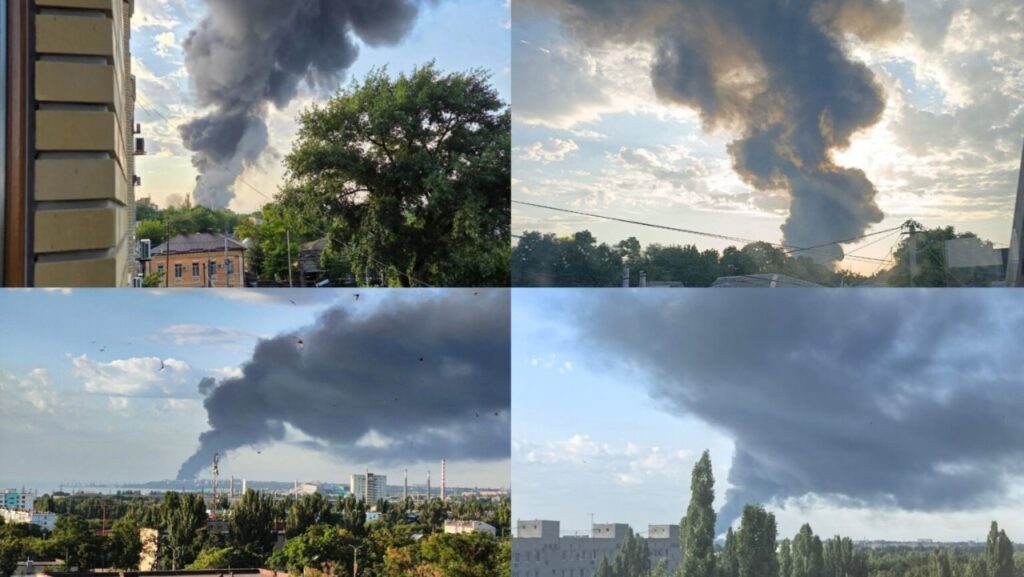
The attack on Taganrog lasted all night, local residents reported. Fires broke out at the port, where the Kurganneftprodukt terminal — annual transshipment volume of 1.2 million tons — burned, Ukrainian channels reported. The facility reloads oil products from rail onto sea vessels in the Azov Sea. Astra’s OSINT analysis identified the burning site as the Kurganneftprodukt fuel depot.
Fire and smoke engulf a fuel reservoir at the Kurganneftprodukt oil terminal in Taganrog, Russia, 10 July 2026. Photo: Astra/Telegram
City mayor Svetlana Kambulova claimed an evacuation of residents whose homes fell into the emergency zone, TASS reported. Rostov Oblast Governor Yuri Slyusar claimed firefighters were extinguishing the port fire, with drone debris damaging a detached house and an administrative building’s roof.
A fire also broke out near the Taganrog Aviation College, which trains specialists for Rostov Oblast’s aviation and machine-building industries, Petro Andriushchenko of the Center for the Study of Occupation reported.
Drones damaged at least two tankers in Taganrog Bay the night before, and a tanker and a fuel reservoir burned there after strikes on 30 May. Ukraine’s drone forces destroyed an Iskander launcher and two Tu-142 planes at the city’s military airfield in late May.
Town of Azov: fuel tanks burn behind their protective nets
A series of explosions hit the city of Azov near Rostov-on-Don, where the largest fire engulfed an oil depot, Exilenova+ reported with OSINT analysts confirming the blaze. The depot sits by the Azov sea port and stores and transships light oil products. Ukrainian channels identified the site preliminarily as the DonTerminal depot. Footage shows Russia had covered the reservoirs with anti-drone nets — the strike hit them regardless on the morning of 10 July.
A fuel reservoir burns at the oil depot in Azov, Rostov Oblast, Russia, with protective nets visible over the tanks, 10 July 2026. Photo: Exilenova+
The drones also struck the Azov Optical-Mechanical Plant, which makes sights, rangefinders, thermal imagers, and fire-control systems for Russian aircraft, armor, and warships. The plant belongs to Russia’s Tactical Missiles Corporation and was targeted by drones in July 2025.
Ukraine hit the Azov Optical-Mechanical Plant, Rostov region, a sanctioned Russian defense-industry site.
The plant produces electronics, optics, thermal-imaging systems and seeker components used in Russian precision weapons, missiles, anti-tank systems and military vehicles. pic.twitter.com/mpHFpShwLR
— Special Kherson Cat (@bayraktar_1love) July 10, 2026
Slyusar claimed about 35 drones were downed over Taganrog, Azov, and two districts, with fires at two oil-product storage sites in Azov and an administrative building in the village of Kagalnik. An Azov resident wrote in the comments that the city’s sirens sounded only after the fires had started. Eyewitness footage suggests Ukraine’s Defense Forces used domestically made FP-1 or FP-2 kamikaze drones for the Rostov Oblast strikes, as the targets sit relatively close to the front line.
Moscow: drones through the night, a fire near the Kapotnya refinery
Moscow came under drone attack through the night of 10 July, with Domodedovo airport temporarily halting flights, Moscow Mayor Sergei Sobyanin claimed. Sobyanin’s posts counted six drones downed overnight, four more toward morning, and five by midday — 19 claimed in total. Russian Telegram channels reported similar restrictions at St. Petersburg’s Pulkovo airport.
A smoke plume rises over Moscow in the area of the Kapotnya oil refinery, 10 July 2026. Photo: Exilenova+
By midday, Exilenova+ shared a video showing a tank farm with one tank burning and reported a fire in the area of the Kapotnya refinery in Moscow, with details being clarified. Astra reported a declared missile danger in Moscow Oblast alongside the unconfirmed Kapotnya fire, with authorities urging residents to stay away from windows.
Fire in Moscow
A fuel tank is ablaze in the Russian capital after a Ukrainian drone strike.
Exilenova+ pic.twitter.com/mhYIBCRUcC
— Euromaidan Press (@EuromaidanPress) July 10, 2026
Nizhnekamsk smokes again
Exilenova+ also reported a fresh fire in the area of the Nizhnekamsk refinery in Tatarstan, with details pending. Ukrainian drones struck the Nizhnekamsk refining cluster two days earlier.
Smoke rises in the area of the Nizhnekamsk oil refinery in Tatarstan, Russia, 10 July 2026. Photo: Exilenova+
Russia’s Defense Ministry claimed air defenses intercepted 376 Ukrainian fixed-wing drones overnight across Belgorod, Bryansk, Kaluga, Kursk, Leningrad, Novgorod, Pskov, Rostov, Smolensk, and Tver oblasts, the Moscow region, Krasnodar Krai, occupied Crimea, and the Azov Sea.
Ukrainian drone attacks on Russian shipping in the Sea of Azov as seen from a commercial vessel
The video was published yesterday.
Exilenova+ pic.twitter.com/eKaV2o6Jem
— Euromaidan Press (@EuromaidanPress) July 10, 2026
In addition to the strikes on Russian oil facilities, the Ukrainian forces continued targeting Russian tankers in the Sea of Azov and hitting various targets across occupied Crimea.
Read also
-
Russia’s refinery in Saratov, two in Tatarstan, a pumping station in Bashkortostan — one night’s oil target list
-
Russia’s refinery feeding occupied Crimea is burning after an overnight Ukrainian strike
-
Three days, 21 ships: Russia’s Azov Sea fuel run to occupied Crimea is turning into a shooting gallery
(function(w,q)[];w[q].push([“_mgc.load”]))(window,”_mgq”);