(function(w,q)w[q]=w[q])(window,”_mgq”);
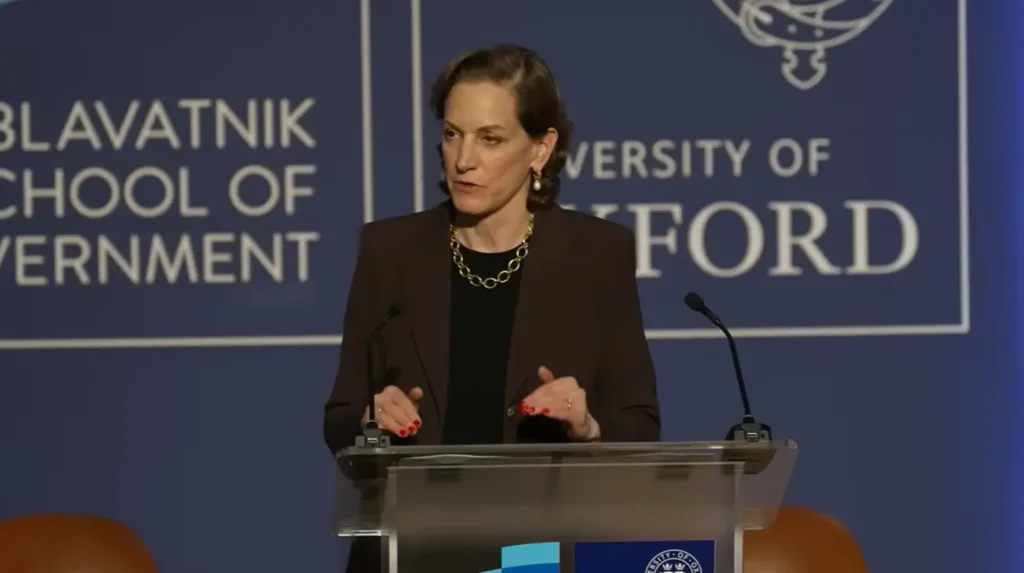
On 27 January 2026, Anne Applebaum—Pulitzer Prize-winning author of Autocracy, Inc., a book arguing that autocratic systems survive through elite complicity, selective blindness, and the willingness of respectable institutions to look away—delivered a lecture on autocracy at Oxford’s Blavatnik School of Government and publicly thanked the school’s benefactor, Len Blavatnik, as did Chancellor Lord Hague.
Blavatnik is an individual sanctioned by Ukraine’s National Security and Defense Council in December 2023. Until the second half of 2022, he held an approximately 8% indirect stake, valued at roughly $610 million, in Rusal, an aluminum producer whose management was implicated in recruiting fighters and materially supporting Russia’s war against Ukraine.
He is listed by Garry Kasparov’s Free Russia Forum as a key enabler and beneficiary of Putinism. His methods have been shown to intimidate Western journalists into self-censorship.
Or, as I prefer the more accurate term: Blavatnik is a kremligarch.
Applebaum knows what reputation laundering looks like. She wrote the book on it. The question is why she participated in it—and what it costs Ukraine and the West.
The contradiction
In recent months, Applebaum has criticized Steve Witkoff—Trump’s envoy to Russia—repeatedly and forcefully, questioning his financial motives, calling him an enabler of Putin’s war, accusing him of parroting Kremlin talking points. At this lecture and on other platforms, she asks pointed questions about who benefits financially from the Ukraine deal and how that influences the Trump administration’s foreign policy.
Comically, at the lecture, Blavatnik gets visibly bored and asleep (around the 40th minute) as Anne blows hot air about ties with kleptocrats impacting US foreign policy.
Blavatnik (third from the left, 1st row) appears to fall asleep during a lecture by Anne Applebaum on Autocracy at Oxford University. Screenshot from lecture video
What she does not mention—not in The Atlantic, not on CNN, not at the Munich Security Conference—is that Witkoff’s most important business partner is the man she publicly thanked at Oxford.
Steve Witkoff is co-developing a massive luxury real estate project in New York with Blavatnik’s Access Industries, an elite hotel, and a 200-acre resort and golf project in Florida. As Popular Information reported, Witkoff has maintained this partnership while serving as Trump’s chief negotiator on the war—the same war in which Blavatnik held stakes in a company implicated in supporting Russia’s military effort.
Witkoff is a Russia-friendly envoy who repeats Kremlin talking points and negotiates terms that shock European leaders and blindside Kyiv. And his key business partner has been normalized by the very institutions that should have been raising alarms.
Russia’s top economic negotiator Kirill Dmitriev talks to US President Donald Trump’s envoy Steve Witkoff in Saint Petersburg on April 11, 2025. Photo: Vyacheslav PROKOFYEV/AFP/Eastnews
When I wrote to Applebaum about this, she replied that she is happy to lecture in front of any oligarch and that the Blavatnik School is unlikely to be renamed. This is a remarkable response from someone who served on the board of the National Endowment for Democracy, which in 2021 organized a report on reputation laundering in Western universities that specifically mentions Blavatnik.
The late dissident Vladimir Bukovsky anticipated this. When we co-signed a letter against Blavatnik’s donation in 2015, Bukovsky told me that the main lesson students take from the Blavatnik School is that duplicity works. One can say many nice words about good governance, fight against kleptocracy—and then present a kremligarch as a respected figure and personally thank him in front of the crowd.
The school that silence built
Applebaum’s lecture was not an isolated lapse. The Blavatnik School has a pattern of platforming figures entangled with Kremlin-connected networks while producing almost nothing on the subjects you’d expect a leading European government school to examine: kremligarchs, sanctions enforcement, and the mechanisms of Russian influence in the West.
The school hosted Putin’s finance minister Alexei Kudrin for a lecture. It hosted Vladimir Ashurkov, a de facto lobbyist for Alfa Group, who along with Navalny’s former aide Leonid Volkov was caught in efforts to whitewash Blavatnik’s partners from Alfa—all of them sanctioned in the UK, US, and Ukraine. And it offered a “masterclass” platform to Peter Mandelson—who was entangled with Blavatnik’s sanctioned Rusal partner Oleg Deripaska.
Anne Applebaum delivers a lecture on Autocracy at the Blavatnik School of Government at Oxford University, 27 January 2026
Bloomberg revealed last month that Mandelson, a former UK ambassador, sought a Russian visa for convicted sex offender Jeffrey Epstein through Deripaska’s office. Mandelson has since resigned from the House of Lords and was arrested on 24 February. His advisory firm, Global Counsel, is on the verge of collapse.
The Blavatnik School has said nothing about any of it.
Compare the school’s output on Russian kleptocracy with that of peer institutions in Europe and the United States, and the gap is striking. The silence is not accidental. It is the product.
How the money got in
Blavatnik donated £75 million to Oxford in 2010 for a new school of government bearing his name. At the time, he had made billions from the sale of TNK-BP, a Russian oil joint venture, in a deal so lucrative that in 2013 even dictator Vladimir Putin publicly criticized the offshore profits that AAR oligarchs—Blavatnik among them—extracted from it. Putin showed more skepticism about Blavatnik’s money than Oxford’s gatekeepers.
Between 2010 and 2013, I quietly shared concerns about Blavatnik’s money with Oxford’s leadership, including Ngaire Woods—now dean of the Blavatnik School and my former tutor in global governance and international relations. I warned of his role in Russia’s kleptocratic system and evidence of the harassment of BP executives in Russia.
They never wanted to even look at it.
Others went public. Together with me, prominent UK and international dissidents and experts called for Oxford and other institutions to reassess their relationship with Blavatnik in 2015, 2016 (also in Russian, showing the Blavatnik School employing Putin’s methods of censorship), and 2019.
After Russia’s full-scale invasion in 2022, 31 organizations—mostly from Ukraine—and 215 individuals, including Nobel Peace Prize winner Oleksandra Matviichuk, demanded the removal of Blavatnik’s name from the school and other institutions.
Oxford’s response was dismissive. Woods and other administrators with vested interests claimed “global benefits” and “robust due diligence.”
Freedom of Information requests in a 2022 investigation by Oxford’s own Cherwell newspaper showed this was, at best, sloppy: the due diligence was conducted by relatively junior staff whose identities Oxford refused to disclose, some Committee to Review Donations members did not attend the meetings where Blavatnik’s gift was discussed, and no Russia experts, Russian speakers, or former BP or TNK-BP insiders were consulted. Key warnings were ignored, critical information censored.
At the school’s founding, Woods publicly bragged that she ignored “naysayers” focusing instead on training a “new global elite.”
Blavatnik’s “philanthropy” was critically scrutinized by CNN in 2022 and Australia’s ABC in 2025. The story resembles Friedrich Dürrenmatt’s play The Visit: a wealthy benefactor offers money to a struggling town, and the town’s moral resistance gradually collapses. Oxford was the first major Western institution to accept Blavatnik. Administrators like Chris Patten and Woods, aided by a largely dysfunctional Committee to Review Donations, approved what should never have been normalized.
When challenged today, Woods refuses to engage. The machine runs on silence.
The cost to Ukraine and the West
Anne Applebaum delivers a lecture on Autocracy at the Blavatnik School of Government at Oxford University, 27 January 2026
Reputation laundering at Oxford does not stay at Oxford. It legitimizes access to politicians, shapes public narratives, and weakens sanctions regimes.
Blavatnik has donated to politicians across the aisle in the US and to the Conservatives in the UK. His institutional respectability—anchored at Oxford, reinforced at Harvard, validated by a knighthood—makes each subsequent relationship easier to justify. It is this respectability that makes a business partnership with a US presidential envoy unremarkable, that makes Witkoff’s refusal to explain his Russian business ties something the press treats as a minor awkwardness rather than a disqualifying conflict of interest.
The chain is traceable. Kremlin-connected wealth flows into Western institutions. Institutions provide legitimacy. Legitimacy provides access to politicians. Politicians shape the deals that determine Ukraine’s future.
I have been tracking these networks for fifteen years—first as an analyst at TNK-BP, where I was fabricated as a spy by the FSB and Kremlin-connected oligarchs, then as a fellow at Chatham House and a researcher at the Hudson Institute and the Atlantic Council.
I have watched Western institutions accept money they should have refused, host people they should have scrutinized, and dismiss warnings they should have heeded.
A lecture on autocracy delivered at a sanctioned kremligarch’s school—without mentioning the kremligarch—is not neutral. It is sanitizing. And when the lecturer then attacks the kremligarch’s business partner for his Russia ties, without ever disclosing the connection, the sanitizing becomes something worse.
It becomes the very mechanism her own books describe.
Do academics and students at Oxford really want to help launder the reputation of a kremligarch—granting him access to top politicians and the ability to pressure or censor the Western press? Do they want a leading government school to be part of an appeasement that echoes the worst institutional failures of the last century?
These are not rhetorical questions. I hope there are still enough people at Oxford and its Council, as well as in the UK government, with the capacity for basic deduction of cause-and-effect relationships.
Editor’s note. Euromaidan Press reached out to Ms. Applebaum for a comment but received no response at publication time. We are open to publishing Anne Applebaum’s response.
Ilya Zaslavskiy
Ilya Zaslavskiy is a specialist in due diligence, sanctions, and kleptocracy. He holds an MPhil in International Relations from the University of Oxford. He heads Underminers.info, a research project exposing Eurasian kleptocrats in the West. Until April 2025, he was a senior campaigner with Razom We Stand, and since then has continued with the academic research on Russia’s malign influence in the West. He was previously a fellow at Chatham House, and a senior program manager at the Center for International Private Enterprise. He wrote multiple research papers for the Atlantic Council, Hudson Institute, Martens Centre, and other leading think tanks.
Editor’s note. The opinions expressed in our Opinion section belong to their authors. Euromaidan Press’ editorial team may or may not share them.
Submit an opinion to Euromaidan Press
(function(w,q)w[q]=w[q])(window,”_mgq”);