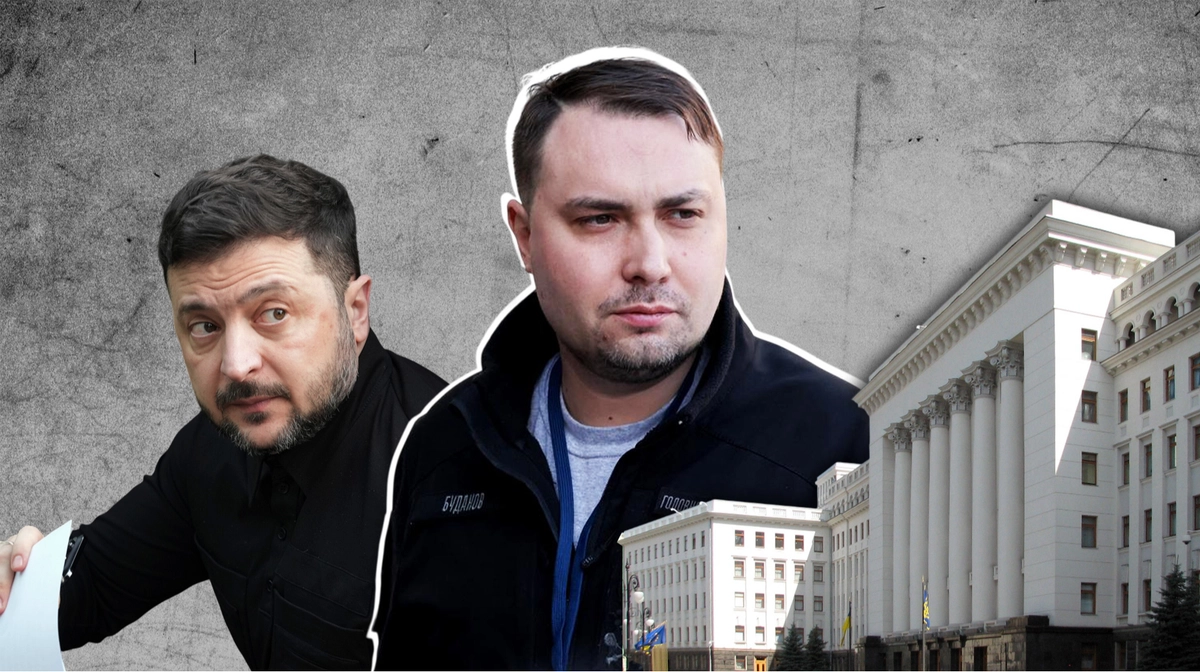
A spy (Kyrylo Budanov), a cop (Oleh Tatarov), a Security Service officer (Viktor Mykyta) and a frontline brigadier (Pavlo Palisa) walked into the civilian President’s Office. What happened next?
It’s one month since the biggest political reshuffle of Volodymyr Zelenskyy’s presidency. On 2 January 2026, Kyrylo Budanov, the former chief of Ukraine’s Defence Intelligence, took over as head of the President’s Office from the once all-powerful Andrii Yermak. Budanov could be a serious reinforcement for the Office, as he enjoys both strong authority within the military and noticeable electoral support among the public.
This is a major transformation for the entire system of power, although one that is still barely visible inside the President’s Office itself.
Advertisement:
Not only has Budanov refrained from making any staff changes – judging by official photo reports from meetings at the Office, he hasn’t even changed out of his military uniform.
So it’s only natural that a number of questions should arise.
Has Budanov’s arrival really changed anything at the President’s Office other than the name on the door of the first-floor office?
Why did Zelenskyy need this change of leadership – and why did the lieutenant general himself agree to it?
How is the change affecting the peace talks, where Budanov is gradually beginning to play first fiddle?
Is the new head of the Office really that uninterested in domestic politics? If so, why was he willing to make the move from purely military work into the top league of state governance?
“Everyone’s comparing Budanov’s arrival with the Yermak-era Office, when the head of the Office was an extremely influential figure in domestic politics, foreign affairs – basically everywhere,” an Ukrainska Pravda source in Zelenskyy’s team reflects. “Budanov will probably be like that too. But that’s not 100% certain. Because, as they say, power is not given, it is taken. And it’s not clear yet what Kyrylo will actually manage to take.”
As yet, no one knows which of Yermak’s wide-ranging powers Budanov actually wants. Is he only interested in the peace talks and ending the war, or does he also harbour ambitions to control the Verkhovna Rada [the Ukrainian parliament – ed.] and the government? Ukrainska Pravda set out to find answers to these questions.
Why Budanov moved to the Office
“Do you remember how, at the end of last year, Zelenskyy posted photos of himself with the candidates for head of the Office, pretending to choose?” a member of the president’s inner circle said in a conversation with Ukrainska Pravda. “Budanov had already agreed, at the very first meeting, but Zelenskyy still had to decide what he wanted – although he had leaned towards Budanov right from the very start.”
To understand the nature of Zelenskyy’s hesitation, you need to understand exactly what he was choosing between.
As Ukrainska Pravda reported back in December 2025, there were two feasible frontrunners for the post: Mykhailo Fedorov and Kyrylo Budanov. Whichever one was appointed would have resulted in a completely different future for the entire governing team.
Basically, Zelenskyy had two options.
Option 1 was to appoint Fedorov and do a complete reboot of the President’s Office, turning it into a sort of Office of Reforms: maximum concentration of power and a long list of shock transformations. To get an idea of what the atmosphere would have been like in this scenario, look no further than the Ministry of Defence, where Fedorov has already dismissed almost all the deputy ministers and brought in well-known people from outside the system like Pavlo Yelizarov, Serhii “Flash” Beskrestnov and Serhii Sternenko.
Option 2 was to turn the President’s Office into a kind of “centre for peace negotiations”. Fedorov would not have been suitable for that role at all, whereas Budanov was the perfect candidate given his extensive contacts both in the United States and among the Russians.
In addition, Budanov had no illusions that Zelenskyy is still the “shock reformer” he was in 2019. Accordingly, Budanov had no intention of clearing out the entire senior leadership of the President’s Office.
For Zelenskyy, Yermak’s removal from the inner circle came with its own sensitivities. A full reboot of the team could have destabilised his entire chain of command. That’s why appointing Budanov as the new head of the old Office looked like the less traumatic option for the president.
Moreover, the “coup” within the system against Yermak – in which Budanov played a key role – showed Zelenskyy that an entire revolutionary group had formed within the government, outside his direct control. This time it had worked to remove Yermak, but it would have been extremely risky to overlook such a group in the future.
“Those who say that bringing Budanov closer is dangerous for Zelenskyy are mistaken. What would have been dangerous was leaving him where he was,” a member of the President’s team explained. “Kyrylo was on the ‘Island’ [the Defence Intelligence headquarters is on Rybalskyi Island in Kyiv – ed.], meeting whoever he wanted, contacting anyone at his discretion. Now at least Zelenskyy knows where he is, what he’s doing and who he’s talking to.”
Further political expediency in Budanov’s appointment lay in the fact that Zelenskyy could shift the most difficult area – the peace negotiations – onto the new head of the Office. And this was relatively low-risk for himself: if Budanov succeeds in achieving a positive outcome from the talks, it can be presented as a victory for Zelenskyy and his team; if the negotiations fail, there is room to frame it as a failure of the negotiating group – and, by extension, the head of the Office.
For Budanov, this was a risk, and he could not have failed to understand that. But ultimately the potential benefits of moving to the Office outweighed the risks.
First of all, Budanov believed that the negotiations had so far been unsuccessful in part because of who was conducting them and how they were being conducted on the Ukrainian side. The lure of taking control of the most crucial undertaking – the peace talks – was one of the main factors that persuaded Budanov when he made his decision.
The second factor that tipped Budanov towards the move was his political ambitions. It is no secret that he ranks third or fourth in presidential polling, enjoys extremely high public trust, and is capable of consolidating votes from other major candidates.
The one thing Budanov lacked in that regard was experience in public-facing politics. The move to the President’s Office offered an excellent opportunity to leap straight into the top political league. As Andrii Yermak’s experience demonstrated, there are no fields of influence you can’t access as head of the Office. You just have to want to.
So far, Budanov’s public political presence evokes much the same reaction as his expensive official suits: impeccably tailored, sitting well, but nevertheless looking rather odd. In fact, it might even have been reason enough to agree to move to the Office just to get everyone used to seeing Budanov in a tuxedo rather than his ubiquitous fleece.
All the more so given that the story of the extensive reshuffle of the security services and the complicated case of the dismissal of former Security Service Head Vasyl Maliuk gives grounds to believe that Budanov may not have had many alternatives: either make a graceful transition to the Office, or lose control of Defence Intelligence in a far less elegant manner. According to Ukrainska Pravda sources, Zelenskyy did not explicitly lay down such an ultimatum. But credit must be given to Budanov’s analytical skills: he decided to take the job before the president presented him with an unpalatable choice.
Especially since Budanov’s primary motivation was a desire to take the negotiation process into his own hands, despite all the risks. This is the issue he has been most focused on in his first month as head of the President’s Office.
Read more: All change: why Zelenskyy needs to reshuffle Budanov, Fedorov, Shmyhal, Maliuk and other top officials
Budanov leads the negotiations
During the reshuffle at the President’s Office, it was Volodymyr Zelenskyy himself who put the emphasis on strengthening the peace negotiations. Immediately after appointing Budanov, he told journalists that he was bringing everyone involved in the negotiations together at the Office.
“I am strengthening the negotiating team. That’s what I’m doing,” the president said at the time.
It’s too early to say to what extent Budanov’s arrival has strengthened the negotiating team. But it is already possible to trace how he has changed it.
During the period when Yermak was attempting to establish a monopoly on negotiations with Ukraine’s partners, communication was actually being conducted through several different channels.
The first channel – the official one – was run by Yermak in cooperation with the Ministry of Foreign Affairs. At least two other so-called back channels operated through the connections of Budanov and Davyd Arakhamiia, leader of the Servant of the People parliamentary faction.
And the signals that reached Ukraine’s partners and enemies through these three different channels were also different: the official channel adhered to the rhetoric of the peace formula, while the unofficial ones conveyed a more down-to-earth and realistic assessment of the situation and processes in Ukraine.
After the official negotiation channel effectively came under Budanov’s control, the entire negotiation process on the Ukrainian side began to speak with one voice.
This became especially evident after Arakhamiia officially returned to the negotiating team. Firstly, Arakhamiia has a wide network of contacts in the United States. Secondly, he worked closely with Budanov back in the Yermak era. Thirdly, and equally importantly, since the Istanbul talks he has had direct contact with Russians such as the oligarch Roman Abramovich.
It was for these reasons that Budanov and Zelenskyy jointly decided to bring back the leader of the first delegation to a group that has a chance of becoming the last one.
It is significant that once Budanov and Arakhamiia entered the negotiation process, the nature of the communication changed – not only with the Americans, but also with Russia. In parallel with the changes in the Ukrainian delegation, Putin replaced his negotiators as well. Now, instead of [Putin’s aide Vladimir] Medinsky and the other long-standing Russian diplomats, with their monologues about Rurik [the semi-legendary 9th-century founder of the ruling dynasty of Kyivan Rus to whom Putin traces the origin of the Russian state – ed.], the talks are being conducted by military officials.
“Previously, our people used to have to listen to hour-long sermons about who conquered whom and when back in the past. Now they have military officers sitting there and discussing very specific things: withdrawal mechanisms, guarantees, timelines, and so on. This is probably the key change that came about when Budanov arrived,” one of Ukrainska Pravda’s sources familiar with the negotiations said.
Issues like the moratorium on energy strikes, and other agreements that are not yet global but still tangible, are initially discussed by the negotiating teams and only later elevated to the presidential level.
Over the past month, Budanov has already attended several meetings in various parts of the world. So it’s entirely understandable that, according to most of Ukrainska Pravda’s sources in the President’s Office, parliament and government, domestic politics has not been a priority for the new head of the Office so far.
As one senior member of the governing team joked, Budanov lacks a “residency qualification”.
“To understand politics here, you need to live in Ukraine for a while. And all this month, Kyrylo’s either been heading off somewhere or coming back from somewhere. I think he’ll still have time for domestic issues, though.”
Budanov’s willingness to take on such sensitive topics as mobilisation problems, unauthorised absence from units and corruption in enlistment offices suggests that that time may come very soon.
Old faces in the new Office
Despite being very involved in the negotiation process, Budanov is still trying to delve into the essence of affairs in the Office he now has to lead. And his initial actions say a lot about what the President’s Office will look like under its new head.
First and foremost, Budanov has completely rejected the idea of purges at the Office. In particular, he has not dismissed Oleh Tatarov, who is known as an overseer of the law enforcement system who is toxic for society. And he persuaded Iryna Mudra, who is responsible for the implementation of judicial reform in Ukraine and the creation of a special tribunal for Russia, to stay at the President’s Office.
In the final months of Andrii Yermak’s “reign”, Mudra had made active efforts to leave the Office. First, she sought an ambassadorship in Israel. Later, an option emerged for her to head the Ministry of Justice.
A “primary” was even supposed to take place for the main candidates for the position – Mudra and Denys Maslov, chair of the parliamentary legal policy committee – at a meeting of the Servant of the People faction. But the day before, Budanov held a meeting with them in the President’s Office. He asked Mudra to stay on as his deputy so as not to destabilise the Office.
According to Ukrainska Pravda sources close to Budanov, the first people to come to Budanov’s office to “renew their oaths” were Viktor Mykyta and Iryna Vereshchuk. The third was Pavlo Palisa, who is responsible for liaising with the military. However, this gesture does not appear to have significantly strengthened their positions within the Office.
Officially, Mykyta is responsible for selecting candidates for regional administrations. In fact, however, he merely manages the process. Often the last word remains with Tatarov, who has breathed a sigh of relief and quite noticeably strengthened his influence since Yermak’s resignation, Ukrainska Pravda sources in Parliament and the President’s Office say. This was clearly visible in the latest regional appointments: two out of the five new heads of Oblast Military Administrations are protégés of Tatarov.
Another troubling tendency emerged during the regional reshuffles. A senior Ukrainska Pravda source in the Servant of the People party described it like this: “There’s always someone close to the president who tells him that everyone around him is an enemy. It used to be Andrii Borysovych [Yermak]; now it’s Lytvyn” [Dmytro Lytvyn, Zelenskyy’s communications adviser – ed.].
Several sources in Parliament and the President’s Office told Ukrainska Pravda that since Yermak’s departure, Lytvyn has become the main “anxiety generator” for Zelenskyy. He tries to interfere even in processes he has nothing to do with – from amending wording in legal documents to influencing personnel appointments. That was the case, for example, when a new head of Ternopil Oblast Military Administration was being selected: “warnings” from Lytvyn about an old criminal case scuppered Chortkiv Mayor Volodymyr Shmatko’s chances of being appointed.
Sources in the President’s Office told Ukrainska Pravda, however, that Budanov has so far made no attempt to curb the influence of Lytvyn, who reports directly to the president.
The atmosphere at the President’s Office has changed radically compared with the Yermak era. Previously, staff would spend the lion’s share of their working hours merely shielding themselves from their boss’s outbursts.
A source at the Office told Ukrainska Pravda: “People who knew how to wheel and deal and throw a spanner in the works were favoured in order to maintain an atmosphere of mutual distrust. Nothing could be decided without Yermak. If he was busy, you might wait two or three weeks for an answer.
Since Budanov arrived, there’s a sense that the Office works as a team. The leader sets tasks and everyone gets on with them. If you need Budanov to get involved, you can just walk into his office or send a message. He responds within five minutes. Ten minutes later you have a solution. If he doesn’t need to be directly involved, you do the work yourself, and no one crucifies you for doing your job.” The source’s enthusiasm is clear.
The new head of the Office has introduced weekly Sunday meetings to discuss pressing issues – from his deputies’ work plans to the parliamentary and government agendas.
In terms of working with the parliament, Budanov hasn’t yet had a chance to show what he can do, as the first serious plenary week of 2026 doesn’t begin until 10 February. Over the past month, there have been several sessions that have included votes on reshuffles in government and the security sector. On those occasions, Budanov showed that he has certain contacts among MPs.
Ukrainska Pravda has learned from parliamentary sources that Budanov personally called some MPs and asked them to vote in favour of recent dismissals and appointments. However, sources in the Servant of the People party believe Budanov delegates parliamentary work to Davyd Arakhamiia as much as possible, as the two have a solid working relationship.
“I think we’ll only bring Budanov in to work with parliament in extreme cases. There should always be a ‘bad cop’ that people are a bit afraid of,” one senior party official joked in a conversation with Ukrainska Pravda.
Another senior official in the president’s team told Ukrainska Pravda that Budanov “pushes his deputies to work at full capacity”. He has not dismissed anyone yet because he wants to work out who is capable of what.
Diplomat Serhii Kyslytsia is assisting Budanov with the negotiations. Two other international policy specialists in the Office – Ihor Zhovkva and Ihor Brusylо – oversee Ukraine’s EU and NATO integration and handle the bulk of the diplomatic work.
There has been no deputy head responsible for economic matters since Rostyslav Shurma was dismissed during Yermak’s tenure – and it doesn’t look as if one will be appointed now either. The situation is similar as regards social policy, which was previously overseen by Yuliia Sokolovska. When Zelenskyy appointed her as ambassador to Spain, social issues were divided between Iryna Vereshchuk, Iryna Mudra and Olena Kovalska.
According to one Ukrainska Pravda source in the Office, Budanov has a mandate to make personnel changes if any of the deputies fail to cope with their responsibilities.
“He’s not touching anyone for now, to avoid creating conflicts over nothing and so he can see what people are capable of. But if someone can’t manage the load, believe me, they’ll be steered towards the exit pretty swiftly,” a member of Zelenskyy’s inner circle told Ukrainska Pravda.
***
In his first month as head of the President’s Office, Kyrylo Budanov was given carte blanche with respect to the negotiations. He is now fully focused on the trilateral talks and has already achieved some results: the president has described the talks as “constructive“, while the media report that there has been “progress” on military issues.
But with unlimited power comes great responsibility. Budanov is aware that any misstep on the international stage could be used against him by Volodymyr Zelenskyy, who sees him as a potential political rival.
For now, domestic politics remains outside Budanov’s immediate focus. But given his proven ability to extract advantage from situational alliances with even the most toxic people, it is safe to assume that he will also be able to manage the diverse and influential crowd within the corridors of power.
If the head of the Office succeeds in negotiating peace with the Americans and the Russians, he’s unlikely to have any problem bringing regional governors or members of parliament to heel.
So it would be unwise to rule out the possibility that Budanov will seek to build up as much power as he can – and to use his appointment as a kind of “school of public administration” prior to a future election campaign.
Authors: Roman Romaniuk, Anhelina Strashkulych, UP
Translation: Myroslava Zavadska
Editing: Teresa Pearce