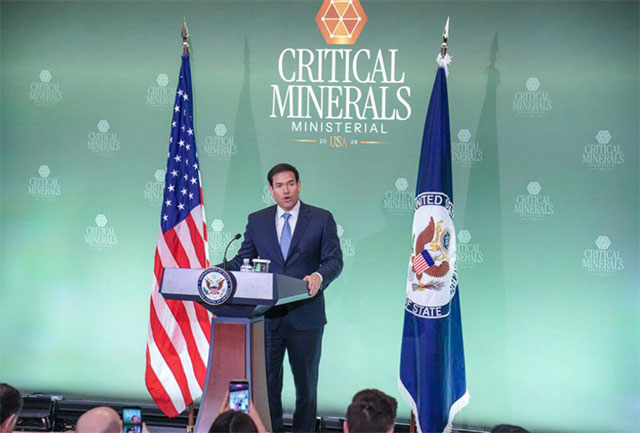
Marco Rubio, the U.S Secretary of State addresses delegates during the Critical Minerals Ministerial in Washington D.C. on Feb.4. COURTESY PHOTO/U.S DEPARTMENT OF STATE.
Inside Trump’s plan to rebuild global supply chains without China
NEWS ANALYSIS | RONALD MUSOKE | On Feb. 4, delegations from more than 50 countries streamed into the U.S. Department of State for a summit that Washington D.C views as foundational to the next era of industrial power.
Foreign ministers, trade officials, and senior economic policymakers gathered alongside U.S Vice President JD Vance, Secretary of State Marco Rubio, Treasury Secretary Scott Bessent, Interior Secretary Doug Burgum, Energy Secretary Chris Wright, and U.S. Trade Representative Jamieson Greer. Representatives from 54 countries and the European Commission filled the room—stretching from Angola and Argentina to Japan, Norway, Saudi Arabia, and Ukraine. China was not among them.
The gathering, the inaugural Critical Minerals Ministerial, marked a decisive turn in U.S. economic diplomacy. The Trump administration is attempting something few governments have tried at this scale; which is redesigning the global market for critical minerals through coordinated diplomacy, massive public financing, industrial stockpiling, and preferential trade arrangements among allies.
“These minerals power our infrastructure, our industry, and our national defence,” Rubio said in his opening remarks. “Our goal is to have a global market that’s secure, a global supply that’s enduring and is available to everyone… at an affordable price.”
Yet, behind the diplomatic language was a sharper objective: reducing the world’s dependence on China, which dominates large portions of mining, refining, and processing for materials essential to artificial intelligence, batteries, robotics, and advanced manufacturing.
A market Washington says is broken
Vice President Vance opened the summit with a blunt assessment. “We know that today the international market for critical minerals is failing,” he told the assembled ministers. “Supply chains remain brittle and exceptionally concentrated.”
Vance described a recurring pattern that many governments in the room recognized. “How many times, cumulatively, have one of us or many of us in this room heard some variation of the story that I’m about to tell? A lithium mine, a gallium recovery centre – you name it – is announced, sometimes with years in planning and financing nearly in place,” Vance said.
“Then overnight, foreign supply floods the market, the prices collapse, and investors pull out. The project stalls, and eventually the project dies on the vine. We’ve all seen it firsthand in all of our countries. And the result is a global market where consistent investment is nearly impossible, and it will stay that way so long as prices are erratic and unpredictable.”
The consequence, he argued, is a global system that discourages long-term investment and rewards strategic dumping. “We see telltale signs of a market distorted beyond recognition—one that punishes strategic investment, one that punishes diversification, and one that punishes long-term planning.”
Although China was not named directly in those remarks, U.S. officials made clear throughout the day that they see Beijing’s dominance as the core vulnerability. “We’ve all become dependent on arrangements we did not choose,” Vance said, “and right now, arrangements that we cannot control.”
Vance said, these are the things the U.S and its partners want to fix. “Let’s make the prices more predictable and less erratic so that we can support the domestic supply chains and the investment that makes those supply chains possible,” he said.
Why the summit was convened
The Trump administration organized the ministerial to align trade policy, development finance, and diplomacy around a single goal– diversifying supply while strengthening partner countries that produce or consume critical minerals.
“Our goal here—the reason why we’re doing this conference—is to align trade policy, development finance, and diplomatic engagement towards a shared strategic objective,” Vance said. “That objective is very simple: diversifying global supply in the critical minerals market while strengthening the partner countries who help all of us in this shared effort.”
In one day, the United States signed several new bilateral critical minerals frameworks or memorandums of understanding with countries including Argentina, Ecuador, Morocco, Peru, the Philippines, the UAE, and Uzbekistan.
Over the past five months, Washington has signed ten more and completed negotiations with seventeen additional nations. These agreements lay the groundwork for cooperation on pricing, project development, financing, and supply chain gaps. Rubio framed the gathering in historical terms, recalling the 1974 Washington Energy Conference that led to the creation of the International Energy Agency in the very room that the ministerial was held.
“It’s interesting that about 50 years ago, actually in this very room, ministers from around the world joined then-Secretary of State Henry Kissinger for the Washington Energy Conference. That meeting took place during a moment where global energy supplies were concentrated, where markets were distorted, and access to a single critical resource – at that time, of course, being oil – had become a tool of political pressure. That meeting led directly to the creation of the International Energy Agency to coordinate among like-minded partners and secure access to energy commodities,” Rubio said.
“Today, we return 50 years later in the hopes of advancing a bilateral critical minerals framework agreement to the same end on that front. These frameworks are designed to create alternative sources of supply and to protect every single stage of production – from mining to refining and processing to manufacturing, all of these things – protecting them from non-market disruption. They will provide platforms for coordinating policies that ensure all of our citizens can enjoy abundant and affordable access to these critical minerals.”
Rubio added: “We stand ready and intend to work with each country here today to find a specialized role that you can play. If you don’t have minerals, you can help refine them. And if the countries gathered here include the largest consumers of critical mineral products, who together have the buying power – together, collectively have the buying power – to build a more resilient and diverse global market.”
FORGE and Pax Silica
One of the summit’s centerpiece announcements was the creation of the Forum on Resource Geostrategic Engagement, or FORGE, which replaces the earlier Minerals Security Partnership. Going forward, FORGE will serve as the coordinating body for allied governments, working simultaneously at the policy and project levels. Chaired initially by South Korea, it is designed to identify priority investments, align regulations, and accelerate development of mining and processing capacity across partner countries.
Japanese State Minister for Foreign Affairs, Horii Iwao, welcomed the initiative. “Japan shares a deep sense of concern and urgency about the risk of disruptions to critical mineral supply chains,” he said. “Diversity as opposed to concentration is what makes us resilient.”
Horii emphasized that no single country can solve the problem alone. “Diversity only comes from collective action,” he said. “With the launch of FORGE, now it is time for action.” “Amid rising geopolitical risks, Japan will accelerate efforts to secure upstream sources. At the same time, we will take flexible measures downstream, such as diversifying procurement sources in cooperation with like-minded partners who are here today,” he said.
“In recent years, we have already witnessed firsthand supply chain disruptions. Even in recent months, this challenge has become further deteriorated. Against such backdrop, we have come to understand that we are in the same boat, as any supply chain disruption would bring significant impact on the global economy. We should work together to address this challenge.”
“To prevent such supply chain disruptions, the key is to diversify supply sources, including the refining and processing of geographically concentrated critical minerals. To do so, it requires a collective action. We must seize this opportunity to advance cooperation among like-minded countries, partners, like us.”
FORGE aims to connect mineral-rich countries such as Angola, Argentina, Australia, Brazil, Canada, and the Democratic Republic of the Congo with major consuming economies like the United States, Japan, and Europe—creating coordinated production rather than fragmented national efforts. Horii said Japan “strongly believes” that FORGE will become an important venue and a vehicle for us to focus on supply chain diversification and ensure policy coordination.
President Felix Tshisekedi of the Democratic Republic of Congo (L) shakes hands with Marco Rubio, the Secretary of State on the sidelines of the Critical Minerals Ministerial in Washington D.C. COURTESY PHOTO/DRC PRESIDENCY X HANDLE.
Running alongside FORGE is Pax Silica, another U.S.-led partnership focused on securing what officials described as the “strategic stacks” of the global technology supply chain. While FORGE concentrates on minerals themselves, Pax Silica extends downstream—into refining, processing, end-use applications, recycling, and reprocessing. Its purpose is to ensure that materials extracted by partner countries feed into allied manufacturing ecosystems rather than adversarial ones.
“Pax Silica and artificial intelligence may be the future,” Rubio said. “Still, the future will never come to pass unless we rebuild the factories and reopen the mines upon which these technologies depend.”
The initiative reflects the Trump administration’s belief that control of raw materials is inseparable from leadership in AI, robotics, semiconductors, and advanced manufacturing. Recognizing that governments cannot build this system alone, U.S. officials stressed Pax Silica’s close partnership with private industry, which will invest across mining, processing, manufacturing, and recycling.
Project Vault: America’s first civilian minerals reserve
Two days before the ministerial, President Trump announced Project Vault, establishing the U.S. Strategic Critical Minerals Reserve. Backed by up to US$10 billion in the Export-Import (EXIM) Bank of America financing, Project Vault will store essential raw materials in facilities across the United States, insulating domestic manufacturers from supply shocks. “This is the first time in the history of the United States we’ve ever stockpiled minerals for our civilian economy,” said David Copley, the Senior Director for Global Supply Chains. EXIM Chairman John Jovanovic described it as a cornerstone of U.S. industrial policy.
“Project Vault is designed to support domestic manufacturers from supply shocks, support U.S. production and processing of critical raw materials, and strengthen America’s critical minerals sector,” he said. Major manufacturers—including GE Vernova, Boeing, Western Digital, and Clarios—have signaled participation. Suppliers include Mercuria, Hartree, and Traxys.
Scott Strazik, the CEO of GE Vernova, called the initiative “historic leadership” that would strengthen energy security. Mercuria’s Brian Falik said Vault represents “a transformative approach to strategic sourcing.” Unlike traditional defence stockpiles, Project Vault is explicitly commercial, aimed at stabilizing supply for industries ranging from power generation to aerospace.
Rebuilding America’s mining ecosystem
Senior American officials outlined a four-part domestic strategy; investing in mining projects, stockpiling minerals, protecting producers from dumping, and rebuilding the U.S. mining ecosystem. For decades, Copley said, mining in America was sidelined.
“We’ve had some of the worst mine development timelines in the world—29 years to build an average mine,” he said. Only about 200 to 250 mining engineers graduate annually in a country of 340 million.
Under President Trump, that is changing. The administration is deploying equity investments, creating public-private minerals funds, accelerating permitting, and prioritizing more than 50 mining projects at the federal level.
“We are no longer standing around admiring the problem,” Copley said. “We have a plan, and we’re focused on project execution.” Environmental impact statements that once took years are now being completed in weeks. “Our goal is that the United States again becomes a very attractive place for the mining sector,” he said.
The DRC as a test case
The scale of financial commitment is unprecedented. Over the past six months, the U.S. government has supported more than US$30 billion in projects through letters of interest, loans, and investments. The EXIM Bank alone has issued US$14.8 billion in letters of interest for critical minerals in the past year.
The U.S. International Development Finance Corporation has committed or explored over US$1 billion, including major investments in Brazil, Kazakhstan, Ukraine, and global consortiums such as Orion.
The U.S. Trade and Development Agency has also announced new feasibility studies, global events, and project-scoping missions. “USTDA’s approach offers our partners a responsible alternative for developing their natural resources while reducing China’s stranglehold on essential supply chains,” said Deputy Director Thomas Hardy.
The Democratic Republic of the Congo featured prominently. Ahead of the ministerial, mining giants, Glencore, signed an MOU with the U.S.-backed Orion consortium. The inaugural Joint Steering Committee under the U.S.-DRC Strategic Partnership Agreement designated Strategic Asset Reserve sites, granting U.S. firms preferential access. Both governments emphasized peace and security as prerequisites for investment, underscoring how mineral strategy now intersects with regional stability.
China responds
Meanwhile, Chinese officials criticized the summit’s approach. Responding a day after the Ministerial Meeting in Washington, Chinese Foreign Ministry spokesperson, Lin Jian, called for an “open, inclusive international trade environment.” In an interview with Global Times, Scholar Jian Junbo from the Centre for China-European Relations at Fudan University’s Institute of International Studies warned that Washington’s “small-circle” strategy risks supply chain fragmentation. He argued that excluding China is unrealistic and that tariff-based blocs threaten global stability.
“China is the world’s largest supplier of critical minerals and fully excluding China from global supply chains is simply unrealistic. Safeguarding supply chain stability requires abandoning unilateralism, Cold War mentality and the impulse to form closed, tariff-based blocs. Such protectionism and exclusivity are, in fact, the greatest threat to global supply chains,” he said.
However, it appears, U.S. officials see it differently. For them, this is about restoring market integrity and protecting national security. Vice President Vance framed it as collective self-reliance. “What is before all of us is an opportunity at self-reliance—that we never have to rely on anybody else, except for each other,” he said.
By the end of the ministerial, Washington had signed new agreements, launched FORGE, advanced Pax Silica, expanded Project Vault, and aligned dozens of governments around a shared strategy. Rubio closed by emphasizing that this was not meant to be an American-only project. “This may have started with us,” he said, “but this must be an international, global initiative.”
What emerged in Washington was the framework of a new resource order—built on alliances, public investment, coordinated pricing, and a deliberate move away from Chinese dominance. Or as Vance put it: “We should shape a market worthy of the great men and women of our countries who depend on that market.”
For the Trump administration, critical minerals are no longer just commodities. They are the foundation of economic power, technological leadership, and national security and, Washington is moving decisively to ensure that foundation is built with allies, not adversaries.