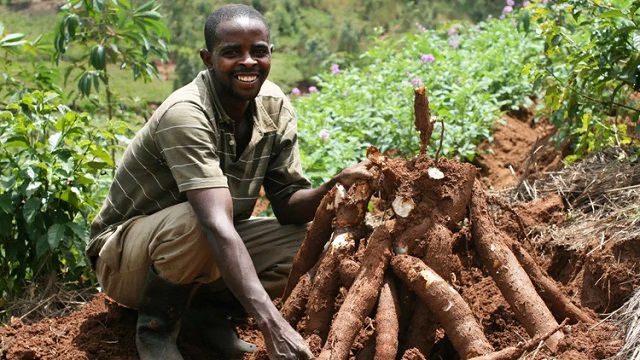
Great food harvests for family, but Ugandan farmers need to start earning more from their sweat
When Farmers Prosper Africa Prospers
COMMENT | DAVID WOZEMBA WATAKA | Uganda undoubtedly grows more food than it eats. While several of our neighbours still import grain to feed their people, our farmers continue to send maize, beans and rice across the borders into regional markets. That is a genuine strength of our agri-food systems, and it points to where our next opportunity lies. The food is already being grown. What needs to be resolved is how we can uplift millions of farmers, who depend on agriculture for livelihoods, to earn a fair return on their investment. Adding value closer to the farm and opening up better markets at home and across the region can potentially increase incomes of farmers. When done well, farm harvests have the potential to move millions of rural households into the money economy.
Government has set a clear direction. The agro-industrialisation pillar of the National Development Plan, the six presidential directives on agriculture, and the Parish Development Model (PDM) all push towards adding value and building markets closer to where farmers live.
In January 2025, Uganda hosted the Kampala CAADP Summit and produced the Kampala Declaration, the ten-year plan that now guides agricultural policy across Africa. Hosting that summit was no small thing for a country that, two decades ago, was still putting the basics of its farm economy in place.
There has been real progress since. Uganda reviewed its fertiliser policy to make room for blended products and soil health. It drew up a seed sector investment plan and tightened seed inspection and certification. Private lending to agriculture has risen as banks such as the Uganda Development Bank strengthen products that support agriculture financing. Aggregation centres have spread across the countryside, giving farmers somewhere to store and bulk their harvest before they sell. These gains belong to Ugandan institutions and the farmers who use them.
However, productivity remains low because few farmers use improved seed or apply limited quantities of fertiliser or no fertilizer at all, and extension services reach too few of those who do. Floods and droughts are becoming more severe. Weak quality control continues to eat into the worth of farmers’ surplus when they try to sell it abroad. And the national budget still puts far less than the agreed ten per cent into agriculture. None of this cancels the progress that has been made, but it does show how much remains to be done.
It is a setting in which AGRA has worked for the past twenty years, and our anniversary is a good moment to be open about what we have done and what remains to be done. We are not the main actor in any of this. We work with the government, non-government, academia, research institutions, and private sector to support its priorities, and the fairest test of our effort is whether the institutions and farmers we have supported are stronger.
Some of that work goes back to the early years. AGRA helped train 49 master’s and 20 doctoral researchers who now work at the National Agricultural Organisation (NARO), Makerere University and other institutions. These scientists contributed to 59 improved crop varieties. We supported seven seed companies and the inspection systems that certify their quality. More recently we have helped attract 62.8 million dollars in investment for agribusinesses, supported credit that reached more than 50,000 farmers, and backed regional trade worth over 21 million dollars. In total we have put 69.8 million dollars into the country, all of it aimed at a food system Uganda owns and runs.
Looking ahead, our plans and the country’s run together. Uganda’s priorities for 2024 to 2028 focus on maize, common beans, soyabean, cassava, groundnuts and rice, the crops with the best chance in regional markets, and AGRA’s work sits squarely behind them. A new programme with the Mastercard Foundation is meant to create jobs for young women in the agrifood economy. We have worked with the Government of Uganda, and other development partners to improve trade and data systems, and other partnerships are targeting improving climate resilience and the post-harvest losses that continue to quietly drain farmers’ income.
Twenty years is worth marking, but the milestone that counts is not AGRA’s. It is the slow, hard-won growth of a food system that is starting to pay Ugandan farmers properly and put young people to work. That progress belongs to government, farmers, scientists and businesses across the country. We are glad to have had a hand in it, and we mean to stay for the next stretch.
*****
The writer is the Country Director of AGRA Uganda.