Eddie Mutwe
How ordinary Ugandans in security forces and the judiciary are the quiet levers of the Machinery of Injustice
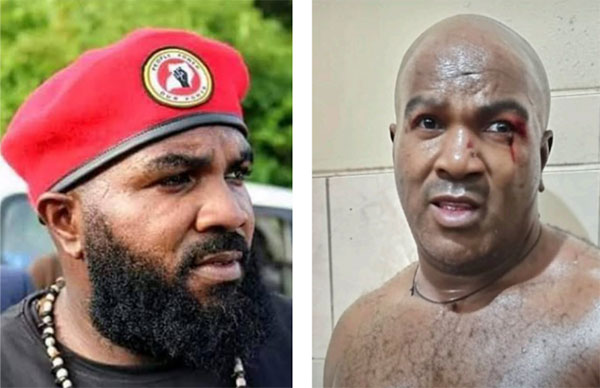
COMMENT | NNANDA KIZITO SSERUWAGI | Anybody of a clear conscience must have felt a sense of personal torture the night we saw images of Eddy Mutwe (Edward Ssebuufu), the former chief bodyguard of Bobi Wine (Robert Kyagulanyi), blindfolded and visibly tortured in what the CDF called “teaching him Runyankore” in a “basement.” For most of us, at least if I am to speak for myself, I thought that the backlash from that incident would make Eddy Mutwe the last victim of such vivid public torture. I was even somehow glad it happened, because sometimes we need extreme events or incidents of violence to stamp the consciousness of a people with a sense of “Never again!” But I was wrong. Now, it seems like that was just the beginning. And to be clear, I am no pacifist. I don’t think that violence (especially political violence) is inherently evil/wrong. But I found the violence in the above-named incidents and subsequent incidents of abductions and torture unnecessary, needless, pointless, petty, and sadistic.
The next public victim of this form of torture has been the former Lord Mayor of Kampala, Erias Lukwago. Blindfolding in itself is a form of torture aimed at making the victim experience psychological pain. The complete visual isolation it is characterised by induces severe disorientation, anxiety, apprehension and panic. If you’re obsessive about putting yourself in other people’s skin to feel their pain, simply viewing images of a tortured and blindfolded person can spread chills down your own spine. And to make another caveat, I am not persuaded by the political orientation of Eddy Mutwe’s NUP/People Power, nor do I identify with Lukwago/Besigye’s politics. I have what I would describe as an emotionally numb empathy/appreciation for President Yoweri Museveni.
Like Lukwago and Eddy Mutwe, many activists, opposition politicians, lawyers, and generally Ugandans opposed to the current government have in the past six years been abducted (the government insists they are “arrested”) on sometimes frivolous charges. Those lucky to land in court are often denied bail and dumped in jails for years without an end to their plight in sight.
Recently, we have also witnessed media entities being arbitrarily closed down overnight. The face hovering over the public imagination as the power behind these acts is that of the CDF, General Muhoozi Kainerugaba (MK). Neither has he been shy or subtle about his motives. Like Donald Trump, he has his interesting mind mapped out clearly on his X page.
I want to avoid falling prey to the thinking that what we’re witnessing in Uganda today is the work of the singular, deliberate cruelty of a man. Nevertheless, I understand why, for most people, this view is the most emotionally satisfying conclusion to make. Hatred unites people, and nothing is easier to hate and to unite against than the image of a powerful antagonist like MK. But hating MK would be a serious misreading of how systemic injustices such as those we’re experiencing today happen. And it has the undue advantage of letting every enabler of this injustice off the hook.
To make this case, I want to borrow the German and American historian and philosopher Hannah Arendt’s concept: the banality of evil. It is one of the most misunderstood ideas in modern political philosophy. She conceptualised it while covering Adolf Eichmann’s trial in 1961 in Jerusalem.
It is often misunderstood because many people who come across it assume that Arendt meant that evil is trivial or that its consequences are small. However, what she actually meant is even more unsettling. By “the banality of evil”, she meant that what history records as atrocious, horrific, widespread injustices are often not actions of fanatical monsters but rather the doings of ordinary, unthinking bureaucrats who simply go about their work, serving the status quo.
While covering Eichmann’s trial, she was surprised by not finding a monster in court. As she watched him testify, it struck her that this was not a man consumed by hatred. This was not a man whose interior life matched the scale of the brutality he had organised. Instead, here was an unremarkable bureaucrat. His language was punctuated by ordinary clichés and official jargon. His mind was not capable of any depth of imagination. He was simply thinking about his own career, ticking off office targets, complying with what his superiors expected of him. In her account, Eichmann was not defined by “ideological fanaticism but thoughtlessness”. He was simply incapable of examining his actions from the standpoint of another human being. And this is not to say he was stupid. People in offices executing instructions are rarely stupid. They are hired with good grades and tested for discipline. This was Eichmann, but he was simply unwilling to think. He couldn’t have an internal dialogue with himself. Most of us function with some kind of inbuilt brake that enables us to audit our actions, to have friction between our conscience and actions. Eichmann had no brakes. He was simply a man in an office, sitting at his desk, perusing diligently through files, and obediently executing orders.
He was not a corrupted man. He was not consumed by radical evil. He was not capable of wilful extreme wrongdoing for personal benefit. He was just a government worker who had stopped exercising judgement. His job description was clerical, processing transport schedules. It never bothered him to dwell on the names of the people he was processing and what their fate in gas chambers or concentration camps would be. He was simply doing paperwork, handling lists.
It was this systematic refusal to let conscience interrupt procedure that Arendt called ‘banal’.
Her observations fit Uganda’s current dilemma with uncomfortable precision. No single soldier, prison warder, policeman, intelligence operative, state attorney, court clerk, magistrate, or judge feels wholly accountable for where Uganda may lead if the unbridled callousness and injustice with which political prisoners are being treated continues. Their sense of moral responsibility is dispersed under the umbrella of the state’s bureaucratic administration.
The soldiers who abducted Lukwago probably were on a morning routine military task and never thought about what he would be charged with or hoped the “more educated” lawyers in the DPP’s office would not charge him with an offence for which he might be thrown in jail for over ten years. Maybe they thought he would get bail, since he is a prominent lawyer and leader. The state attorney who drew his chargesheet probably never felt like he/she was denying him medical care that might lead to his death and the suffering of his family. The magistrate who denied him bail might have felt like she was merely applying the law to the facts before her. That’s what they taught her at LDC. It is just the right thing to do, based on the law. In a narrow sense, each of the perpetuators of Lukwago’s undue suffering can convince themselves of their innocence, because their actions were small performances of their job descriptions on a random morning or afternoon.
This is what Arendt called the “rule by nobody”, whereby everyone performs their role in a system but no one feels responsible in their own eyes.
These people do not feel that they are cruel. They simply think that they are trying to earn a livelihood, pay fees for their children and cover their rent like “anyone else”. They are “simply” being disciplined at work. They are “just” conforming to their superiors’ instructions to avoid personal cost for insubordination, which seems like the right thing to do.
The state attorneys and magistrates who argued and denied Mohammad Ssegirinya’s bail, despite his ill health and subsequent death, do not feel guilty for murder. Their language spoke of “investigations”, “burden of proof”, “sureties”, and such nonsensical legalese, just like Nazi murderers like Eichmann spoke of such things as “resettlement” and “a final solution to a problem”. These words do the dirty work of hiding the grave misdoings of public and civil servants.
It does not require a network of thousands of committed sadists to make the machinery of state-enabled injustice work. It just requires simple-minded bureaucrats to sign documents, follow procedures, wear robes, and pronounce Abracadabra.
Gen MK cannot, by himself, whatever breed of Muchwezi he might be, produce the scale of injustice attributed to him. He requires the compliance of everyone in the state bureaucracy to help him. He doesn’t even know these people. He might never meet them; they might never meet him. He is not fond of them; they are not fond of him. They are simply doing their jobs, looking after their families – good people.
Without appearing to make excuses for Gen MK, I want to suggest that we all should feel responsible for contributing to the better governance and development of our country. I want to think that he feels, in some way, he is doing the right thing for Uganda as well. Let MK do what he thinks is right for Uganda. But so must every other person in any government office. Exercise your conscience. Be judicious. Take responsibility for doing the right thing for Uganda without simply promoting heinous injustices in the guise of completing repetitive office tasks.
Know that your small actions matter for how Uganda turns out. Be civically conscious. Know that you’re doing it for your children, and it matters as much as earning a living for them does. They won’t make much out of life in a country torn apart by political upheaval. Your willingness to violently arrest or abduct someone, your willingness to torture someone, and your willingness to deny someone bail have little to do with the President of Uganda or the commander of the armed forces. Let them do what they wish while you also do what you can, what is in your power. That’s how democracy is built, by each negotiating for the right thing in the corner of their office.
***
The writer is a Ugandan thinking about Uganda.
Snnanda98@gmail.com