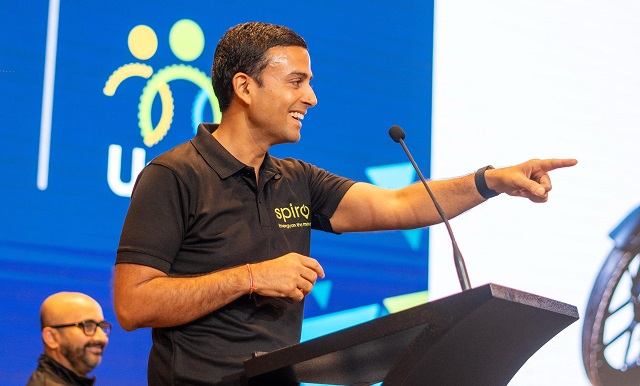
Spiro founder Gagan Gupta
Kampala, Uganda | THE INDEPENDENT | African electric mobility company Spiro has secured a landmark $215 million equity investment to accelerate the expansion of its electric vehicle (EV) and battery-swapping infrastructure across the continent, positioning the company among Africa’s leading clean energy and transport platforms.
The funding round attracted support from major institutional investors, including Impact Fund Denmark and Equitane, underscoring growing global confidence in Africa’s emerging electric mobility sector and the continent’s transition toward cleaner transport systems.
The investment will be used to expand Spiro’s battery-swapping network, strengthen its manufacturing and assembly operations, advance technology development, and support expansion into new high-growth African markets.
The company currently operates in seven countries—Uganda, Kenya, Rwanda, Nigeria, Cameroon, Benin, and Togo—and plans to extend its footprint into additional markets, including the Democratic Republic of Congo and Ethiopia.
According to Spiro, the latest capital injection comes after years of investment in technology, infrastructure, and operational efficiency, enabling the company to move beyond the proof-of-concept stage and focus on large-scale growth.
The investment arrives at a time when many African countries are seeking ways to reduce dependence on imported fuel, strengthen energy security, and modernize urban transportation systems. Rising fuel prices and increasing demand for affordable transport alternatives have also accelerated interest in electric mobility solutions.
For riders, the economic benefits are significant. Spiro estimates that operating one of its electric motorcycles can lower daily transport costs by up to 40 percent, translating into savings of as much as $2 per day compared to conventional fuel-powered motorcycles.
The company also highlighted the environmental benefits of its electric mobility ecosystem. A third-party lifecycle assessment conducted on Spiro’s operations in Kenya found that the company’s electric motorcycles reduce climate impact by 72 percent compared to fossil-fuel motorcycles, preventing approximately 19 tonnes of carbon dioxide emissions over a vehicle’s lifespan.
The study further reported an 80 percent reduction in ozone depletion potential and a 20 percent reduction in particulate matter emissions, demonstrating the potential of electric mobility to improve air quality in rapidly growing urban centers.
Spiro Founder and Equitane Chairman Gagan Gupta described the past year as a turning point in the company’s growth journey.
“This past year marked a defining strategic milestone for Spiro,” Gupta said. “Across seven active markets, our deployment of 100,000 electric vehicles and 2,500 smart-swap stations has turned sustainable mobility into an affordable, everyday reality.”
He added that the company has become an important contributor to local industrial development across African markets.
“Spiro has become a major driver of local industrialization, value creation and manufacturing across African markets with 6,000 sustainable direct and indirect jobs,” Gupta said. “Supported by our global pool of investors, we are entering our next growth chapter to deliver clean, cost-effective energy and transport alternatives to millions of riders across the continent.”
Spiro has built one of Africa’s largest electric mobility ecosystems, with more than 100,000 electric motorcycles currently on the road, over 2,500 battery-swapping stations, and more than 30 million battery swaps completed to date.
Its growing industrial footprint includes manufacturing and assembly facilities in Kenya, Rwanda, and Uganda, as well as a modern battery recycling plant in Nigeria.
The company’s technology platform is supported by a research and development team comprising more than 150 engineers and backed by over 30 proprietary patents. Spiro is also investing in innovations such as solar-powered battery-swapping stations and second-life battery applications for renewable energy storage.
Vice President, Jessica Alupo, accompanied by the Minister of Gender , Labour and Social Development recieve a Spiro dueing the 4th National Labour Convention 2026.
Beyond transportation, the company is positioning itself as part of Africa’s broader clean-energy transition by developing distributed energy infrastructure capable of supporting national renewable energy goals while reducing reliance on fossil fuels.
Impact Fund Denmark Chief Executive Officer Lars Bo Bertram said the institution’s decision to invest was driven by both the commercial prospects and environmental impact of electric mobility in Africa.
“We are investing in Spiro and bringing Danish pension capital into one of Africa’s most promising growth markets because we see potential for significant commercial growth in Spiro and electric mobility across Africa, as well as measurable climate impact,” Bertram said. “That is exactly the type of investment we want to make.”
Spiro describes itself as Africa’s largest electric mobility company and says its long-term ambition is to manufacture electric vehicles in Africa for both regional and international markets.
The latest investment is expected to strengthen the company’s position as one of the continent’s leading clean infrastructure players while accelerating Africa’s transition toward affordable, sustainable, and locally driven mobility solutions.