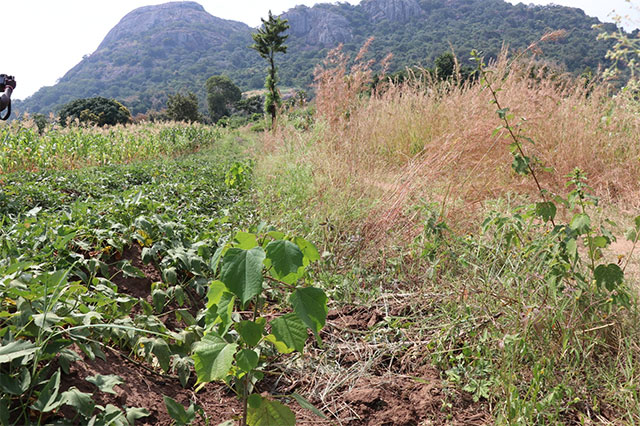
Project participants have planted many trees on boundaries to help the region recover from degradation
Koboko, Uganda | THE INDEPENDENT | Uganda’s forest cover has been on the decline in the past two decades. According to Global Forest Watch, between 2000 and 2020 Uganda lost over 23% of its tree cover in both natural and planted forests.
One of the biggest drivers is the high demand for fuelwood and charcoal, which leads to deforestation as people cut down trees in protected and forested areas. With Uganda’s rapid population growth, this pressure on land and natural resources is only increasing—making degradation a growing threat, more so in refugee-hosting districts where population is on the rise.
For this reason, the Government of Uganda (GoU) through the Ministry of Water and Environment received funds from the World Bank (WB) towards the implementation of the Investing in Forests and Protected Areas for Climate Smart Development (IFPA-CD) Project.
Catholic Relief Services is implementing the project under the name Intensive Mixed Use Agroforestry Systems on household Plots” with a focus on increasing uptake of agroforestry in refugee host communities in 19 targeted districts in Western and Northern Uganda that either host refugee settlements or are within 5 km of a settlement boundary.
“This innovative project seeks to address environmental degradation, improve food security, and enhance livelihoods by promoting the adoption of sustainable agroforestry practices that integrate trees, crops, and livestock targeting refugee hosting farming communities,” said Joseph Ebinu, Program Manager, Catholic Relief Services.
“Our goal is to support government structures and systems to strengthen national and community‑level efforts to mitigate and adapt to climate change. We’re working to balance community needs with conservation, helping people sustainably depend on the environment while also protecting and restoring it for the future.” He said.
The project hopes to restore 17,550 hectares working with 87,782 households. The project lifespan is 2024-2026.
“I received 120 tree seedlings from Catholic Relief Services, 800 wood trees, and 400 high-value crops like cocoa. I look forward to my family benefiting in terms of fruits for the children; we sell wood for fuel and school fees for my children and grandchildren,” said Haji Abdalah Yusuf Banya, a project participant in Rukulia village, Koboko district. He has involved and interested his family in the project and hope for them to continue caring for the trees for generations.
Abdalah Yusuf Banya from Rukulia Village, Koboko district shows off one of the many trees he has planted, mixed with other crops
The project which started in 2024 and ends in June 2026, has achieved the following results.
13,739.7 ha of land have been committed for land restoration in this project
10,509 farmers registered or supporting with land restoration on their land (26 % youth, 28 % women)
2,449,688 trees distributed and planted – 85% survival rate
The project is promoting a business model on a few selected items which include high-value crops, fruit trees and small ruminants.
“As we plan to plant more trees, we also aim to create linkages of farmers to service providers including processors, financial institutions, follow up with the extension services, and Initiate the market linkages/actors,” said Ebinu.
The Koboko District Forest Officer, Ojia Gilbert, one of the districts of implementation, said that the project has been timely as the district has been struggling with declining forest cover. He said that five years ago, for example, Koboko forest cover was only at 14 percent. However, with interventions like these, they project an increase in forest cover.
“This project, together with others, is addressing both climate change, environment degradation and food security as the tree enhance soil fertitlity,” said Ojia.
CRS is working with partners ICRAF and Ecotrust to impellent the project.