
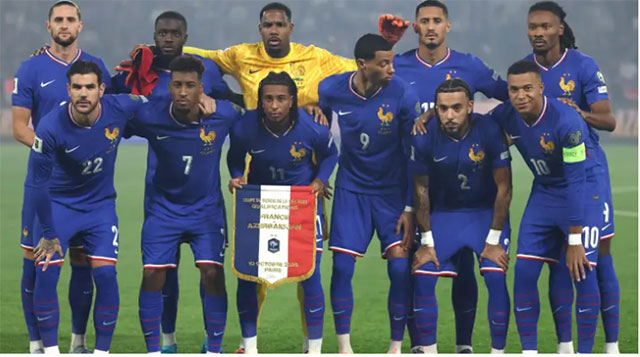
The France team at the World Cup 2026
Despite African brilliance on the world stage, players increasingly choose foreign flags, citing better organisation, respect and pathways than African federations offer, writes Sean Andah.
African players are never far from the pinnacle of the world’s game. The perfect illustration of this can be seen in France and its approach both to development in football and to a sense of national identity, carried over and evolved from old colonial policy. Unlike the British empire and other leading European powers of the time, France instilled a policy of assimilation in its colonies, aiming to turn colonised people into “civilised” Frenchmen and women having (in theory) equal rights with their colonisers, to be developed through the mission civilisatrice.
France’s 1998 World Cup winning squad relied on stars with roots in Africa and the French Caribbean, such as Marcel Desailly, Zinedine Zidane, Lilian Thuram and even a young Thierry Henry.
Exactly 20 years later, this was even more apparent as France won a second World Cup, featuring the likes of Adil Rami, Presnel Kimpembe, Raphaël Varane, Samuel Umtiti, Paul Pogba, Benjamin Mendy, Blaise Matuidi, N’Golo Kanté, Steve Nzonzi, Nabil Fekir and young stars such as Ousmane Dembélé and Kylian Mbappé.
At that tournament a whopping 78% of France’s squad came from families with roots outside the French mainland. It is quite ironic, therefore, that while many on social media dubbed this squad “Africa FC” as it went on to lift the prestigious trophy, Africa itself had one of its worst World Cup showings since 1982 – with not a single African nation making it past the group stage.
So, what is holding African players back from representing African countries?
Some players may feel a genuine kinship with the countries they represent, growing up in immigrant families, or coming from families that have been citizens of these nations for decades, with their connection to their countries of origin dwindling over time.
For others, not representing an African country is an active decision. England and Manchester United midfielder Kobbie Mainoo was born in Stockport to two Ghanaian parents, and has opted for a squad role behind the likes of Jude Bellingham
– much to the chagrin of the Ghana FA president, Kurt Okraku, who called the decision “unfortunate”, going on to say that “full-blooded Ghanaians should be representing their countries.”
Opportunitites
While European countries do offer prestige, representing an African nation can provide greater opportunities for regular football and a more central role within a national team. Current Golden Boy trophy holder Désiré Doué already has two Champions League medals to his name, having played a key role in the attacking system of the Paris Saint-Germain team, establishing himself as one of the world’s best young attacking players. However, due to strong positional competition in one of the top national teams on the planet, he is often relegated to the bench in France’s international games. Meanwhile Doué’s older brother Guéla, who plies his trade for Strasbourg, a middling Ligue 1 side, is a core part of Ivory Coast’s World Cup squad, providing reliable support in both attack and defence from his right back position, scoring a goal and providing an assist in The Elephants’ historic win over France in the pre-tournament friendlies.
The US star striker Folarin Balogun is an uncommon case. Born to Nigerian parents and raised in London, he spent 12 years at the Arsenal academy.
After spending a majority of his youth career with England’s national team, he instead chose to defy all expectations, accepting the call up to the US team, for which he was eligible due to a freak circumstance: his mother was turned away from a return flight to London after a holiday in New York, due to the airline not wanting to transport someone in such a late stage of pregnancy. Balogun was thus born in New York and and spent the first two months of his life there, before returning to his family in London with birthright US citizenship.
African football has always lacked a certain level of prestige and high regard. Even when a player chooses to represent their home country and is spoken of as one of the world’s best, they are discouraged by their clubs when it comes to representing an African nation, pressured in some cases to prioritise European club football instead.
In 2022 the Senegalese Football Federation was at loggerheads with English Premier League side Watford, accusing it of refusing to release Ismaila Sarr for that year’s Africa Cup of Nations (AFCON) tournament as it drifted closer to the relegation zone.
That same year, Napoli owner Aurelio De Laurentiis made an explicit public statement, asserting that he would not allow his club to sign any more African players unless they signed a waiver agreeing to give up their right to represent their countries at AFCON. De Laurentiis made this statement at a time when Kalidou Koulibaly, Napoli’s star defender, was also captain of the Senegalese national team. The consequences of this institutional disregard are tangible. Players with African heritage increasingly opt out of representing their countries of origin entirely, citing poor organisation, inadequate facilities and a lack of basic professional respect. A number of players with African heritage have rejected call-ups, switched allegiances or distanced themselves from national setups that they feel do not treat them as professionals.
Boateng brothers
The Boateng brothers illustrate this well. KevinPrince and Jérôme were integral to the success of the national teams they represented, but while Jérôme is regarded as a German footballing legend and one of the best defenders to grace the sport, Kevin-Prince was, in his own words, pushed out of the Ghana squad in the middle of a World Cup for demanding better terms and timely pay for himself and his team-mates.
When the experience of representing an African nation is characterised by logistical chaos and a sense that the federation does not value its own players, the decision to prioritise European football becomes easier to justify. Another perspective on why players may not represent their home country is due to war or conflict in the region, leading them to become refugees in other countries.
This is the case for players such as Alphonso Davies of Bayern Munich, who was born in Ghana as a Liberian refugee and now captains the Canadian national team; while Alexander Isak and Taha Ali of the Swedish national team were born to Eritrean and Somali refugee parents respectively. Australia’s national team the Socceroos fully embraces this trend, with players Nestory Irankunda, Mohamed Touré, Awer Mabil and Tete Yengi being born as refugees or having a refugee parent. African football, both on and off the pitch, is seen by those at the top of the football world as unrefined and underdeveloped, with poor management and coaching and even worse facilities.
****
Source: African business


