‘Everything and everyone we love is at stake’ – Greta Thunberg
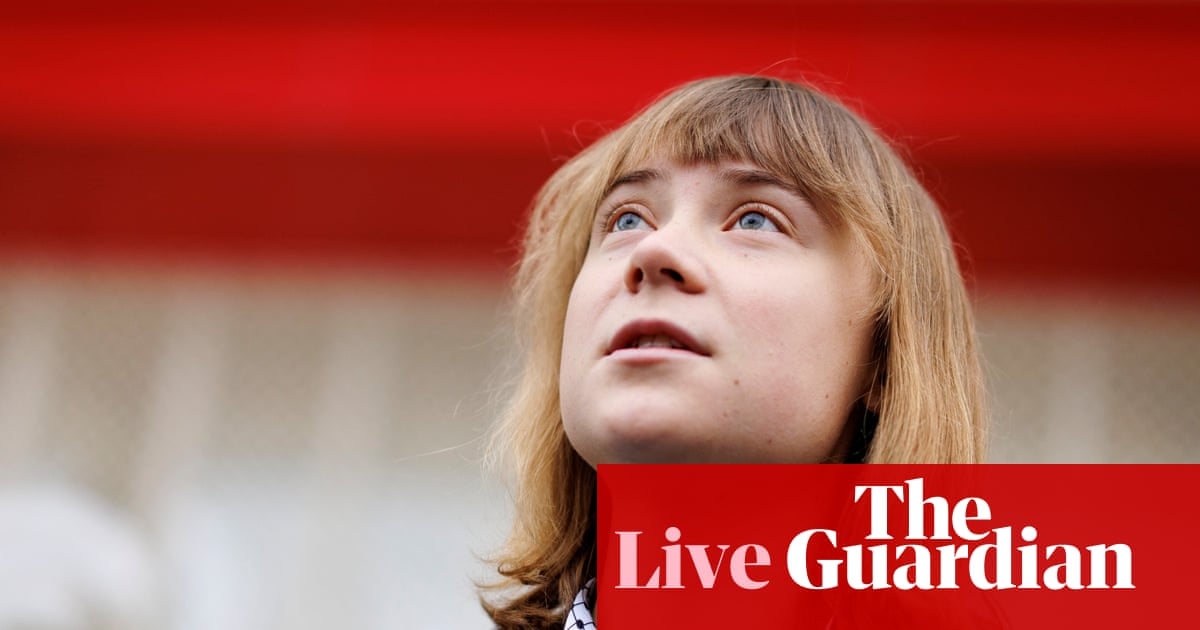
Greta Thunberg, the Swedish climate activist who inspired global climate protests several years ago, said climate change is “threatening everything” and that “everything and everyone we love is at stake.”
In comments reported by AP, she told reporters in Antalya: “We should act to protect and benefit people rather than constantly sacrificing the global majority, and the very planet we are all living on, for a fortunate few to keep making unimaginable profits and maintaining geopolitical power,” she told reporters.
Cop31 is the first UN climate summit Thunberg has attended since the Cop26 conference in Glasgow, Scotland, in 2021, where she dismissed promises made by global leaders as “blah, blah, blah.”
Since then, fossil fuel emissions have continued to rise – though they flatlined this year – adding even more planet-heating gas to a beleaguered atmosphere. While many big polluters have taken steps to clean up their economies, none are doing so fast enough to keep global heating to the 1.5C Paris climate target.
Share
Updated at 15.34 CET
Key events
Matthew Pearce
Greenpeace has unveiled a giant limestone boulder carved into the likeness of Sir David Attenborough, which it plans to throw into the North Sea to deter bottom trawling.
Dubbed the “Attenboulder”, the sculpture was revealed aboard the campaign group’s ship Arctic Sunrise on the River Thames on Tuesday.
The “Attenboulder” on the MY Arctic Sunrise. Photograph: Andrew McConnell/Greenpeace
It will join the boulders Greenpeace placed in the Southern North Sea marine protected area earlier this month, in protest at the lack of restrictions on fishing in most of it. The Marine Management Organisation has threatened legal action unless Greenpeace stops placing boulders.
The unveiling comes as Blue Planet III renews attention on ocean protection.
Will McCallum, Greenpeace UK’s co-executive director, said: “Right off our coasts the government still allows industrial fishing vessels to bulldoze the seabed and all of the incredible marine life it holds.
“These are supposed to be safe havens for wildlife – not killing grounds. The government’s inaction makes a mockery of the term ‘marine protected area’ and is an insult to Attenborough’s urgent work over many years.”
Share
More than 700 groups ranging from trade unions to disability advocates have urged diplomats to prioritise a “just transition” for the people who will be hit hardest by a shift to a clean economy.
Building on a commitment at last year’s summit that social movements described as a “historic win”, organisations from 88 countries demanded a mechanism at Cop31 to turn promises of a just transition into action. Known as the Belém-Antalya Mechanism (BAM), it would seek to support issues including human rights, gender equality and good jobs, while respecting Indigenous rights.
Activists demanding a “just transition” at Cop31. Photograph: Burak Kara/Getty Images
“Workers and communities, especially in the Global South, welcomed and celebrated the Cop30 decision to develop a just transition mechanism – or BAM – which has the promise of delivering real support and action for just transition on the ground,” said Lidy Nacpil, coordinator of the Asian Peoples’ Movement on Debt and Development. “However, in pre-Cop, governments of the Global North have once again exposed their determination to pour cold water over this promise, by limiting what a mechanism can do and delaying the process of its operationalisation.”
The open letter calls for the mechanism to have the mandate and institutional set-up needed to deliver a just transition – including the ability to provide technical and financial support – as well as giving workers and communities a seat at the table.
Share
Updated at 15.57 CET
‘Everything and everyone we love is at stake’ – Greta Thunberg
Greta Thunberg, the Swedish climate activist who inspired global climate protests several years ago, said climate change is “threatening everything” and that “everything and everyone we love is at stake.”
In comments reported by AP, she told reporters in Antalya: “We should act to protect and benefit people rather than constantly sacrificing the global majority, and the very planet we are all living on, for a fortunate few to keep making unimaginable profits and maintaining geopolitical power,” she told reporters.
Cop31 is the first UN climate summit Thunberg has attended since the Cop26 conference in Glasgow, Scotland, in 2021, where she dismissed promises made by global leaders as “blah, blah, blah.”
Since then, fossil fuel emissions have continued to rise – though they flatlined this year – adding even more planet-heating gas to a beleaguered atmosphere. While many big polluters have taken steps to clean up their economies, none are doing so fast enough to keep global heating to the 1.5C Paris climate target.
Share
Updated at 15.34 CET
Here’s a video of Chris Bowen, Australia’s climate minister and president of the Cop31 negotiations, making the case for working together – and the benefits of doing so – at the opening of the summit yesterday. (Subtitles are on.)
Australia’s Chris Bowen tells Cop31 the world can still limit global heating to 1.5C – videoShare
Updated at 14.57 CET
Turkey’s celebration of the discovery of two new oilfields last night is already raising eyebrows. While Recep Tayyip Erdoğan’s language is more restrained than that of his Azerbaijani counterpart, President Ilham Aliyev, two years ago – when he called oil and gas a “gift from God” at the Cop29 summit – it clashes directly with the strategies to phase out fossil fuels being discussed in Antalya today.
Jeni Miller, head of the Global Climate and Health Alliance, a network of more than 300 health groups addressing climate change, said it sends a “deeply troubling message” to communities where lives, homes and futures are already at stake from climate change and fossil fuel pollution.
“The message from Turkey could not be more contradictory,” said Miller. “How can a country host the world’s most important climate conference – with Cop31 President, Murat Kurum, calling for stronger health systems to protect people from the climate crisis as part of the Antalya Initiative for Resilient Health Systems (AIR) – and on the same day announce plans to expand production of the fossil fuels driving that crisis”
ShareFiona HarveyFormer US secretary of state John Kerry. Photograph: Tolga Akmen/EPA
China is leading the world in moving away from fossil fuels, and the rest of the globe – including the US – must now follow, the former US secretary of state John Kerry has told the Guardian, as Cop watchers wonder exactly how China is going to approach this year’s climate summit.
As Cop31 opens – this year the climate conference is in Turkey – there is plenty of speculation about whether China will finally step into the leadership role that it has long avoided. In its latest “five-year plan” adopted in March 2026, China for the first time pledged to “actively participate in and lead global climate governance”. Cop31 could provide the first indications Beijing is ready to put that rhetoric into action, something it has historically been reluctant to do.
Green energy is a vital component of the export engine that has kept China’s sluggish post-pandemic economy on track. The success of its exports stands in contrast to its failure to significantly boost domestic general consumption, a structural weakness that has persistently vexed leaders.
In 2025, clean-tech exports surpassed $220bn, and they should grow again this year; the world’s largest emitter is now the world’s leading supplier of clean energy technology. China accounts for about 85% of solar and 80% of lithium-ion battery supply chain production capacity, and in 2025, nearly 75% of electric cars were manufactured there.
Smart moves now by China would position it as a linchpin in a future electrostate world order, persuade rivals to cooperate, and solidify its influence in the global south.
Meanwhile other countries, including the US under Donald Trump, have fallen badly behind. Kerry said they would lose out economically – as well as putting the climate in further danger – unless they, too, embraced low-carbon power and rapid electrification. “The only country that has hugely accelerated is China. The rest of the world is stumbling along while Mother Nature is sending us more powerful signals every week, every day,” he said.
“[China] realised suddenly they had way too much dependency on oil and gas from other places, and they decided they needed to be independent. Other countries, since the war in Iran, and since the strait of Hormuz has been interrupted, have made a similar decision, and they’re moving independently. There’s been a massive uptick in deployment of renewables. Thank you, Donald Trump.”
ShareJoe Pinner
‘I’ve seen how coastlines change’
I’ve been interviewing some of the young climate activists who have gone to the summit. Today I spoke to Yania Hussain Ishan, an 18-year-old climate activist attending Cop31 with the Maldives youth delegation.
She joined a Unicef climate programme at 16 and went on to found Barnacles, a climate initiative working to connect young people.
Yania Hussain Ishan, an 18-year-old climate activist from the Maldives. Photograph: UNICEF Maldives / Hussain Yameen Ali
“Growing up in the Maldives has shaped the way I understand climate change. It’s difficult to separate it from everyday life when so much of what makes our home what it is depends on our environment. I’ve seen how coastlines change, how waves reach roads and public spaces, how flooding affects businesses near the shore, and how rough seas can disrupt the journeys that connect our islands. These are things you grow up seeing, but as you get older, you start thinking a little more about what they mean for the future.
“Sometimes I wonder what the Maldives will look like when I’m older, or what it will be like for children growing up here 20 or 30 years from now. Will they get to experience the same things we did? Will the places we grew up with still feel the same? I don’t think these are questions young people should have to spend so much time worrying about, but for many of us, they’re difficult to ignore.
“At Cop31, I hope we can move beyond repeatedly acknowledging how vulnerable countries like ours are and start paying closer attention to what actually needs to happen. Climate finance, adaptation and loss and damage have very real implications for the lives people get to lead. I also hope young people are given opportunities to meaningfully influence these conversations, rather than simply being invited to participate.
“I think about my own future and what the Maldives will look like by the time I’m older. I want to be able to build my life here, and I want the generations after me to have that same opportunity. I want them to experience the Maldives in all the ways that make it home to us, rather than having to learn about what it once was.”
Share
The death toll from an explosion at a steelworks in western Turkey yesterday has risen to 17 people, Turkish officials have said.
The blast and fire ripped through the iron and steel factory in Aliağa, near Izmir, about 400km northwest of Antalya, on Monday.
Smoke rising from the Habas iron and steel plant in Izmir, Turkey, after a deadly explosion. Photograph: Ali Ihsan Ciftci/IHA/AP
In comments reported by AFP, the provincial governor, Suleyman Elban, said a crane fell into a furnace as it was replacing a boiler, which led to an explosion in a nearby steel mill.
The Turkish President, Recep Tayyip Erdoğan, offered condolences to the grieving families yesterday, when 16 people were thought to have lost their lives. The death toll has since risen to 17.
Share
Updated at 12.52 CET
‘Find the courage to speak the truth to powerful interests’ – John Kerry
Graham Readfearn
Now the former US secretary of state, John Kerry, has joined the calls for Cop31 to pick up the mantle of building support to transition away from fossil fuels.
“We are going to have to draw on ourselves and find the courage to speak the truth to powerful interests that seem intent to ignore the basic science.
“We know clean power is cheaper than fossil power. That argument is over except amongst those people who keep wanting to hold on to the past.”
Then the UN secretary general is excused from the stage to attend another meeting, and the room gives him a raucous standing ovation as he walks out.
António Guterres, secretary-general of the United Nations. Photograph: Graham Readfearn/The GuardianShare
Updated at 12.34 CET
Graham Readfearn
We’ve just heard from Patricia Espinosa, the former UN climate boss (succeeded by Simon Stiell) and now we are hearing from former US secretary of state and climate ambassador, John Kerry.
Kerry has congratulated Brazil for keeping the fossil fuel transition issue alive, and the room has erupted in cheers.
ShareGraham Readfearn
We’re in the plenary that’s promoting Brazil’s new roadmap to transition away from fossil fuels, and the UN’s chief climate negotiator, Simon Stiell, has backed up the comments of the UN secretary general a few moments ago. Perhaps not unexpected, given Guterres is his boss. But he said:
“Antalya must accelerate delivery [of a transition away from fossil fuels]. This roadmap can help us do that.”.
ShareGraham Readfearn
The UN secretary-general, António Guterres, has just issued a challenge to Turkey and Australia to carry on the work to develop a roadmap for the plan to transition away from fossil fuels.
Remember that this roadmap, promoted by last year’s Cop president, Brazil, is not even on the official agenda here at Cop31.
We might see this as an intervention. Guterres said:
“Now, here at Cop31, we must move from discussing the transition to organising it, financing it, and delivering it. I thank the Presidency for its leadership.
“Let us leave Antalya with clear next steps to advance this Roadmap. I encourage the current and future Cop Presidencies to carry this work forward. We must give the world reason to believe in the commitment made at Dubai to transition away from fossil fuels.”
This will need a response from Australia and Turkey.
ShareGraham Readfearn
The president of last year’s Cop30 in Brazil, the veteran Brazilian diplomat André Aranha Corrêa do Lago, is presenting his roadmap for “Transitioning Away from Fossil Fuels in Energy Systems” on a stage here in Antalya.
Alongside him is the UN secretary-general, António Guterres, former US secretary of state, John Kerry, and British conservative politician, Lord Alok Sharma, who was the president of Cop26 in Glasgow.
A pretty remarkable lineup. The very large plenary room is packed.
ShareGraham Readfearn
A short update on our Cop31 bus journey from hell.
We have arrived. It only took three and a half hours. And it turned out I had the key for our Guardian Cop31 media cubicle, which meant my colleagues had to do some wrangling to get inside.
But to show they bore no grudges and, as a testament to the collegiate and supportive spirit that exists within the Guardian’s Cop31 reporting team, here is what greeted me at my desk after my odyssey.
Fruit arranged in a smiley face. Photograph: Graham Readfearn/The Guardian
Maybe I’ll try the tram tomorrow.
Share
Updated at 12.34 CET
Summit host Turkey celebrates new oilfields
As Turkey convenes world leaders to forge agreements that stop climate breakdown, its own leader is celebrating new fossil fuel exploration.
President Recep Tayyip Erdoğan, who is expected at Cop31 in Antalya later today, announced the “encouraging” discovery of two new oilfields in the Gabar mountains in a post on X last night.
“We have discovered oil in two further fields in the region. Production began in October at the fields we have named Gaziler and Çardaklı. According to our initial assessments, these two new fields hold an in-situ oil potential of 135m barrels.”
The new fields and further wells should increase oil production by 30% in the Gabar region, which has “virtually become the capital of oil”, Erdoğan said in separate comments made after a cabinet meeting yesterday.
Burning fossil fuels is the main driver of carbon pollution and the resultant heating of the planet, and roadmaps to a clean economy require steep, immediate cuts to the supply of coal, oil and gas.
Turkey is far from alone in expanding fossil fuel infrastructure while promising climate action. In recent weeks, co-host Australia granted a licence to restart production at an offshore gasfield, the UK gave the green light to the already-licenced Jackdaw gasfield, and Norway announced a new oil and gas discovery in the North Sea.
Share
Updated at 10.54 CET
Graham Readfearn
Bus horror update. So I am still on the bus and it has been three hours. We think we are still half an hour away (I said that an hour ago).
A traffic jam at the Cop31 climate summit. Photograph: Graham Readfearn/The Guardian
Some people got off and tried the tram. Splitters. We watched a packed tram go past and leave a few of the splitters on the platform.
Some people are walking. We are now a forming a community forged in bus hell. Philippa has some Simit – like a Turkish bagel. Here’s a picture of us.
A delayed bus with delegates at the Cop31 climate summit. Photograph: Graham Readfearn/The GuardianShare
Updated at 12.34 CET
Carbon pollution flatlined in 2026, scientists find
Fiona Harvey
Soaring oil and gas prices following the war in Iran have encouraged people to look beyond fossil fuels, leading to an easing of climate-damaging carbon emissions this year.
Carbon dioxide from oil, gas and coal is forecast to flatline for 2026, based on data from the year so far, according to a comprehensive assessment by scientists. Emissions from burning oil alone will drop by 2% as drivers economise on fuel use and flock to electric vehicles instead.
The findings, presented on Tuesday morning at the Cop31 climate talks hosted by Turkey in Antalya, show both the impact of the Iran war and the global expansion of cheap renewable energy, chiefly solar and wind power.
Talk of a global turnaround would be premature, however, the report’s authors and other analysts said. The reduction in emissions from fossil fuels for 2026 will be about 0.4% compared with last year.
A barge moving past a coal-fired power plant near New Haven, West Virginia, US. Photograph: Carolyn Kaster/AP
Yet this year’s slight fall could be temporary, and was more than offset by increased emissions from deforestation and land use change, following major fires in south-east Asia and further conversions of wild land to agriculture.
Many factors could disrupt the fragile trend of slowing emissions from fossil fuels, including an intensified expansion of coal in India, an easing of oil prices and US president Donald Trump’s enthusiasm for fossil fuels. Much greater investment in renewable energy, and low-carbon technology such as electric vehicles, would still be required to make permanent reductions in annual emissions, the report’s authors said.
ShareGraham Readfearn
In an attempt to get to the venue a bit early, I decided to ditch the tram and try the special Cop31 buses. This was a bad decision.
We have just reached the two-and-a-half-hour mark on the bus and are still crawling through Antalya traffic. New friendships are being spawned in here. We are starting to eat each other’s food.
I want to thank Philippa Bayley from Groundwork for the walnut and chocolate biscuits she snaffled from her hotel buffet.
Exceptional, which is more than I can say for the traffic.
Share
Opening summary: world’s fever rapidly worsening as conference enters day 2
Oliver Milman
Good morning from Turkey and welcome to the second day of Cop31, the UN gathering that is taking place, again, to help prod indolent countries clear of catastrophic planetary heating.
A lot of angst was vented on the first day of the summit over whether this goal is being achieved, and even if Cop is the best forum in which to achieve it. Perhaps sensing the fractured, distracted geopolitical mood, Chris Bowen, Australia’s climate minister and Cop negotiations chief, plaintively urged countries to “show the world that multilateralism works. Let’s show the world we are equal to the challenge.”
Further evidence, if it was needed, was unveiled yesterday showing the world is failing rather badly in this challenge to stem its growing fever. But research published this morning shows carbon emissions from fossil fuels are falling slightly, and there is still hope here in Antalya that things can change. If not then, well, what are we all doing here? Right?
About 100,000 delegates crammed into the well-tended conference venue yesterday and the long queues for registration badges led the UN to plead for people to return for them today if attendance on Monday wasn’t compulsory.
Tuesday will lay the groundwork for the arrival tomorrow of leaders from more than 90 countries, with notable absentees including the heads of the US and China. Today’s theme is “energy and transport, touching on a key goal of this Cop to get the world to agree to greatly increase the share of energy used via electricity”. That power will, hopefully, be clean.
Let’s see how close to consensus the world will be on that. At the very least, the Turkish baked goods promise to be delicious and there is some tasteful art constructed of discarded waste to look at. Onwards.
Share
Updated at 09.24 CET