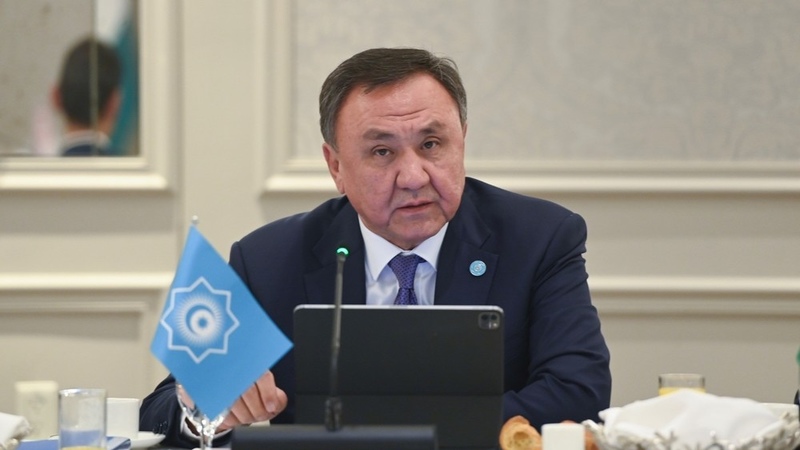
AKIPRESS.COM – Ambassador Kubanychbek Omuraliev,
Secretary General of the Organization of Turkic States,
Istanbul, October 2026
There are critical moments in the life of nations and states when shared history ceases to be merely a memory and becomes a force shaping the future. I believe the Turkic World is living through such a moment today.
Across a vast geography connecting East and West, the Turkic World brings together a population of around 180 million people, bound by deep historical and cultural ties and increasingly connected through trade, transport, investment, education, technology and people-to-people cooperation. What for centuries was sustained through common language, culture, traditions and collective memory is increasingly taking institutional and practical form under the umbrella of the family Organization of Turkic States (OTS).
The transformation has been remarkable. Since its establishment in 2009, the OTS has evolved from a platform focused primarily on political dialogue and cultural affinity into a comprehensive and action-oriented framework of cooperation.
As I approach the completion of my tenure as Secretary General, I see this moment not simply as an occasion to look back at what has been accomplished. More importantly, it is an opportunity to reflect on what makes our cooperation distinctive, what it can offer to our peoples, and what kind of Turkic World we wish to build together in the decades ahead.
A Unity Rooted in Something Deeper
The OTS possesses a quality that is rare among international organizations.
International institutions are often created in response to a particular political challenge, economic necessity or security concern. The foundation of the OTS is different. Our cooperation rests upon something that existed long before the establishment of the Organization itself: centuries of shared history, linguistic affinity, common cultural traditions, values and a profound sense of belonging to the same civilizational space.
Common history, language, identity and culture are not simply references to our past. They provide a foundation of trust upon which strong and sustainable cooperation can be built.
Few, if any, international organizations enjoy such a natural foundation. Yet heritage alone does not guarantee a shared future. The responsibility of our generation is to transform this historical closeness and affinity into opportunities, connectivity and cooperation that respond to the realities and challenges of the 21st century.
There is a simple expression that captures this idea particularly well: “Biz Birlikte Daha Güçlüyüz” – Together, We Are Stronger.
Remarkably, this words, written using letters that form part of the Common Turkic Alphabet, are understood across the Turkic World and requires almost no translation, reflecting the deep linguistic and cultural bonds among our peoples. Today, “Together, We Are Stronger” is not merely an expression of solidarity, but a guiding principle for practical cooperation.
From Shared Identity to Institutional Strength
One of the most important transformations of recent years has been the gradual conversion of this natural affinity into institutional capacity.
Today, the OTS continues to make significant strides in strengthening cooperation among its Member States. Currently, 65 cooperation mechanisms exist under OTS umbrella, which range cover– from economy, trade, transport and customs to energy, digitalization, industry, science and technology, health, education, youth, agriculture, labour and social protection, intellectual property, space and many others. Since 2023 alone, 32 new mechanisms have been established – matching the total number created by the end of 2022. This reflects not only the expansion of our agenda but also the growing determination of our Member States and Observers to translate shared priorities into concrete institutional cooperation.
What matters even more than the numbers is a change in how we work together. Political consultations have become more frequent and substantive; ministries and specialized institutions are in closer contact; and our ability to think together, plan together and act together has grown. I would describe this stage of our development in three words: implementation, transformation and institutional deepening.
As Chair of the Coordination Committee of the Turkic Cooperation Organizations, the OTS maintains close and structured cooperation with affiliated and related organizations, including the Parliamentary Assembly of Turkic States (TURKPA), the International Organization of Turkic Culture (TURKSOY), the Turkic Academy, the Turkic Culture and Heritage Foundation, the Turkic Investment Fund (TIF) and the Union of Turkic Chambers of Commerce and Industry (TCCI). Together, these institutions contribute to a multidimensional framework of cooperation, strengthening institutional ties and advancing shared priorities across the Turkic World.
The establishment and operationalization of the Turkic Investment Fund represent an important milestone in this evolution. For the first time, the Turkic States have created a joint financial institution designed to mobilize their economic potential, support investment and entrepreneurship, strengthen small and medium-sized enterprises and facilitate joint projects. The Council of Central Banks, the Turkic Green Finance Council and the Turkic Investment Promotion Network (TurkIPAnet) further reinforce this emerging financial and investment architecture.
Yet among the most encouraging developments I have witnessed during my tenure is the emergence of cooperation networks beyond governmental and formal institutions, including within the private sector and professional communities.
Notaries, auditors, engineers, trade unions and representatives of other professions are establishing contacts, creating networks and exploring institutional forms of cooperation within a broader Turkic framework. This growing cooperation is also reflected in initiatives such as the Union of International Road Transport Associations of the OTS, the Union of Turkic Ski Resorts and the Turkic Red Network, bringing together stakeholders across transport, tourism and humanitarian cooperation. Business communities, universities, young people, experts and professional associations are finding their own reasons – and increasingly their own ways – to connect.
When people and professional communities begin building connections on their own initiative, cooperation acquires a life beyond institutions. It becomes rooted in society itself.
For me, this is one of the clearest signs of the growing maturity of Turkic cooperation.
An Emerging Economic and Strategic Space
The growing importance of the Turkic World is shaped not only by our shared heritage, but also by the scale of our collective economic and strategic potential. According to figures reported for the end of 2025, the combined GDP of OTS Member States and Observers exceeded $2.4 trillion, their aggregate trade turnover reached approximately $1.27 trillion.
Together, the Turkic States would represent the world’s 11th largest economy and third-largest energy provider. With substantial reserves of oil, natural gas, coal and critical minerals, including over 40 percent of global uranium production, our countries possess significant energy potential while increasingly investing in renewable energy development.
In a time of rising demand and fast changes in global energy systems, working together is not optional – it is necessary thing to do. Recent OTS Summits stress the importance of energy security which depends on connecting pipelines, power grids, storage, and transport routes to ensure stable supply, increase trade, and strengthen economic and geopolitical stability.
The Turkic States are strengthening regional and international energy connectivity through major infrastructure projects, including the Southern Gas Corridor, the Central Asia–Azerbaijan Green Energy Corridor, the Kambarata-1 Hydropower Plant and the Black Sea Submarine Cable. These initiatives reflect the growing role of the Turkic World in enhancing energy security, diversifying supply routes and advancing renewable energy cooperation.
In this regard, the Turkic World Vision-2040 provides an important strategic framework. It calls on us to deepen economic integration, improve connectivity, strengthen institutions, invest in knowledge-based industries, and promote sustainable and inclusive growth.
Perhaps nowhere is this logic more visible than in connectivity.
The Trans-Caspian International East-West Middle Corridor is becoming an increasingly important link between Asia and Europe, with freight volumes potentially reaching 11 million tons by 2030. The China–Kyrgyzstan–Uzbekistan railway, with a projected capacity of up to 15 million tons annually, will further strengthen regional connectivity and expand trade opportunities across Eurasia.
But a modern corridor is more than railway tracks, roads and ports. Goods must cross borders efficiently; information and documentation must move with them.
The OTS is complementing physical infrastructure with customs and digital solutions, including the Simplified Customs Corridor, e-Permit, e-CMR and digital TIR, to facilitate cross-border trade and reduce administrative barriers. The Digital Economy Partnership Agreement and ongoing efforts to conclude a free trade agreement in services and investment will further strengthen economic integration among our countries.
We also welcome the recently established cooperation among competition authorities, financial intelligence units, investment promotion agencies, supreme audit institutions and tax administrations. These partnerships strengthen institutional connectivity and improve economic governance across the Turkic World.
The digital economy remains at the center of this agenda. Digital trade platforms, interoperable e-customs systems, fintech cooperation, secure data exchange, and common approaches to digital regulation can make economic relations more efficient and accessible. Digital transformation is not simply a technical matter. It is one of the foundations of modern economic integration.
The objective is straightforward: to make connectivity work better for those who actually use it.
Taken together, these developments point towards the gradual emergence of a more connected Turkic economic space – one in which infrastructure is reinforced by efficient borders, trade is supported by investment, and the strengths of individual countries increasingly become sources of shared opportunity.
Towards a More Connected Turkic World
For the younger generation, the Turkic World should be a living space of opportunity. The Turkic Universities Union (TURKUNIB) and Orhun Exchange Programme help bring students, academic staff and universities closer together. Youth initiatives, including the Youth Volunteering Educational Programme, the Multilateral Youth Exchange Programme and the International Youth Camp, further promote people-to-people contacts, mutual understanding and a sense of shared identity among young people across the Turkic World. Meanwhile, while initiatives under discussion such as the Turkic ID and Common Museum Card aim to facilitate travel and access to our shared cultural heritage.
A transport corridor becomes more valuable when businesses use it. Business cooperation becomes stronger when supported by investment. Investment becomes more productive when connected with technology and human capital. And all of these become more sustainable when our societies participate in and benefit from the process.
The future of the OTS therefore lies not simply in expanding the number of areas in which we cooperate, but in bringing existing mechanisms together into a more coherent space of opportunity.
Our strength lies precisely in building upon our unique foundations while remaining open to the wider world.
Our long-term direction is set out in the Turkic World Vision-2040. Deeper connectivity and integration, pursued with full respect for the sovereignty and national priorities of our States, should strengthen our common capacity to address climate change, food and health security, emergencies and other cross-border challenges.
A Turkic World Open to the World
A stronger Turkic World should also mean a more connected and outward-looking Turkic World.
Our geography gives us a natural role in this regard. For centuries, the lands of the Turkic World have connected peoples, cultures, markets and ideas across Eurasia. Today, we have an opportunity to give this historical role a modern meaning.
By improving transport links, facilitating trade, connecting energy networks, encouraging innovation and strengthening contacts among societies, the Turkic States can contribute not only to their own prosperity, but also to greater connectivity and cooperation across the wider Eurasian region.
This approach is reflected in the OTS’s growing engagement with the United Nations system and other international and regional organizations, as well as in the development of the OTS+ format, which provides a flexible platform for cooperation with countries and partners beyond the Organization. Our aim is to develop mutually beneficial, practical partnerships that contribute to peace, stability, connectivity, sustainable development and dialogue.
Our objective is not to build walls around the Turkic World, but to build bridges that connect it with the wider world.
A Turkic World that is more connected within can also be more open, more relevant and more capable of contributing to dialogue, development and shared prosperity beyond its own borders.
The Road Ahead
Over the past years, I have had the privilege of witnessing and making my humble contribution to the Turkic World move closer together in ways that are increasingly diverse and increasingly tangible.
Yet perhaps the most important conclusion I draw from these years is that we are still at the beginning of what is possible.
The foundations have been laid. The commitment of our Member States is strong. The institutional architecture has expanded. Our collective economic and strategic potential is increasingly recognized. And our societies themselves are discovering new ways of connecting with one another.
The forthcoming 13th OTS Summit in Ankara, which will mark the beginning of Türkiye’s Chairmanship, offers an important opportunity to carry this momentum into the next phase of our common work.
Looking ahead, the success of our cooperation must be measured not only by the agreements we sign or the mechanisms we establish, but by the tangible benefits we deliver to our peoples. Our priority must remain to translate our collective ambitions into meaningful opportunities and lasting progress for future generations.
I remain deeply grateful to the Heads of State of our Member States and Observers for their vision and unwavering support, as well as to our governments, institutions, Permanent Representatives, experts and colleagues at the OTS Secretariat. Their dedication, professionalism and shared commitment have been indispensable to every step of our collective progress.
It has been a great honour to contribute to this journey as Secretary General.
Although my tenure as Secretary General is drawing to a close, my commitment to the unity, cooperation and prosperity of the Turkic World will remain unchanged. I will always regard it as a privilege to have contributed to this common endeavour and will continue to believe in the extraordinary potential of our shared future.
The Turkic World must continue its journey from affinity to connectivity, from potential to capacity, and from cooperation to tangible benefit for its people.
Our ancestors gave us a shared heritage. What we leave to future generations must be more than the memory of that heritage.
It must be a shared future built upon it.
Across our languages and across our geography, the following message should continuously resonate: Biz Birlikte Daha Güçlüyüz – Together, We Are Stronger.