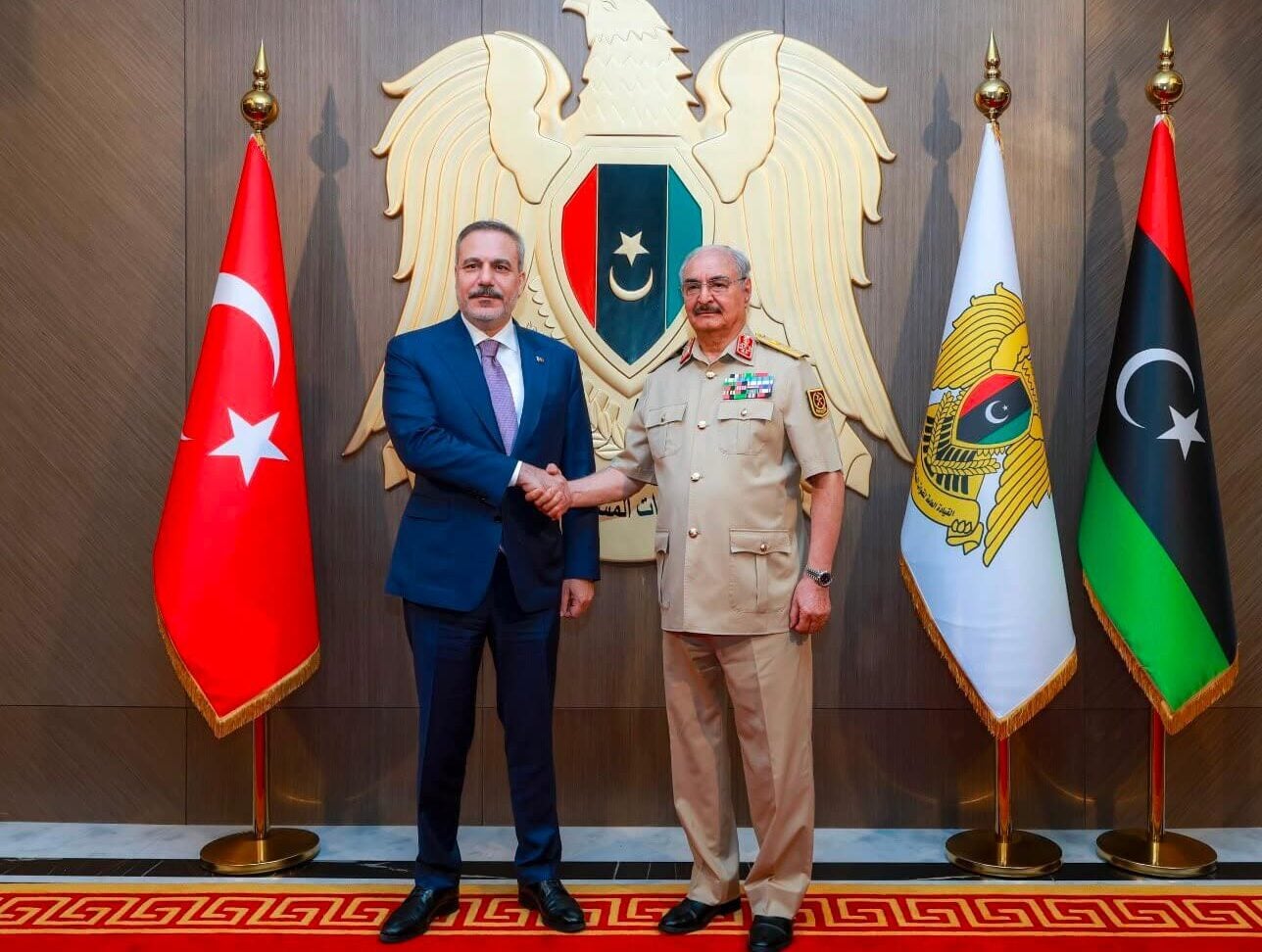
Turkey hosted talks last week between Libya’s rival eastern and western administrations aimed at reunifying the country, but no agreement has been reached, a senior Turkish official familiar with the discussions told Agence France-Presse on Wednesday.
Turkey is among the few countries involved in Libya that maintain ties with both sides.
“Discussions have so far focused primarily on military unification, while political unity is expected to be addressed at a later stage,” the official said.
Military officials from both administrations and diplomats attended the talks in Ankara, the official said, adding that Turkey was mediating between the two sides.
Beset by instability since the 2011 overthrow of Muammar Gaddafi, Libya is divided between a UN-recognized government in Tripoli and a rival administration in the east backed by military commander Khalifa Haftar.
Turkey strongly supported the Tripoli-based government during Libya’s years of conflict, but its ties with the eastern administration have warmed significantly in recent years after a long period of hostility.
Turkish Foreign Minister Hakan Fidan said Friday that the time had come to reunify Libya’s rival administrations, suggesting an announcement could come soon. His remarks followed a meeting he hosted with senior European diplomats and regional powers in İstanbul.
“We have now reached a stage where the conditions are ripe to permanently secure the reunification of the east and the west,” Fidan told journalists.
“One of the most important pillars of national unification is how the military units currently controlled separately by both sides will be brought together under a single umbrella.”
The Turkish official said Wednesday that the parties had agreed to continue meeting.
“Turkey is the priority to host the talks but they could also take place in Libya,” he said.
‘Positions aligned’
Turkey’s mediation comes as Washington and the United Nations are also pushing for the reunification of Libya, which has Africa’s largest oil reserves.
Asked whether the Turkish and US plans clashed, a foreign observer told AFP that Ankara and Washington’s positions were aligned.
“Turkey remains close to the United States, and it would be an error to assume that it has distanced itself. In my view, their positions are, in fact, aligned,” the observer said.
“If there is any significant friction, it is primarily in relation to the Europeans — who are deeply divided on this issue notably France and Italy — as well as Russia, which would see its influence diminish.”
The so-called “Boulos plan,” named after senior US presidential advisor Massad Boulos, would allow Abdulhamid Dbeibah, who heads the Tripoli government, to remain prime minister while Saddam Haftar, the eastern commander’s son, would become head of the Presidential Council.
Libya’s eastern-based parliament last week approved a maritime boundary agreement with Turkey, years after rejecting it when it was first signed.
The agreement has sparked criticism from the European Union, Greece, Israel and Egypt over sovereignty and international law.
Turkish President Recep Tayyip Erdoğan rejected the criticism as having “no legitimate basis” in remarks after a cabinet meeting on Monday.
“Our policy in the eastern Mediterranean is very clear. We are not seeking to score points against anyone in the Eastern Mediterranean,” he said.
Analysts say Libya’s approval gives Turkey stronger political backing for offshore surveys and negotiations over exploration.
© Agence France-Presse