Turkey faces growing economic and security risks as the conflict sparked by US and Israeli strikes on Iran deepens, with analysts warning that prolonged instability could trigger oil shocks, refugee flows and heightened militant activity along its eastern border.
The confrontation began on February 28 with Israeli and US attacks on Iran and quickly spread as Tehran retaliated against Israel and targets in the Gulf.
Ankara has condemned both the strikes on Iran and Iran’s retaliation against Gulf countries, urging an immediate halt to hostilities and offering diplomatic support to prevent further escalation.
Oil shock and economic strain
Economists say Turkey’s most immediate vulnerability lies in energy markets. Oil prices rose sharply after the strikes, with Brent hovering near $80 per barrel, according to the CNBC-e Turkish edition, which cited Goldman Sachs as saying the impact on Turkey will depend on how high prices rise and how long they remain elevated.
If Brent stays at current levels through the end of the year, Turkey’s current account deficit could increase by $18 billion, roughly 1 percent of gross domestic product, Goldman estimated. Turkey’s current account deficit stood at $25.2 billion in 2025.
Economist Mahfi Eğilmez warned in a commentary published on his website that rising oil prices would quickly feed into fuel costs, transportation expenses and production inputs, intensifying inflationary pressures and increasing demand for foreign currency.
In periods of heightened geopolitical risk, he wrote, capital tends to exit emerging markets, putting additional strain on exchange rates and raising borrowing costs.
Eğilmez calculated that each $10 increase in oil prices could increase Turkey’s current account deficit by at least $2.5 billion and push inflation up by about 1 percentage point.
Such a sustained energy shock, he warned, would narrow room for monetary easing and complicate efforts to stabilize prices and the lira.
Migration pressures and border stability
Beyond economic exposure, analysts say the greater long-term uncertainty lies in security and migration dynamics along Turkey’s eastern frontier if the conflict inside Iran escalates beyond external strikes.
Sinan Ülgen, director of the Center for Economics and Foreign Policy Studies (EDAM), told Deutsche Welle (DW) Turkish service that airstrikes alone would not automatically trigger a refugee wave.
The key turning point, he said, would be whether foreign intervention leads to internal unrest and violent domestic conflict similar to Iraq in the 1990s or Syria in the 2010s.
Iran’s neighbors have long warned that major attacks on the country could destabilize the region, including by driving refugees across borders. Turkey hosts more than 74,000 Iranians with residence permits and about 5,000 refugees.
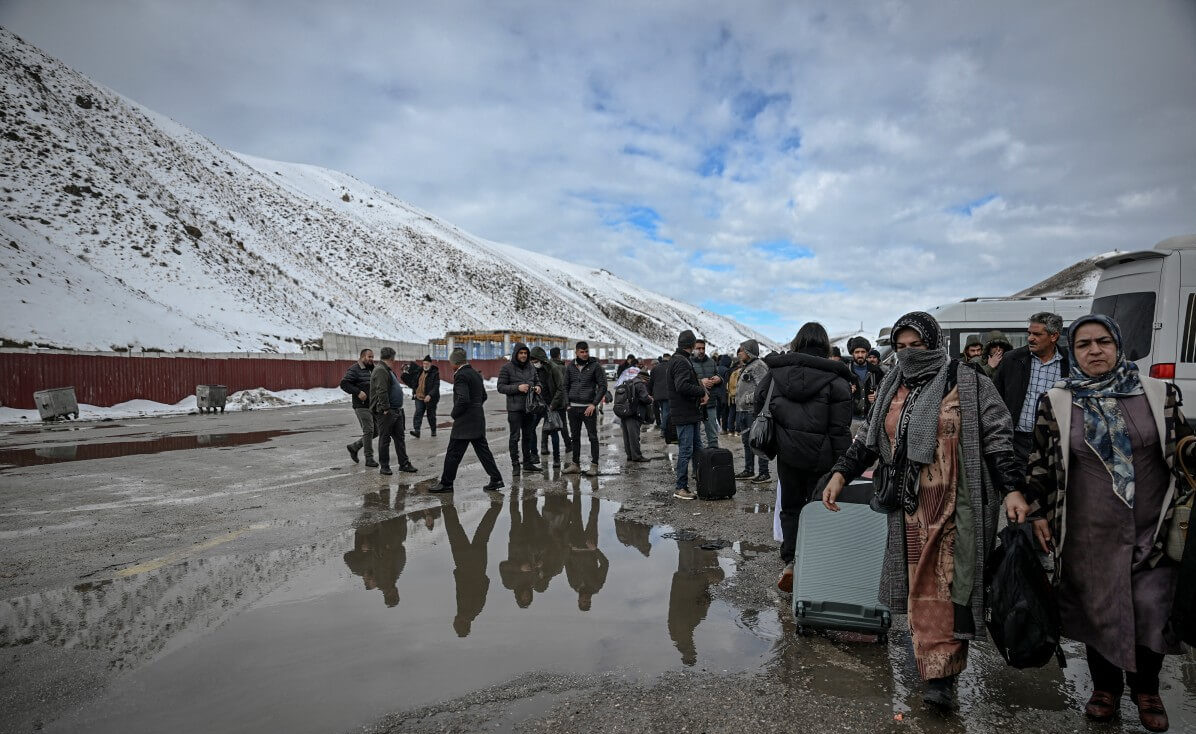
Turkey shares a 534-kilometer border with Iran. Trade Minister Ömer Bolat said there was no extraordinary situation at key crossings, though day-trip passenger crossings were suspended.
President Recep Tayyip Erdoğan also said authorities had not observed border security problems and that police, gendarmerie and intelligence services were taking necessary measures.
Opposition warns of renewed migration influx
Opposition figures have also warned that Turkey could face renewed migration pressure.
Murat Bakan, a lawmaker from the main opposition Republican People’s Party (CHP), said the conflict could confront Turkey with a new wave of irregular migration. He called on all concerned parties to “act against this major risk” in a social media post.
Bakan also questioned why Interior Minister Mustafa Çiftçi chaired a border security meeting, arguing that land border protection legally falls under the Ministry of Defense and the Land Forces Command.
Ümit Özdağ, leader of the ultranationalist Victory Party (ZP), warned that Turkey could not absorb another refugee wave and compared the potential fallout to the Syria crisis.
Speaking at a fast-breaking dinner event in Bursa, he called on the Turkish military to establish a buffer zone inside Iranian territory and said any humanitarian response should be organized inside Iran rather than across the Turkish border.
“We are a nation that has already paid a heavy price from migration since 2011,” Özdağ said. “We are in no position to accept more people.”
Turkey’s 534-kilometer (332-mile) border with Iran is already one of the region’s main transit corridors.
The country hosts millions of Syrian and Afghan refugees, by most measures the largest such population in the world, and the political pressure over migration has remained a dominant issue for years.
Beyond migration, analysts warn that internal destabilization in Iran could also reshape the security landscape along the border and could pave the way for armed groups hostile to Turkey, such as the Kurdistan Free Life Party (PJAK), an Iranian affiliate of the outlawed Kurdistan Workers’ Party (PKK), to expand their activities.
Dr. Cemal Kazak argued in a column for the Independent’s Turkish news website that the most dangerous scenario for Turkey would not be rivalry with a functioning Iranian state but a fragmented or militarized Iran in which state authority erodes.
Drawing comparisons to Iraq and Syria, he said prolonged instability could transform border areas into arenas for proxy competition and non-state actors, complicating Turkey’s security environment along its eastern frontier.
Turkey’s NATO membership adds further sensitivity because of facilities such as the İncirlik Air Base and the Kürecik radar site.
Opposition leader and former prime minister Ahmet Davutoğlu urged the government to declare Turkish territory and military facilities off-limits for attacks on Iran and to seek consultations under NATO’s Article 4 mechanism.
He also called for tighter oversight of İncirlik and raised concerns about Kürecik’s exposure in a confrontation involving Iran.
The Turkish Presidency’s Directorate of Communications denied claims that Turkey allowed its airspace, territory or bases to be used in operations against Iran, calling such reports disinformation.
Ülgen told DW that Iran targeting Turkey was not a realistic scenario, noting that Tehran has struck countries that are not NATO members and would likely avoid expanding the conflict to include a NATO ally.
For Ankara, officials have emphasized diplomacy while signaling vigilance on the border and economic fallout, aware that a prolonged war could simultaneously strain Turkey’s finances, security posture and social stability.