A court-appointed expert panel has assigned a combined 20 percent share of fault to two municipalities and two government agencies over the collapse of a luxury apartment complex in southern Turkey during devastating earthquakes in 2023, the ANKA news agency reported.
On February 6, 2023, magnitude 7.8 and 7.5 earthquakes struck Turkey, killing more than 53,000 people and leaving millions homeless across 11 provinces in the country’s south and southeast.
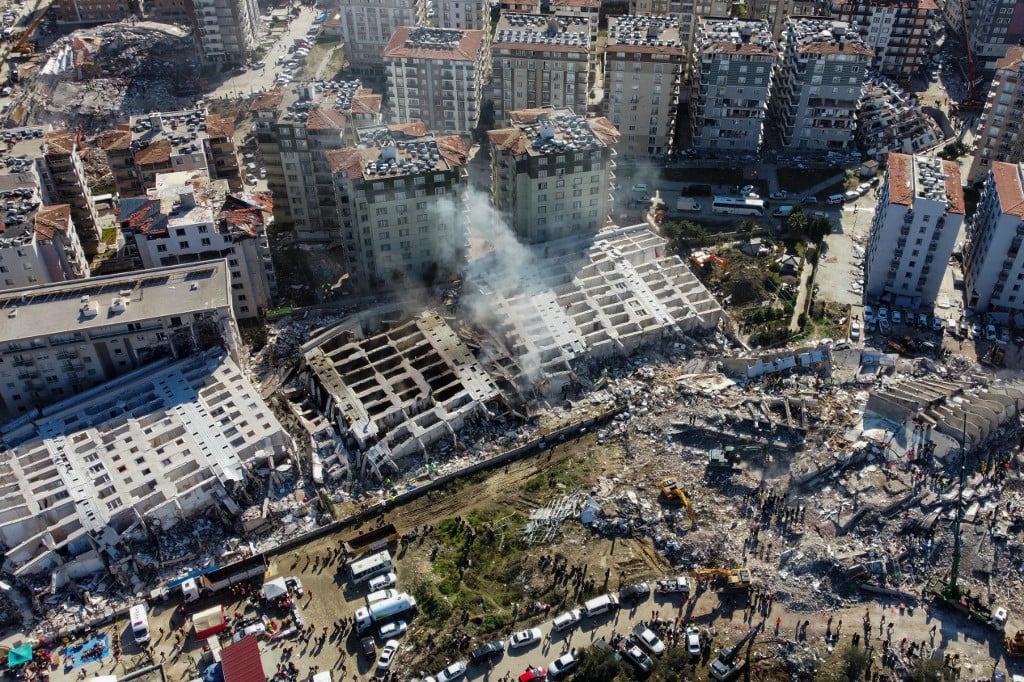
Rönesans Residence was a 249-unit luxury complex in Antakya, the historic center of southern Hatay province. Hundreds of people were inside the building when it toppled during the first earthquake, killing 269.
Built by ANTİS Yapı beginning in 2011, the complex offered amenities associated with a five-star hotel and was marketed as “a corner of paradise.”
It became one of the most prominent symbols of the disaster because the relatively new development had been presented as a modern, high-quality residential complex.
The finding places part of the responsibility for the collapse on public institutions, in addition to the contractors and technical personnel already standing trial.
Families of the victims have argued that failures by public institutions to enforce construction rules, identify vulnerable buildings and prepare for a major earthquake also contributed to the death toll.
The scale of the destruction triggered widespread criticism of lax construction oversight, zoning policies, building amnesties and failures in disaster preparedness and emergency response.
The expert report was submitted to the Hatay 1st Administrative Court in a lawsuit filed by relatives of people killed in the collapse.
The plaintiffs are seeking damages from the Ministry of Environment, Urbanization and Climate Change, the Disaster and Emergency Management Authority (AFAD), the Hatay Metropolitan Municipality and the Antakya Municipality over alleged administrative negligence.
The panel assigned 10 percent of the fault to the Antakya Municipality, 5 percent to the Hatay Metropolitan Municipality, 3 percent to the environment ministry and 2 percent to AFAD.
The case is pending, and the court has not yet ruled on whether to adopt the findings.
The expert panel said the Antakya Municipality had failed to adequately identify earthquake-vulnerable buildings, designate disaster-risk areas and take timely measures to reduce those risks.
It assigned the municipality the largest share of fault among the four public bodies.
The Hatay Metropolitan Municipality was assigned 5 percent of the fault over shortcomings in coordinating disaster and emergency planning with government agencies, universities, professional organizations and other local administrations.
The report also faulted the municipality for failing to provide adequate public education and disaster preparedness programs.
The environment ministry was assigned a 3 percent share for inadequate oversight during the planning and construction process and for failing to ensure sufficient urban planning and transformation in earthquake-prone areas.
AFAD was assigned 2 percent for failing to carry out adequate disaster planning and inspections in a region facing a major earthquake threat.
The administrative compensation case is separate from the criminal trial of contractors and technical personnel involved in the construction of the complex.
A 141-page expert report prepared for the criminal case identified serious structural design and engineering deficiencies, including weaknesses on the ground floor, discontinuities in the load-bearing system and design choices that reduced the strength of structural elements.
That report identified structural designer Hüseyin Yalçın Coşkun as primarily at fault and assigned secondary fault to contractor Mehmet Yaşar Coşkun, the site manager and several other technical personnel.
Prosecutors are seeking sentences of up to 22-and-a-half years for the defendants on charges of causing the deaths of multiple people through conscious negligence.
Ghanaian footballer Christian Atsu, who played for Turkish Super Lig club Hatayspor, team trainer Taner Savut and national handball player Cemal Kütahya were among the victims along with dozens of children.
The body of former Turkish ambassador Devrim Öztürk, a resident of Rönesans Residence, is still missing.
The collapse has remained central to demands by victims’ families for accountability not only from those who designed and built the complex but also from the public institutions responsible for regulation, inspections and disaster planning.
Civil engineers and earthquake specialists told the Financial Times, which released an exclusive report about the collapse of Rönesans Residence in late February 2023, that it was too soon to tell exactly why the Rönesans fell over. But they agreed that such modern blocs should not have collapsed as a result of the 7.8 magnitude earthquake, nor the second 7.5 magnitude shock that followed several hours later.
More than 13,800 buildings collapsed in Hatay, while at least 22,000 people were killed there in the earthquakes. The Antakya, Defne and Samandağ districts were nearly wiped off the map.