Orhan Sait Berber, Geneva
Diplomats, UN officials and press freedom advocates warned at a panel discussion in Geneva on Tuesday that exile no longer guarantees safety for journalists, who are increasingly being targeted through cross-border repression, including digital surveillance, online harassment, legal intimidation and physical attacks.
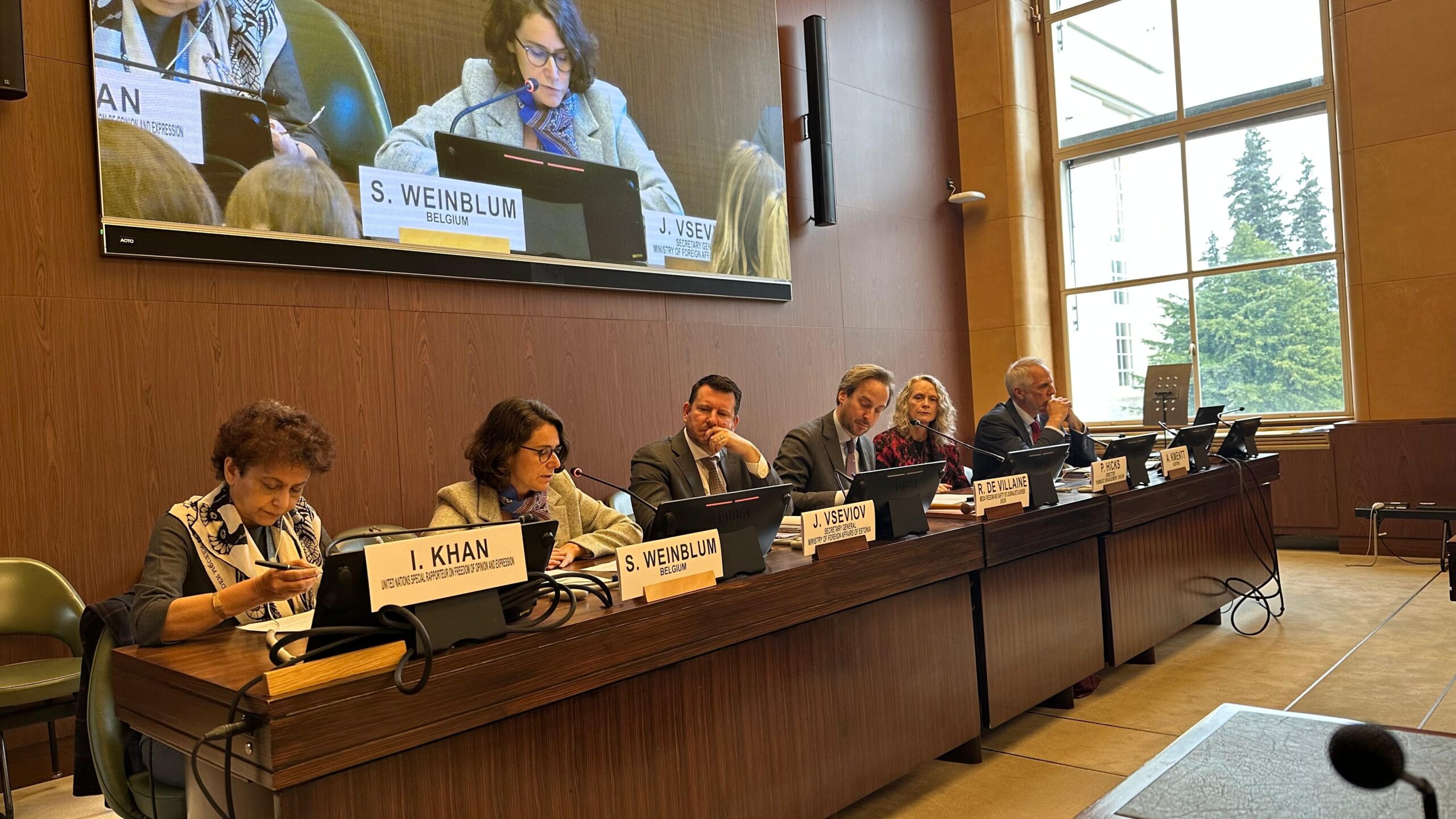
The event, held at the UN’s Geneva headquarters to mark World Press Freedom Day, was convened by the Office of the United Nations High Commissioner for Human Rights (OHCHR) and Estonia with several co-sponsors, including Austria, Canada, Belgium, Finland, Sierra Leone and the United Kingdom.
Speakers said authoritarian governments are increasingly extending repression beyond their borders, targeting journalists abroad through spyware, online harassment, legal intimidation, passport cancellations and threats against family members.
The phrase repeated most often throughout the event was, “Exile is no longer safe.”
UN rapporteur cites Khashoggi killing
Irene Khan, the UN special rapporteur on freedom of opinion and expression, described transnational repression as a growing threat not only to press freedom but also to the rules-based international order.
Irene Khan, UN special rapporteur on freedom of opinion and expression. (Photo: Turkish Minute)
Khan said exiled journalists often serve as the only remaining source of independent information for people living under authoritarian governments.
“Think of Jamal Khashoggi,” Khan said. “Unfortunately, he is probably one of the best-known journalists in exile who actually lost his life through transnational repression.”
Khashoggi, a Saudi journalist and Washington Post columnist critical of the Saudi government, was killed inside the Saudi Consulate General in Istanbul in October 2018 after entering the building to obtain marriage documents.
According to Turkish investigators, Khashoggi was killed shortly after entering the consulate by a team sent from Saudi Arabia, and his body was dismembered. His remains have never been found.
The killing triggered international outrage, and UN investigators later described it as an “extrajudicial execution.” Western intelligence agencies, including the CIA, concluded that Saudi Crown Prince Mohammed bin Salman likely approved the operation, an allegation denied by Saudi authorities.
Khan also referred to the forced diversion of a flight carrying Belarusian journalist Raman Pratasevich, poisonings targeting Russian journalists and harassment of BBC Persian staff linked to Iran.
“The audacity with which this happens is extremely worrying,” she said.
Belarusian journalist describes pressure in exile
One of the strongest personal testimonies came from exiled Belarusian journalist Yauhen Merkeis.
Merkeis said he was imprisoned in Belarus for working for independent media, sentenced to four years in prison and later forcibly expelled to Lithuania.
He said his family continues to face pressure from Belarusian security services and that journalists in exile are routinely labeled “extremists,” subjected to surveillance and stripped of valid travel documents.
“The Lukashenko regime is very innovative and creative in oppressing independent media and civil society,” he said.
Belarus has faced widespread international criticism for its crackdown on independent media and political opposition under President Alexander Lukashenko, especially after the disputed 2020 presidential election and subsequent mass protests. Hundreds of journalists, activists and opposition figures have been jailed or forced into exile in recent years.
Several speakers also pointed to Russia as a major example of transnational repression. Since the start of the war in Ukraine in February 2022, many independent Russian journalists have fled abroad after Moscow criminalized criticism of the military and tightened censorship laws.
Digital threats follow journalists into exile
Fiona O’Brien of the Committee to Protect Journalists warned that spyware tools such as Pegasus effectively turn journalists’ phones into “24-hour surveillance devices.”
Pegasus is highly sophisticated spyware. Once installed on a phone, sometimes without the user even clicking a link, Pegasus can secretly access messages, emails, photos, passwords, microphones and cameras, effectively allowing operators to monitor nearly every aspect of a target’s digital life.
Human rights groups and media investigations have linked Pegasus to surveillance campaigns targeting journalists, activists, lawyers and political opponents in multiple countries.
O’Brien described a recent case in which the address of an exiled Belarusian journalist was published by pro-government media, exposing him to physical danger.
She also cited reporting by The Guardian showing that phones belonging to associates and relatives of Khashoggi were targeted around the time of his murder.
Joanna Szymańska of Article 19, a London-based free expression group, said governments increasingly use coordinated online reporting campaigns and disinformation to silence journalists in exile and disconnect them from audiences in their home countries.
OHCHR warns of abuse of international mechanisms
Peggy Hicks, speaking at the May 5, 2026, event.(Photo: Turkish Minute)
Peggy Hicks, director of thematic engagement and special procedures at OHCHR, said transnational repression should be treated as a direct human rights violation.
Hicks said governments use a wide range of methods to silence journalists, including digital surveillance, economic pressure, abuse of judicial systems and threats against relatives. In some cases, she said, the repression escalates to kidnappings and assassinations.
She also warned that INTERPOL Red Notices and other international law enforcement mechanisms can be abused under the guise of legitimate legal cooperation.
INTERPOL notices are intended to help locate and arrest people wanted for serious crimes, but rights groups have long warned that authoritarian governments can misuse the system to pursue political opponents, journalists and activists abroad by portraying them as ordinary criminal suspects.
INTERPOL concerns echo Turkey-related cases
Although Turkey was not mentioned directly during the event, discussions about the misuse of INTERPOL mechanisms reflected concerns raised in recent international investigations into Ankara’s use of cross-border legal tools against journalists in exile and dissidents.
A 2026 investigation by investigative outlet Disclose reported that Turkey flooded INTERPOL systems with passport alerts and Red Notice requests after a coup attempt in 2016.
According to the report INTERPOL rejected hundreds of Turkish Red Notice requests after determining they were politically motivated.
The investigation highlighted cases involving exiled journalists, including Akın Olgun, who was detained in Greece in 2022 after his name appeared in an INTERPOL system before the alert was later removed.
During the panel discussion, Hicks warned that international police cooperation tools can be manipulated “under the guise of legitimate law enforcement.”
Estonia: Peace cannot be built on silence
Estonian Foreign Ministry Secretary General Jonatan Vseviov, who opened the event, said media freedom and security must be viewed together.
Estonian Foreign Ministry Secretary General Jonatan Vseviov speaking. (Photo: Turkish Minute)
Vseviov said authoritarian states increasingly target journalists abroad through digital surveillance, intimidation and pressure on family members.
He cited Russia’s actions against exiled journalists and said Estonia currently offers up to 35 annual residence permits for journalists at risk.
“Peace cannot be built on silence,” he said. “Peace is built on truth, accountability and trust.”
UNESCO warns of global decline in press freedom
Sylvie Coudray, director for freedom of expression, media development and media and information literacy in UNESCO’s communication and information division, said global press freedom has experienced its steepest decline in more than a decade.
Coudray said 72 percent of the world’s population now lives under some form of authoritarian rule and pointed to conflict zones such as Gaza, Sudan and Ukraine as examples of what she called “zones of silence.”
She also said 75 percent of women journalists have experienced online violence and warned that deepfake technologies are becoming a growing threat to media freedom.